Headless Shopify + AI Agents: The 2026 Playbook for Autonomous Merchandising, Support, and Ops
Shopify AI agents turn repetitive commerce operations into tool-driven workflows—handling support triage, merchandising changes, and ops checks with human approval where it matters. This playbook explains where agents fit on Shopify, how headless (Hydrogen) changes what’s possible, and what to choose if you’re still theme-first in Liquid.
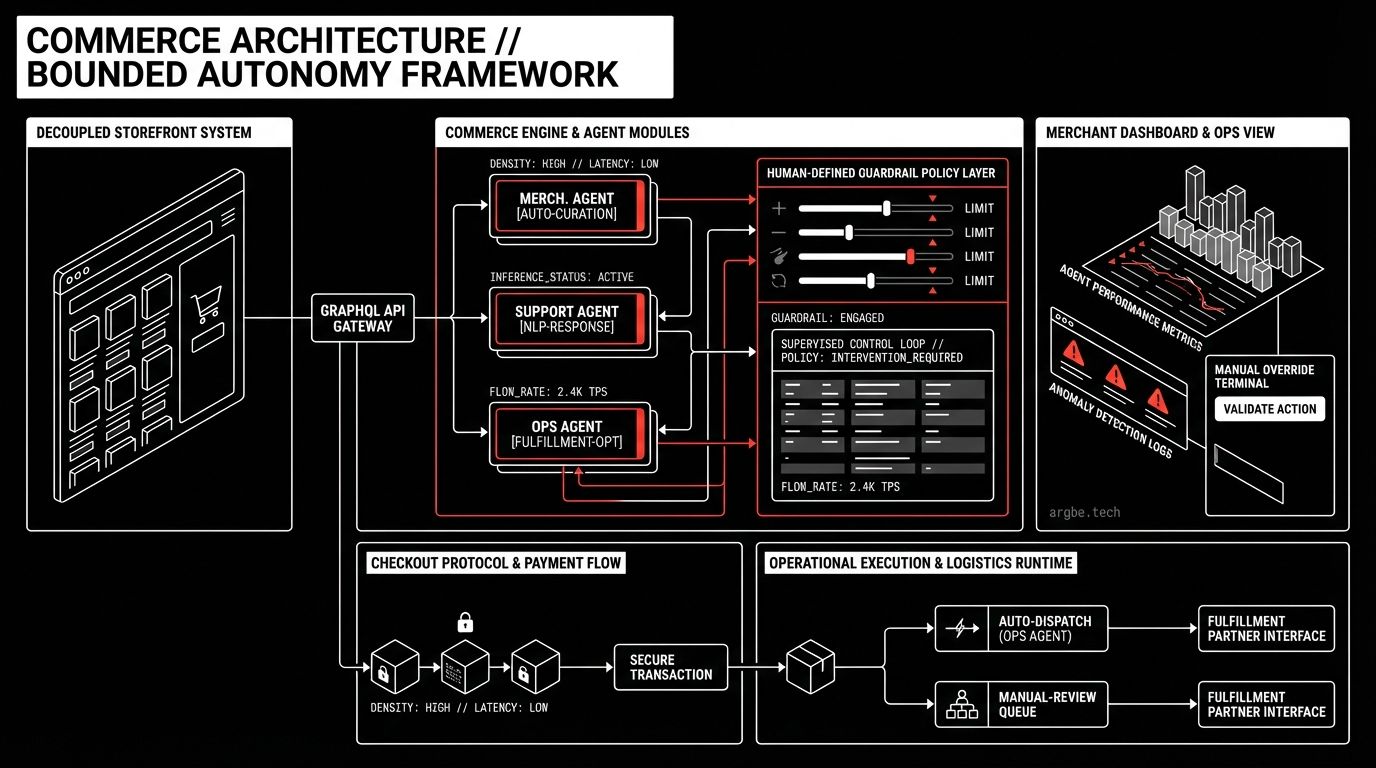
Shopify AI agents are autonomous, tool-connected software workers that can observe commerce signals (tickets, inventory, conversion, returns), decide on a narrow next action, and execute changes inside Shopify (or adjacent systems) with guardrails—especially powerful when your storefront moves beyond Liquid into Hydrogen or other headless patterns.
In practice, teams implement this by connecting a model to a small, permissioned toolbelt—often via mcp shopify—so every action is explicit, auditable, and reversible.
What Shopify AI Agents Really Are (and Aren’t)
Most teams hear “AI agent” and picture a chatbot with a nicer UI. In practice, an agent is closer to a junior operator with access to tools:
- It reads a situation (a ticket, a product feed anomaly, a cart error spike).
- It chooses from a limited set of actions you explicitly allow.
- It acts through APIs, admin tools, or internal services.
- It explains what it did, and why, so a human can audit or roll it back.
The “autonomous” part is the trap. We found the best outcomes come from bounded autonomy: agents do the work that’s expensive to do manually (triage, enrichment, repetitive edits), and humans keep the keys to brand voice, pricing strategy, and anything that can create customer harm.
If you’re still deciding whether you’re theme-first in Liquid or moving toward Hydrogen, start with the cluster fundamentals: The Ultimate Guide to Headless Shopify Development and Shopify Hydrogen vs Liquid: When to Go Headless.
Why Headless Changes the Agent Conversation
Liquid is Shopify’s opinionated storefront layer: fast to ship, stable, and constrained in all the ways that make it safe. Those constraints are also why agent work often ends up “behind the scenes” on theme-first stores (support, ops, catalog QA) instead of in the customer journey.
Hydrogen shifts the boundary. Because Hydrogen is a React storefront that speaks to Shopify through APIs, you gain surfaces where agents can help without touching your theme editor:
- Richer event streams: more reliable signals for “what happened” on a route or component, not just “conversion dropped.”
- Clearer seams: dedicated services for search, personalization, bundling logic, localization, and CMS content.
- Better tooling contracts: agents can call a tool that changes a single thing (e.g., “pause ads for out-of-stock SKUs”) instead of poking at a monolithic theme.
In our experience, headless doesn’t magically make agents safe—it makes them integratable. The work becomes about designing tool boundaries and approvals, not “can AI do it.”
The Three Agent Jobs That Actually Pay Off
There are dozens of “AI for ecommerce” ideas, but most stores get real value from the same three categories.
1) Support triage + resolution drafting (with brand guardrails)
Agents are great at sorting and structuring messy inbound: finding the order, categorizing the issue, pulling policy context, and drafting a reply for human review. The goal isn’t to replace your support team—it’s to stop spending human attention on the parts that are purely mechanical.
We found the biggest win is time-to-first-meaningful-response, not “deflection.” A fast, correct triage keeps refunds, chargebacks, and churn down even when a human still sends the final message.
2) Merchandising hygiene (the unglamorous money)
Catalog quality is compounding. A small percentage of SKUs usually drive a large percentage of sessions and revenue, and those SKUs tend to be the ones where small errors hurt the most: missing variant images, incorrect metafields, broken size guides, duplicate collections, stale badges.
Agents excel at running repeatable checks and proposing fixes:
- flagging products with missing structured data inputs
- detecting conflicting price/compare-at patterns
- checking content parity across markets
- proposing collection rules for new arrivals or restocks
3) Ops monitoring + coordinated fixes
This is the “site reliability” side of commerce: a payment method disappears, a carrier service fails, a webhook backlog grows, or a third-party script spikes page errors. An agent can correlate symptoms, propose a hypothesis, and execute a safe mitigation (feature flag off, pause a flow, route around a dependency) while paging a human with the full context.
What an Agent Should Never Control (Without a Human in the Loop)
If you’re implementing Shopify AI agents, define your red lines up front. These are the areas we keep behind an approval gate by default:
- Pricing and discount strategy: agents can recommend changes, but not ship them unattended.
- Brand voice: agents can draft, but humans own tone and claims.
- Returns/refunds at scale: agents can pre-fill, classify, and flag abuse, but humans control outcomes.
- Inventory allocations: agents can highlight risks and suggest actions, but humans own supply decisions.
This isn’t fear. It’s risk math. When agents make mistakes, they make them quickly—and consistency is not the same thing as correctness.
The “Tools” Layer: Where This Becomes Real
Agents are only useful when they can do something. The cleanest pattern we’ve seen is: pick a strong reasoning model (we’ve built agents using Claude and Gemini), then connect it to a small tool belt via MCP (Model Context Protocol) so each action is explicit, auditable, and easy to revoke.
That tool belt usually looks like:
- Shopify Admin API actions (bounded and permissioned)
- support system actions (ticket lookup, tag, draft reply)
- analytics queries (pre-defined, not arbitrary SQL)
- CMS updates (structured, role-based)
- deployment toggles (feature flags, rollbacks, kill switches)
The nuance: the tools matter more than the prompts. If you give an agent one “UpdateProduct” tool with 40 fields, it will eventually do something you didn’t mean. If you give it five narrow tools (e.g., “SetProductStatus”, “UpdateMetafield”, “AddTag”, “CreateRedirect”, “QueueHumanReview”), you get safety and repeatability.
Data Anchor: Shopify AI Agent Options (Comparison Table)
This table is the “what” that’s easy to cite. The “how”—tool boundaries, evaluation, prompt hardening, and approval design—is where projects succeed or fail, and it depends on your catalog shape, app stack, and markets.
| Option | Best for | Strengths | Tradeoffs | When it fits Shopify stores |
|---|---|---|---|---|
| Theme-first agents (Liquid + back-office automation) | Stores that want AI value without changing the storefront | Fast to pilot; minimal front-end risk; focuses on support + ops + catalog checks | Limited ability to improve customer journey UX; signals are often noisier | You’re staying in Liquid for the storefront, and you want measurable ops wins first |
| Hydrogen storefront + agent-assisted merchandising | Teams investing in headless UX and faster iteration | Clear API seams; better observability; agents can power richer experiences (guided discovery, content assembly) | More engineering surface area; requires disciplined tooling contracts | You’re adopting Hydrogen and want agents to speed merchandising and content ops without breaking UX |
| Hybrid storefront (Liquid core + headless routes) + agents | Teams that want a safe migration path | Keeps marketing velocity; isolates headless complexity; agents can focus on high-impact routes | Two paradigms to maintain; requires careful routing + SEO management | You need headless for specific flows (PDPs, configurators) but Liquid still wins for most pages |
| External agent service + MCP tool belt (platform-agnostic) | Orgs that want a reusable agent layer across Shopify + other systems | Centralized governance; consistent approvals; easy to expand to ERP, 3PL, and BI tools | Needs strong security posture; requires clean tool definitions and monitoring | You have multiple systems and want “one agent brain” that operates through explicit tools |
| “Recommendation-only” copilots (insights, drafts, checklists) | Risk-averse teams or regulated categories | Very safe; improves team throughput; clear audit trail | Less automation; humans still execute most changes | You want the planning and drafting benefits now, and automation later once trust is earned |
Next Steps
If you want Shopify AI agents to work in the real world, pick one workflow where the inputs are reliable, the actions are narrow, and the value is obvious. In our experience, that’s usually support triage, catalog hygiene on top SKUs, or ops monitoring around a known pain point.
To ground the storefront decision, read The Ultimate Guide to Headless Shopify Development and Shopify Hydrogen vs Liquid: When to Go Headless. If you share your top 1–2 operational bottlenecks and whether you’re in Liquid or Hydrogen, we can tell you which agent pattern is safest to pilot and where the hidden complexity tends to land.