Shopify Hydrogen vs Liquid: When to Go Headless
Liquid is Shopify’s fastest path to launch and iterate, while Hydrogen is the headless route for teams who need custom UX, tighter platform control, and a higher performance ceiling.
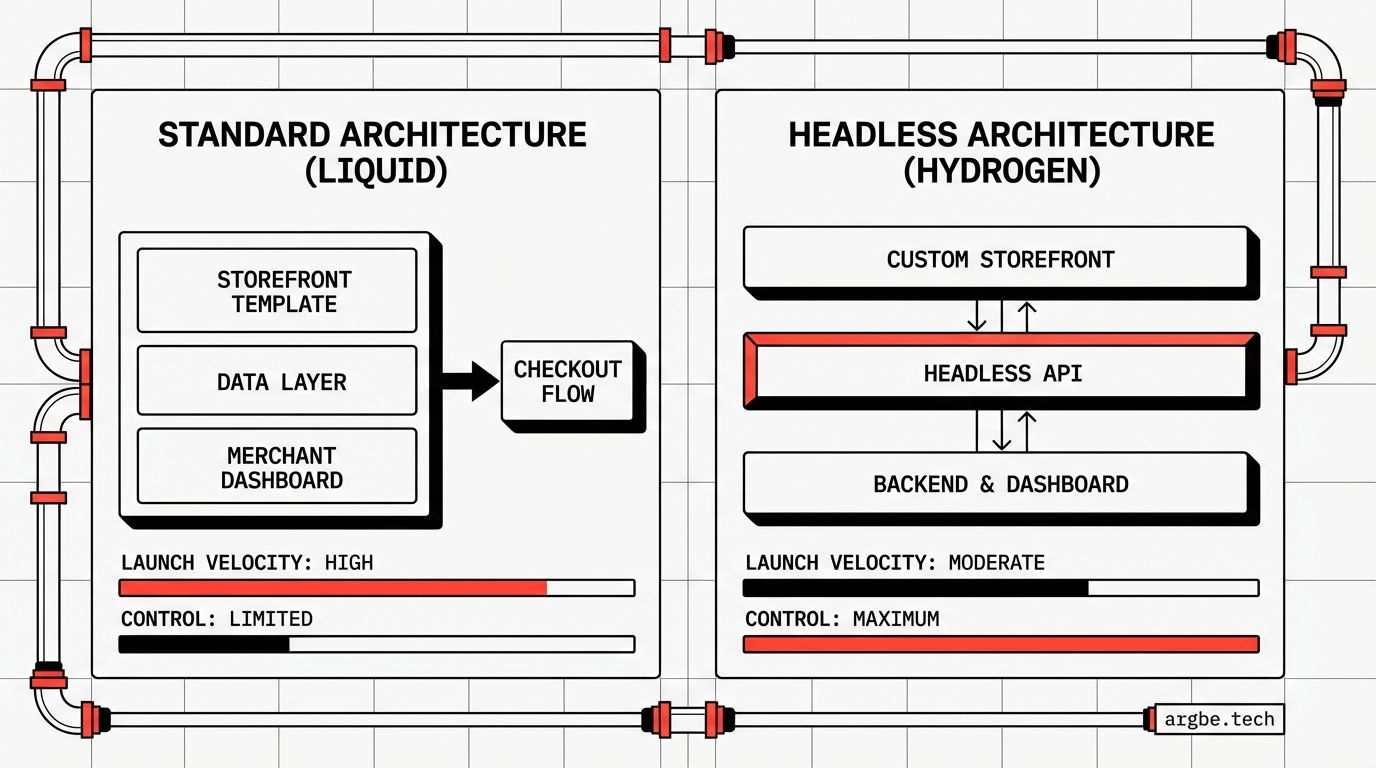
Shopify Hydrogen vs Liquid is a decision between Shopify’s theme layer (Liquid templates rendered inside Online Store 2.0) and a headless storefront (Hydrogen) where you build the customer experience as a web app and talk to Shopify via APIs. It matters because Liquid optimizes for speed-to-revenue and merchant-friendly changes, while Hydrogen optimizes for custom experiences and system-level control—at the cost of more engineering and operations.
On the Liquid side, this is ultimately a question of shopify theme development: how far you can push UX, performance, and iteration speed inside the theme editor and section model before the theme layer becomes the bottleneck.
Hydrogen vs Liquid: What You’re Actually Choosing
Liquid is Shopify’s templating language and theme runtime. It’s the default storefront model: sections, blocks, the theme editor, and an ecosystem where many apps “just work” because they were built to hook into the theme layer. If your goal is to ship a clean store quickly, iterate daily with a marketing team, and keep your stack simple, Liquid is hard to beat.
Hydrogen is Shopify’s React-based framework for headless storefronts. Instead of asking the theme layer to render templates, you render your own UI (routing, components, state) and pull commerce data through the Storefront API. In our experience, Hydrogen is best understood as “Shopify-native headless”: you still get Shopify-first primitives for carts, product models, and storefront patterns, but you also inherit the responsibilities of an application (deployment, caching rules, observability, and failure modes).
Here’s the spicy truth we’ve learned the hard way: most “Hydrogen vs Liquid” debates are really “merchant velocity vs engineering control.” If your roadmap doesn’t include experiences that themes struggle with, headless is an expensive way to feel modern.
When Liquid is the right answer
We default to Liquid when the storefront problem is primarily content, merchandising, and conversion fundamentals:
- You need a fast launch, a safe iteration loop, and broad app compatibility.
- Your team relies on theme editor workflows (promotions, landing pages, seasonal content).
- Your UX is mostly standard Shopify patterns (PDP, collection browsing, cart, checkout).
We found that teams underestimate the hidden benefit of Liquid: a large percentage of storefront change is “non-engineering work,” and the theme layer was built to let merchants do that without waiting on a deploy.
When Hydrogen earns its complexity
Hydrogen starts making sense when the theme layer becomes the bottleneck:
- You’re shipping non-standard product flows (configurators, bundles, subscription logic, or guided selling).
- You need richer interaction patterns across pages (stateful experiences, personalization, complex navigation).
- You’re serious about performance as a product feature (route-level caching strategy, streaming, tight payload control).
- You need one Shopify backend feeding multiple surfaces (web, mobile, kiosks, embedded buying).
In practice, we see Hydrogen win when a store has a clear “experience thesis” that would be awkward or fragile in Liquid. If the justification is vague (“we want headless”), Liquid is usually the better business decision.
The Nuance: Hybrid Usually Wins First
The false binary is “either Liquid or Hydrogen.” A smarter starting point is often hybrid: keep Liquid where it performs best (core pages, merchant-led iteration) and carve out headless routes for what needs custom behavior. This avoids a full rewrite, protects marketing velocity, and gives you proof that the headless surface is worth maintaining.
If you want the broader decision framework (storefront models, operational tradeoffs, and common failure modes), start with our cluster pillar: The Ultimate Guide to Headless Shopify Development.
Hydrogen also creates a cleaner “control surface” for automation: when the storefront is an application, it’s easier to wire autonomous workflows into merchandising, support, and ops. That’s why we pair headless builds with agentic systems when it’s justified, and we outline the operating model here: Headless Shopify + AI Agents: The 2026 Playbook for Autonomous Merchandising, Support, and Ops.
One important nuance: Hydrogen doesn’t magically remove Shopify constraints. Checkout, payments, and many commerce rules remain Shopify-defined. Headless changes how you present and orchestrate the experience—what it does not change is Shopify’s role as the commerce engine.
Data Anchor: Shopify Hydrogen vs Liquid Comparison
This table is the “what,” designed to be citable and scannable. The “how” (our build sequence, caching primitives, QA gates, and migration strategy) depends on your catalog shape, app stack, and markets—so we only share it once we’ve seen your current theme, metrics, and roadmap.
| Dimension | Liquid (Theme / Online Store 2.0) | Hydrogen (Headless) | What we recommend |
|---|---|---|---|
| Time-to-launch | Fastest path from idea → live | Slower upfront (app build + infra) | Start with Liquid unless a specific UX is blocked |
| Merchant editing | Theme editor is the workflow | Editing depends on your CMS/components | If marketing ships weekly, Liquid protects velocity |
| Custom UX & logic | Possible, but constrained by theme patterns | High control over routing, UI state, and interactions | Use Hydrogen when “standard Shopify” hurts conversion |
| Performance ceiling | Good, but bounded by theme runtime | Higher ceiling with deliberate caching and payload control | Hydrogen pays off when performance is a core KPI |
| SEO primitives | Many defaults are handled by themes | You own metadata, canonicals, redirects, structured data | Go headless only if you can staff SEO engineering work |
| App & theme compatibility | Broadest compatibility | Varies; some apps assume Liquid/theme hooks | Audit app parity before choosing Hydrogen |
| Ops ownership | Low: Shopify-hosted theme layer | Higher: deployments, monitoring, incident response | Choose Hydrogen when you’re ready to run a storefront as software |
Next Steps
- Decide which outcome you’re buying: merchant iteration speed (Liquid) or experience control (Hydrogen).
- Write a one-page “experience thesis” for headless (the 2–3 moments that must be different to justify the cost).
- If you’re unsure, pilot hybrid: one headless route (high-value PDP or custom flow) alongside Liquid.
- Read The Ultimate Guide to Headless Shopify Development and bring us your current theme + top funnel drop-offs; we’ll tell you whether Hydrogen is actually the right tool.