Claude vs Gemini vs Grok: Choosing the Right LLM for Agents
Claude vs Gemini vs Grok is a practical model-selection question for teams building tool-connected AI agents. We compare how each model tends to behave in agent loops, then anchor the decision with a table you can reuse in reviews.
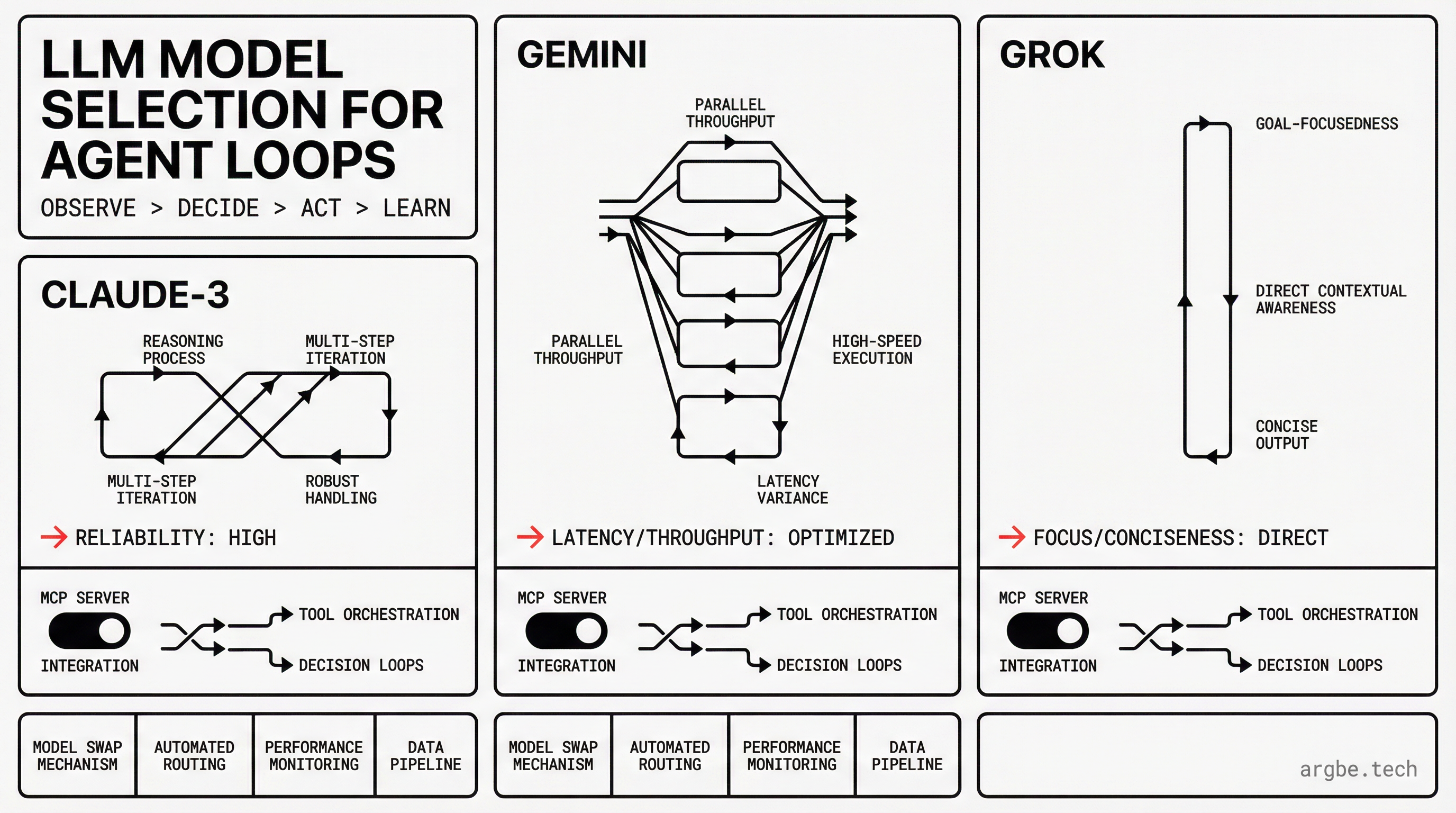
Claude vs Gemini vs Grok is a model-selection decision for AI agents: you’re choosing which LLM will do the “decide what to do next” work inside an action loop, then call tools to execute. In our experience, Claude is the safest default when you need consistent reasoning and clean instruction-following, Gemini shines when multimodal inputs and Google-adjacent workflows matter, and Grok is most useful when you want fast, opinionated drafting in loops where the system can verify outputs with tools.
Start with the agent loop, not the brand
Most teams get stuck because they treat “Claude vs Gemini vs Grok” like a fandom debate. We’ve found it’s more reliable to treat the model as one component in an agentic system: the “brain” that proposes plans, selects tools, and interprets tool outputs.
If you want a crisp definition of an AI agent (and the boundary between agents, chatbots, and automations), start here: What Are AI Agents? A Technical Guide to Agentic Systems.
When the agent is tool-connected, the biggest question isn’t “Which model is smartest?” It’s:
- Will the model follow a tool schema without improvising?
- Will it recover from tool errors without inventing a story?
- Will it stop when success criteria are met?
- Will it respect guardrails under pressure (timeouts, partial data, ambiguous intent)?
That’s also why we connect models to tools through Model Context Protocol (MCP). MCP keeps the integration surface consistent so you can swap Claude, Gemini, or Grok without rewriting your entire tool layer. If you want the concrete mechanics, use: Model Context Protocol (MCP) Server Guide: Build Tool-Connected AI.
Where each model tends to fit in real agent work
We think about agent workloads as a mix of three behaviors: reasoning, interface discipline, and throughput. The same model can look great in a chat demo and fall apart in a tool loop if it gets sloppy with schemas or “helpfully” fills in missing values.
Claude: dependable reasoning when correctness matters
In our experience, Claude earns its place when the agent has to do multi-step thinking, keep constraints straight, and stay calm during failures. If your agent is writing to systems of record (CRM, ticketing, billing), Claude is often the model that makes the controller’s job easier because the output tends to be less chaotic.
That doesn’t replace guardrails. We still assume any model can mis-handle edge cases, so we design for scoped permissions, approvals for risky actions, and forensic logs. If the agent can mutate customer data, read this before you pick a “brain”: AI Agent Security: Permissions, Audit Trails & Guardrails.
Gemini: strong for multimodal and product-adjacent workflows
Gemini is the model we reach for when the agent needs to work across modalities (for example, interpreting screenshots, charts, or visual UI states) or when the workflow sits close to Google surfaces. In practice, that often shows up in “operator-style” agents: systems that observe a UI, call tools, then decide the next step.
The key is to keep the boundary explicit: Gemini does the judgment; the tools do the truth. We use MCP to make those tool boundaries obvious, with typed inputs/outputs and predictable error shapes.
Grok: fast, opinionated drafting—best when you can verify
Grok’s value shows up when speed and voice matter and when the system can verify results externally. We’ve used it most effectively in loops where the agent can write, then immediately check: run a formatter, query a database, validate a schema, or diff an output against a known-good reference.
The pitfall is letting any “provocative” model be the final authority for high-stakes actions. If you’re using Grok in an agent, we recommend designing the loop so it must pass checks (tool-based validation, structured constraints, and human approvals where needed) before anything irreversible happens.
The decision framework we use (citable “what,” gated “how”)
Here’s the “what” we use to choose between Claude, Gemini, and Grok for agentic systems:
- Tool reliability: does the model call tools cleanly and parse responses without drift?
- Constraint discipline: does it keep policies, formats, and stop rules intact over multiple steps?
- Verification friendliness: does it cooperate with checks (schemas, tests, diffing) instead of fighting them?
- Latency + cost budget: can the loop stay within your operational envelope?
The “how” is where teams usually win or lose: the exact eval set, the tool-failure simulations, and the routing rules between models. We don’t publish that full rubric because it’s specific to your tools, your failure modes, and your tolerance for risk. If you want the system view (identity, tooling, evaluations, and guardrails), start with: The Enterprise Agent Stack: Identity, Tooling, Evaluations, and Guardrails for Production AI Agents.
Data: Claude vs Gemini vs Grok comparison table for agents
| Dimension | Claude | Gemini | Grok |
|---|---|---|---|
| Primary strength in agent loops | Careful reasoning and stable instruction-following across steps. | Multimodal judgment and strong fit for workflows that touch product ecosystems and UI interpretation. | Fast iteration and strong “voice” for drafting and brainstorming inside verify-and-correct loops. |
| Tool-calling behavior (common failure mode) | Tends to be disciplined; failures often come from missing context rather than schema chaos. | Strong when inputs are well-structured; can still drift if tool surfaces are ambiguous. | Can be aggressive or speculative; benefits from tight schemas and mandatory validation steps. |
| Best use cases | Support triage agents, policy-heavy assistants, agents that write to systems of record with approvals. | Operator agents, multimodal intake (images + text), workflows that mix multiple input types. | Content drafting agents, rapid prototyping, social-style copy where a controller verifies claims and formatting. |
| Verification strategy that works well | Structured outputs + explicit stop conditions + tool-error handling. | Typed tool schemas + clear observation signals + separation of “judgment” vs “truth.” | Always-on checks (lint/tests/schema validation) + constrained formats + human gates for risky actions. |
| Where it can disappoint | When you expect it to compensate for weak tools, weak state, or unclear success criteria. | When you treat multimodal judgment as ground truth instead of a hypothesis to verify with tools. | When you let it be the final authority on factual or high-impact actions without guardrails. |
| MCP integration note | Works cleanly as the reasoning engine behind MCP-exposed tools. | Benefits from MCP because tool discovery and schemas reduce ambiguity in complex workflows. | MCP helps most when tools enforce constraints and return machine-checkable outputs. |
| Default pick (if you have to choose one) | Choose Claude when correctness and constraint discipline dominate. | Choose Gemini when multimodal inputs and workflow adjacency dominate. | Choose Grok when speed and style dominate and you can verify everything. |
Next Steps
- If you’re still unclear on the system boundary, start with the definition and mental model: What Are AI Agents? A Technical Guide to Agentic Systems.
- If your agent needs tools, wire the “hands” first so model swaps are cheap: Model Context Protocol (MCP) Server Guide: Build Tool-Connected AI.
- If the agent can write or delete data, design permissions and audit trails before you scale autonomy: AI Agent Security: Permissions, Audit Trails & Guardrails.
- If you’re shipping to production, treat model choice as one part of the stack and add evaluations early: The Enterprise Agent Stack: Identity, Tooling, Evaluations, and Guardrails for Production AI Agents.