Building with Supermemory Vs Mem0
An older article from 30 January 2026, kept online for reference. For current work on this topic, see Software development.
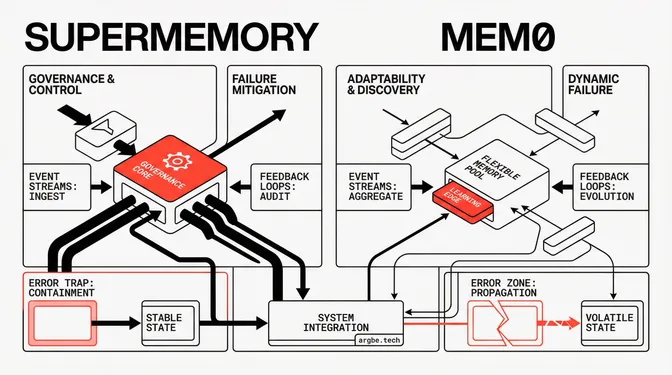
Supermemory vs Mem0 is a decision about how you want long-term memory to exist inside an intelligent platform: as a more productized “memory API” with built-in workflows, or as a composable memory layer you can instrument, tune, and own.
This choice matters because memory is not a feature — it’s part of the platform’s operating system. Once agents can act (and not just chat), memory becomes a reliability and governance surface, not just “better personalization.”
Where memory fits in intelligent platforms
If you’re building an intelligent platform, memory lives next to your agent loop — it’s the persistence layer that makes the system’s behavior repeatable across sessions, deployments, and changing inputs.
-
If your product is built around a sense → decide → act cycle, memory is what keeps the agent’s decisions consistent over time; see how we model that loop in our agentic intelligent platforms architecture guide.
-
If you’re thinking in stack layers (events → orchestration → human approval), memory becomes an operational dependency that must be governable and observable; map it against the intelligent platform stack.
-
If you’re still defining what “intelligent platform” means in your context, anchor on our core framing so memory decisions don’t get reduced to “just add RAG.”
A good memory layer makes the loop safer and more stable. A bad one makes the loop unpredictable.
The decision that actually matters
Most teams compare memory tools like a feature checklist. In production, the real difference is the failure mode you choose to own:
Path A: Productized memory workflows (faster adoption)
You rely on defaults like:
- connectors / ingestion flows
- user profiles
- automatic capture and retrieval behaviors
- “just works” integrations (often via MCP)
This path reduces custom plumbing, but you must validate correctness early (what gets stored, what gets injected, and why).
Path B: Composable memory layer (more control)
You treat memory like infrastructure:
- explicit memory objects
- configurable lifecycle (update/expire/delete)
- retrieval tuning and evaluations
- deeper observability and debugging
This path can be more predictable long-term, but it demands ownership: tooling, metrics, and governance.
Quick orientation: what Supermemory and Mem0 are
Mem0 (platform + open source)
Mem0 is offered as:
- Mem0 Platform (managed service, “ready in minutes” style)
https://docs.mem0.ai/platform/overview - Mem0 Open Source (self-hostable memory layer, Apache-2.0)
https://github.com/mem0ai/mem0
Mem0 also publishes supporting tooling like an MCP server wrapper for memory operations:
https://github.com/mem0ai/mem0-mcp
Supermemory (memory API + ecosystem)
Supermemory positions itself as a universal memory API with built-in components like memory + RAG + profiles + connectors/extractors:
https://supermemory.ai/
It also has an open GitHub ecosystem (including an MCP server):
https://github.com/supermemoryai/supermemory
https://github.com/supermemoryai/supermemory-mcp
Where each tends to fit (general, practical)
When teams reach for Supermemory
This direction is common when:
- you want fast setup with fewer moving parts in your app
- you value built-in workflows (profiles/connectors/extractors) more than bespoke memory pipelines
- you plan to validate memory behavior through a lightweight bake-off before investing in deep instrumentation
Trade-off to watch: “automatic” memory is only good if it’s consistently correct. Your first job is to measure over-injection, stale facts, and false inferences.
When teams reach for Mem0
This direction is common when:
- you want explicit lifecycle control over what’s stored and how it updates over time
- you plan to run evaluations and tune retrieval behavior (as the platform evolves)
- you want the option of self-hosting (or at least reducing lock-in risk)
Trade-off to watch: composability can become a hidden tax unless you set defaults early: schemas, TTL policies, instrumentation, and “what counts as memory.”
What to validate before you commit
Use this lightweight rubric to stay honest:
1) Write quality (what gets stored)
- Does it store only what you intended?
- Does it avoid over-inference (turning “maybe” into “fact”)?
2) Read correctness (what gets injected)
- Does it retrieve the right information for your top workflows?
- Does it over-inject irrelevant context that degrades responses?
3) Lifecycle control (updates and forgetting)
- Can you overwrite stale preferences cleanly?
- Can you expire or delete user memory reliably?
4) Operational visibility (debuggability)
- Can you explain why a memory appeared (or didn’t)?
- Can you troubleshoot retrieval quality without guesswork?
5) Fit inside the intelligent platform loop
- Can memory be bounded and audited in human-in-the-loop flows?
- Does memory behave predictably under continuous deployment and schema churn?
Data anchor: simple comparison table (intro-level)
| Dimension | Supermemory | Mem0 |
|---|---|---|
| Default posture | Productized memory API + built-in workflows | Memory layer with both managed + OSS modes |
| Primary optimization | Setup speed and packaged behaviors | Control over lifecycle + retrieval tuning |
| Ownership | More provider defaults | More developer control (and responsibility) |
| Best for | Product-lean teams shipping quickly | Platform-minded teams owning reliability |
| Validate first | Over-injection + correctness | Update behavior + eval harness + observability |
Minimal bake-off you can run in a day
If you want a real recommendation without a huge research sprint:
- Pick 3 workflows your agents must remember (e.g., “preference updates”, “ongoing task context”, “account / project facts”).
- Create 30 short transcripts that include:
- preference updates (change mind),
- contradictions (new fact replaces old),
- irrelevant info (should not be stored).
- Score:
- wrong-memory rate (false / outdated recall),
- missing-memory rate (fails to recall),
- “time to debug why it happened.”
This gives you directional truth fast — and tells you whether you need product defaults (Path A) or explicit control (Path B).
Next steps
If this guide matches how you build intelligent platforms, the next expansion is straightforward:
- Add a citable architecture section (write/read paths, governance hooks).
- Add a TCO model (managed vs self-host, what you actually pay for).
- Add a reproducible benchmark harness that reflects your real workflows.
Related reading inside this cluster:
On this page