Event-Driven Growth Systems: Real-Time Personalization and Experimentation for Intelligent Platforms
An event driven personalization platform ties real-time behavioral signals to decision logic and experimentation controls. This guide shows how to log assignment and exposure so a personalization “win” survives replay, with a runnable query that shows how latency can fake a lift.
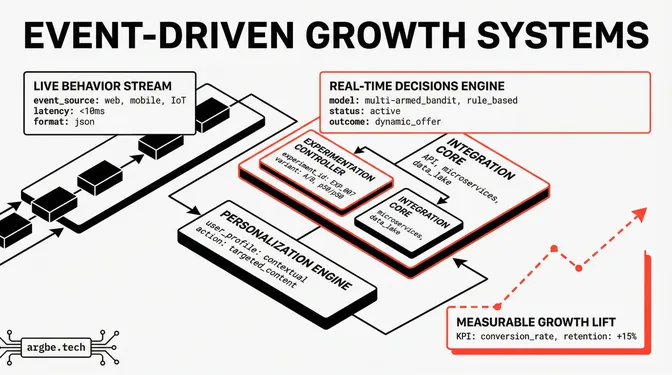
Most “personalization platforms” are analytics tools in disguise: good at describing what happened, weak at deciding what should happen next. Real-time growth is a different job: event-native decisions plus explicit experimentation controls.
Moving decisions from dashboards into runtime can shorten the loop between an idea and a result. It also creates new ways to fool yourself. Real-time systems produce false positives when exposure is inferred, when assignments re-roll across sessions, or when latency changes who receives the treatment.
In event-driven growth, instrumentation is part of the experiment. Assignment, exposure, eligibility, and timing must be recorded as first-class events, or you’re optimizing a dashboard artifact. The worked example below shows one version of that failure, with a query you can run.
Why event-driven personalization is different from batch analytics
Batch analytics systems are optimized for reporting: aggregate, attribute, and explain. That’s valuable, but it happens after the moment your user makes a decision. An event driven personalization platform is optimized for decisions: capture a signal, apply rules (or models), render an experience, and record what happened, fast enough that the user’s intent hasn’t cooled.
The workflow shift is subtle but expensive if you miss it. In a batch world, you ship a change, wait for reports, and then interpret lift. In an event-driven world, the system makes small decisions continuously, and your measurement has to keep up. Teams that “add real-time” on top of existing analytics can end up with personalization that looks successful in dashboards but doesn’t survive a replay of the exposure log.
Event streams also change how you think about causality. When decisions happen close to intent, latency becomes part of the treatment: the same user may or may not receive it depending on whether the decision arrived in time. That’s how your routing layer quietly becomes a confounder. Whatever analysis tool you use, the raw log has to link assignment, exposure, and outcome correctly.
A stream such as Apache Kafka makes routing explicit: it stores streams of events durably, which forces you to define what an event is, when it counts as recorded, and who may act on it (Apache Kafka documentation: introduction, accessed 2026-10-18)1. That’s the opposite of a batch pipeline where “truth” is decided later by whichever query ran last.
Data anchor: event types vs personalization outcomes
The latency budgets below are expressed as deadlines rather than milliseconds on purpose. Derive the numbers from how fast intent decays in your product. For interaction-driven changes, Google’s guidance that a page should respond to input quickly is a useful outer bound (web.dev: Interaction to Next Paint, accessed 2026-10-18)2.
| event_type | personalization_outcome | latency budget (deadline) | experiment_fit | tooling_category |
|---|---|---|---|---|
page_view | Reorder modules / hero variant / contextual CTA | Before first render of the affected section | High (UI variants + quick outcomes) | Edge decisioning + rendering |
feature_used | In-product tips, next-best-action nudges | Within the interaction that triggered it | High (behavior-linked, repeated measures) | Stream processor + decision engine |
activation_milestone | Onboarding step gating / checklist path | Before the next onboarding step loads | Medium (needs persistent assignment) | Assignment service + state store |
billing_intent | Upgrade messaging, plan comparison emphasis | Before the plan comparison renders | Medium (risk-managed, strict guardrails) | Decision engine + policy layer |
error_or_latency | Degrade gracefully: simplify UI, swap fallback | Immediately, on the fallback path | High (performance + conversion coupling) | Observability → rules engine |
Glossary (core entities)
- Event: a timestamped fact (“user did X”) with stable naming and properties.
- Event stream: an ordered log of events that can be consumed in near real time.
- Decision point: where the product chooses a variant or action based on context.
- Eligibility: the set of users or sessions allowed to receive a treatment.
- Assignment event: a durable record, written when the decision is made, of which variant a user was assigned.
- Exposure event: a durable record, written when the variant actually rendered, that the user could have seen it. In the control arm, it’s written at the point where the treatment would have rendered.
- Holdout: a persistent control group excluded from personalization to measure the baseline.
- Latency budget: the maximum time allowed from signal → decision → render.
- Governance: controls that define who can change rules or models, when, and with an audit trail.
If you want the broader platform context for why “decide + act + audit” matters, start with What Are Intelligent Platforms? The Future of Web Apps.
In words: a user event reaches the decision engine, which logs the assignment; the UI renders the variant and logs the exposure; outcome events follow; analysis joins all three by assignment ID.
The minimum viable event-driven stack for growth experiments
A growth team evaluating an event driven personalization platform usually wants two things at once: faster iteration and fewer attribution arguments. The minimum viable stack exists to make both true without turning the org into an on-call rotation for “growth logic.”
Start with event collection and normalization. The tool matters less than the contract: stable names, stable identifiers, and explicit schemas for assignment, exposure, and outcome. Schema-first collectors such as Snowplow validate events against versioned schemas (Snowplow: schemas, accessed 2026-10-18)3. If you can’t answer “what counts as exposure?” without opening a dashboard, you don’t have an experimentable system.
Next is routing and decision logic. This is where many stacks quietly fail: they can route events, but they can’t make a decision within the latency budget and then log it as a first-class event. That’s why feature flags are not just “dev toggles” in this architecture; they’re the exposure control plane (Martin Fowler: feature toggles, accessed 2026-10-18)4. You need deterministic assignment, kill switches, and guardrails that stop “personalization” from becoming an unreviewed deploy path.
Finally, you need event-accurate logging. Not “we think they saw it,” but “the decision engine wrote an assignment event, and the UI wrote an exposure event when the variant rendered.” Product analytics tools draw the same line: Amplitude, for example, distinguishes an assignment event (tracked when a user is assigned) from an exposure event (tracked when a user encounters the variant), and uses exposure for client-side experiment analysis (Amplitude: event tracking, accessed 2026-10-18)5.
Two envelopes that keep you honest without over-specifying your implementation:
{
	"event_name": "experiment_assignment",
	"event_id": "uuid-v4",
	"ts": "RFC3339 timestamp",
	"user_id": "stable_user_id",
	"experiment": {
		"key": "onboarding_nudge_v1",
		"variant": "B",
		"assignment_id": "assignment_uuid",
		"rule_version": 3
	},
	"eligibility": { "rule_version": 3, "eligible": true },
	"governance": { "owner": "growth", "rollback_flag": "ff_onboarding_nudge_v1" }
}
{
"event_name": "experiment_exposure",
"event_id": "uuid-v4",
"ts": "RFC3339 timestamp",
"assignment_id": "assignment_uuid",
"surface": "/app/onboarding",
"rendered_variant": "B",
"counterfactual": false,
"decision_to_render_ms": 180
}In the control arm, rendered_variant is A and counterfactual is true: the UI logs the moment the treatment would have rendered, under the same timing rule.
A note on operational overhead: the real burden is not “more events.” It’s unclear ownership and silent changes. If you’re tying runtime decisions to growth outcomes, give those decisions the change discipline you’d give production infrastructure.
Personalization outcomes that are safe to automate
Automation safety is less about what’s possible and more about what’s reversible and auditable. If you want personalization to compound instead of turning into a trust tax, start where failures are cheap.
Low-risk outcomes are UI and messaging variants that don’t change entitlements: reorder modules, adjust copy, tailor help content, and nudge next steps. The line to protect is between “saw the variant” and “acted on it.” The moment you blur it, your system starts rewarding itself for phantom lift.
Next, graduate to workflow shaping: onboarding paths, defaults, and guidance. This is where teams tend to over-automate early, especially if their event quality isn’t stable. Before you automate, make sure you can replay: if you re-run the event stream, do you get the same assignment for the same user context?
Sensitive outcomes (pricing emphasis, eligibility hints, friction changes) deserve a human-in-the-loop posture. A warehouse view over long horizons is how you catch drift: a rule set can keep “winning” on short-term conversion while hurting retention, support load, or fairness. Automation without longitudinal review is how platforms get quietly worse while dashboards stay green.
One practical governance pattern: treat personalization like a product surface, not a marketing trick. That means an owner, a changelog, and an explicit rollback. If your platform can’t answer “who changed the decision policy?” in minutes, you’re not ready to automate sensitive decisions.
If you’re connecting this to a broader intelligent platform stack, including governance and human-in-the-loop operations, see The Intelligent Platform Stack (2026): Event-Driven Data, Agent Orchestration, and Human-in-the-Loop Operations.
Experiment design in real-time systems
Real-time experimentation fails in predictable ways, and most of them come from treating event streams like faster batch analytics.
Assignment and exposure are different events, and you need both. The decision engine writes the assignment when it decides; that record is durable and complete, and it’s what intention-to-treat analysis uses. The UI writes the exposure when the variant actually renders; that’s what lets you analyze only the users the change could have affected. If you compute exposure later (“they visited the page, so they must have seen the banner”), you will mismeasure, especially when rendering is conditional, blocked, or slow. Analyzing only triggered users and then translating the effect back to everyone is a known technique with its own pitfalls; Deng and Hu describe how to estimate the diluted overall effect correctly (Deng and Hu, “Diluted Treatment Effect Estimation for Trigger Analysis in Online Controlled Experiments,” WSDM 2015, accessed 2026-10-18)6.
Latency creates selection bias. If the treatment only counts as exposed when it renders in time, the exposed treatment group is skewed toward faster devices and networks, while a control that logs every page view is not. Now you’re comparing different populations. The fix is to apply the same rule in both arms: the control logs a counterfactual exposure exactly where, and only when, the treatment would have rendered in time. The worked example below shows the size of the error when you don’t.
Check the sample ratio before you read lift. If you designed a 50/50 split, the assigned and exposed counts should be close to 50/50. A sample ratio mismatch is a symptom of a data-quality problem that can make a bad change look good (Fabijan et al., “Diagnosing Sample Ratio Mismatch in Online Controlled Experiments,” KDD 2019, accessed 2026-10-18)7. Investigate it before analyzing anything else.
Holdouts must persist across sessions. Systems that re-roll users each session turn the control group into a moving target. With durable assignments, a personalized cohort that improves while the holdout stays flat gives you a cleaner read; if both move, you may be seeing seasonality, pricing changes, or other outside effects.
Don’t peek without a method built for it. Streams feel like live scoreboards, but checking a fixed-horizon test repeatedly and stopping when it looks significant raises the false-positive rate. Either decide the sample size in advance and wait (Evan Miller, “How Not To Run an A/B Test”, accessed 2026-10-18)8, or use a sequential method designed to be checked continuously (Johari, Pekelis, and Walsh, “Always Valid Inference,” arXiv:1512.04922, accessed 2026-10-18)9.
None of these checks is specific to personalization. They apply just as much to an ordinary A/B test on a product page or checkout, which is the everyday work of conversion rate optimization.
Choosing between build, buy, or hybrid
The decision is not “build vs buy.” It’s “where do we need determinism and governance, and where do we accept abstraction?”
Buying a decision layer on top of your existing collector can look attractive until you need to audit assignments, replay exposures, or enforce persistent holdouts across surfaces. Vendor abstractions are fine as long as you can extract raw, durable assignment and exposure logs, and you can version decision logic with clear ownership.
The warehouse often forces the hybrid: you need a historical view for long-horizon outcomes (retention, expansion, support cost), and you need runtime decisions that can’t wait for queries (BigQuery: introduction, accessed 2026-10-18)10. The clean pattern is separation of concerns: the warehouse for historical truth, a decision engine for runtime behavior, and a thin governance layer that ties them together.
Operational overhead is the tax you pay for speed. Reduce it with a small surface area: fewer event types, fewer decision points, and a strict rule that anything “personalized” must be experimentable or explicitly labeled as non-experimental (and excluded from lift claims).
Framework choice influences how safely you can render variants and log exposure (SSR vs client-first, edge execution, caching defaults). If that’s on your roadmap, see Astro vs Next.js: Choosing the Right Framework in 2026 and Building with Svelte in January 2026: The Signals That Change Delivery Defaults.
Privacy and consent limits
Assignment and exposure logs tie behavior to a stable identifier, so they are personal data in most setups.
- Consent for storage on the device. In the EU, storing or reading an identifier on a user’s device (an assignment cookie, a local-storage key) generally requires consent unless it is strictly necessary for a service the user requested (Directive 2002/58/EC, Article 5(3), on EUR-Lex, accessed 2026-10-18)11. The EDPB has published guidance on what that article covers (EDPB Guidelines 2/2023, accessed 2026-10-18)12. Get legal advice for your setup; this is not it.
- Consent shapes your sample. If you only log users who consented, your results describe consented users. Don’t generalize them to everyone, and keep the consent rule identical across arms so it can’t create its own imbalance.
- Minimize. Log the assignment ID, variant, rule version, timestamps, and surface. You rarely need more to audit an experiment.
- Sensitive personalization. Pricing emphasis and eligibility hints can amount to profiling; review them with whoever owns privacy before you automate them.
Next steps: a phased rollout plan
Instrument and validate first. Treat your event model as a product contract: name events, define identifiers, and ship assignment and exposure logging before you ship “smart” decisions. Feature flags are your safety rail: every decision point needs a kill switch, a version, and an owner. Define eligibility up front so experiments don’t silently bias toward fast devices or easy segments.
Then run two deliberately boring experiments. Low-risk UI variants with clear, fast outcomes. The goal is not a big win; it’s proving that your logs and analysis are trustworthy under real latency. Use a persistent holdout from day one, keep assignment sticky across sessions, and version decision logic so you can replay and audit.
Then multi-step personalization with governance. Timing and sequencing become variables in their own right: whether a nudge works better instantly or a step later is a question to test, not to assume. Add human review for sensitive changes, and drift checks so a rule set that used to win doesn’t quietly decay as your product and traffic change.
If your longer-term roadmap includes agentic decision loops (not just rules), connect this rollout plan to Agentic Intelligent Platforms: How AI Agents Turn Web Apps Into Self-Optimizing Systems (2026 Architecture Guide).
Reference implementation: the smallest architecture that stays auditable
Most failed “real-time personalization” stacks fail for boring reasons: inconsistent identifiers, inferred exposure, re-rolled users, or decision logic that changes without an audit trail. The minimal architecture below is designed to prevent false lift.
Components and responsibilities
- Event collector (client + server): emits stable events with stable IDs.
- Router / stream: makes event delivery explicit and observable.
- Decision engine (stateless): evaluates rules or models within the latency budget and writes the assignment event.
- Assignment service (stateful): guarantees sticky assignment and persistent holdouts.
- UI: writes the exposure event when the variant renders (or the counterfactual exposure, in control).
- Warehouse + analysis: joins assignment ↔ exposure ↔ outcome and computes lift with guardrails.
- Governance registry: versions policies and rules, owners, and rollback flags.
Failure modes this architecture prevents
- Inferred exposure: “they visited the page so they must have seen it.”
- Asymmetric exposure: the treatment logs renders while the control logs page views.
- Re-rolls: users swap variants between sessions or surfaces.
- Latency bias: only the fastest subset counts as treated.
- Duplicate exposures: retries or double renders inflate counts.
- Silent policy drift: rules change without ownership, review, or rollback.
Worked example: one experiment that survives replay and audit
Scenario: an onboarding nudge on /app/onboarding with two variants (A control, B nudge). We want to know whether the nudge works, without guessing who actually saw it.
Define eligibility (explicit)
A user is eligible if:
- they are on the onboarding route,
- they have not completed
activation_milestone = "project_created", - they are not in the holdout.
Eligibility is computed at decision time and versioned with rule_version, not inferred later.
Assign variants (sticky + holdout)
- A persistent holdout, around a tenth of users, kept across sessions for baseline measurement.
- The rest split evenly between A and B, keyed on
stable_user_idso the same user always gets the same arm.
Assignments must be deterministic for the same context and rule_version. The decision engine writes the assignment event at this point.
Log exposure (durable, symmetric)
The UI writes an exposure event only when the variant actually rendered within the latency budget. In control, it writes a counterfactual exposure at the same point under the same rule. Fields that make audits possible: assignment_id, rendered_variant, counterfactual, ts, surface, and the decision-to-render time.
Define outcomes and the window (separate from exposure)
Outcomes are behavioral events, never views or page loads:
activation_milestone: "project_created"(primary)feature_used: "invite_teammate"(secondary)billing_intent: "plan_compare_opened"(guardrail)
Write down, before launch: the primary metric, the denominator (exposed users for the triggered analysis, assigned users for intention to treat), the attribution window (here, seven days after assignment), and the stopping rule.
Run the query (and watch it catch a false lift)
The query below runs in DuckDB with synthetic, deterministic data. In this data the nudge has no real effect. Fast-device users convert more regardless, and B’s nudge only renders in time on fast devices and some slow ones. The query compares three analyses: naive triggered (B logs renders, A logs every page view), counterfactual triggered (both arms log under the same rule), and intention to treat (all assigned users).
-- experiment.sql: run with `duckdb < experiment.sql`. Synthetic, deterministic data.
-- The nudge has NO real effect. B's nudge only renders in time on fast devices
-- (and some slow ones); fast-device users convert more anyway.
-- md5-based buckets: stable across DuckDB versions and machines.
CREATE MACRO bucket(id, salt, n) AS md5_number(id::VARCHAR || salt) % n;

CREATE TABLE users AS
SELECT u AS user_id, bucket(u, 'device', 100) < 70 AS fast_device
FROM range(1, 20001) t(u);

CREATE TABLE assignments AS
SELECT user_id,
       'asg-' || user_id AS assignment_id,
       'onboarding_nudge_v1' AS experiment_key,
       3 AS rule_version,
       CASE WHEN bucket(user_id, 'holdout', 100) < 10 THEN 'holdout'
            WHEN bucket(user_id, 'arm', 2) = 0 THEN 'A' ELSE 'B' END AS variant,
       TIMESTAMP '2026-10-01 00:00:00' + to_hours(user_id % 72) AS assigned_at
FROM users;

-- Would the variant have rendered within the latency budget? Same rule for both arms.
CREATE TABLE renders_in_time AS
SELECT user_id, fast_device OR bucket(user_id, 'render', 100) < 30 AS in_time FROM users;

-- Naive logging: B logs exposure only when the nudge rendered; A logs every page view.
CREATE TABLE exposures_naive AS
SELECT a.assignment_id, a.assigned_at + to_seconds(2) AS exposed_at
FROM assignments a JOIN renders_in_time r USING (user_id)
WHERE a.variant = 'A' OR (a.variant = 'B' AND r.in_time);

-- Counterfactual logging: A logs where B's nudge *would* have rendered in time.
CREATE TABLE exposures_cf AS
SELECT a.assignment_id, a.assigned_at + to_seconds(2) AS exposed_at
FROM assignments a JOIN renders_in_time r USING (user_id)
WHERE a.variant IN ('A', 'B') AND r.in_time;

CREATE TABLE outcomes AS
SELECT u.user_id, 'project_created' AS event_name,
       a.assigned_at + to_days(u.user_id % 5) AS ts
FROM users u JOIN assignments a USING (user_id)
WHERE bucket(u.user_id, 'convert', 1000) < CASE WHEN u.fast_device THEN 220 ELSE 120 END;

-- 1. Sample ratio check, A vs B (expected 50/50). Chi-square, 1 degree of freedom.
WITH counts AS (
  SELECT a.variant,
         count(*) AS assigned,
         count(n.assignment_id) AS exposed_naive,
         count(c.assignment_id) AS exposed_cf
  FROM assignments a
  LEFT JOIN exposures_naive n USING (assignment_id)
  LEFT JOIN exposures_cf c USING (assignment_id)
  WHERE a.variant IN ('A', 'B')
  GROUP BY a.variant
), expected AS (
  SELECT avg(assigned) AS e_a, avg(exposed_naive) AS e_n, avg(exposed_cf) AS e_c FROM counts
)
SELECT variant, assigned, exposed_naive, exposed_cf,
       round(sum((assigned - e_a) ^ 2 / e_a) OVER (), 2) AS chi2_assigned,
       round(sum((exposed_naive - e_n) ^ 2 / e_n) OVER (), 2) AS chi2_naive,
       round(sum((exposed_cf - e_c) ^ 2 / e_c) OVER (), 2) AS chi2_cf
FROM counts, expected ORDER BY variant;

-- 2. One row per assigned A/B user: exposure under each logging rule, and conversion
--    within 7 days of assignment (exposure follows assignment by seconds here).
CREATE TABLE conv AS
SELECT a.assignment_id, a.variant,
       n.exposed_at IS NOT NULL AS exposed_naive,
       c.exposed_at IS NOT NULL AS exposed_cf,
       bool_or(o.ts BETWEEN a.assigned_at AND a.assigned_at + INTERVAL 7 DAY) IS TRUE AS converted
FROM assignments a
LEFT JOIN exposures_naive n USING (assignment_id)
LEFT JOIN exposures_cf c USING (assignment_id)
LEFT JOIN outcomes o ON o.user_id = a.user_id AND o.event_name = 'project_created'
WHERE a.variant IN ('A', 'B')
GROUP BY ALL;

-- 3. B minus A under each analysis, in percentage points, with a two-proportion z statistic.
WITH rows AS (
  SELECT 'naive triggered' AS method, variant, converted FROM conv WHERE exposed_naive
  UNION ALL SELECT 'counterfactual triggered', variant, converted FROM conv WHERE exposed_cf
  UNION ALL SELECT 'intention to treat', variant, converted FROM conv
), rates AS (
  SELECT method,
         avg(converted::INT) FILTER (WHERE variant = 'A') AS p_a,
         avg(converted::INT) FILTER (WHERE variant = 'B') AS p_b,
         count(*) FILTER (WHERE variant = 'A') AS n_a,
         count(*) FILTER (WHERE variant = 'B') AS n_b,
         avg(converted::INT) AS p
  FROM rows GROUP BY method
)
SELECT method,
       round(100 * p_a, 1) AS cvr_a,
       round(100 * p_b, 1) AS cvr_b,
       round(100 * (p_b - p_a), 2) AS diff_pts,
       round((p_b - p_a) / sqrt(p * (1 - p) * (1.0 / n_a + 1.0 / n_b)), 2) AS z
FROM rates ORDER BY method;
Output (DuckDB v1.4.4, run 2026-10-18):
┌─────────┬──────────┬───────────────┬────────────┬───────────────┬────────────┬─────────┐
│ variant │ assigned │ exposed_naive │ exposed_cf │ chi2_assigned │ chi2_naive │ chi2_cf │
│ varchar │  int64   │     int64     │   int64    │    double     │   double   │ double  │
├─────────┼──────────┼───────────────┼────────────┼───────────────┼────────────┼─────────┤
│ A       │     8993 │          8993 │       7046 │          0.03 │     207.29 │    0.96 │
│ B       │     9017 │          7163 │       7163 │          0.03 │     207.29 │    0.96 │
└─────────┴──────────┴───────────────┴────────────┴───────────────┴────────────┴─────────┘
┌──────────────────────────┬────────┬────────┬──────────┬────────┐
│          method          │ cvr_a  │ cvr_b  │ diff_pts │   z    │
│         varchar          │ double │ double │  double  │ double │
├──────────────────────────┼────────┼────────┼──────────┼────────┤
│ counterfactual triggered │   21.8 │   20.9 │    -0.96 │  -1.39 │
│ intention to treat       │   19.4 │   19.0 │    -0.43 │  -0.73 │
│ naive triggered          │   19.4 │   20.9 │     1.44 │   2.26 │
└──────────────────────────┴────────┴────────┴──────────┴────────┘
Read it in order:
- Assignment is balanced (chi-square 0.03). Randomization worked.
- Naive exposure is not (chi-square 207.29, far above 10.83, the critical value for p < 0.001 with one degree of freedom in the NIST/SEMATECH chi-square table, accessed 2026-10-18)13. That mismatch is the alarm: the two “exposed” groups were defined differently.
- The naive comparison shows a lift that doesn’t exist. B appears to beat A by 1.44 points with z = 2.26, which would pass a conventional p < 0.05 test. It is entirely the fast-device skew.
- Symmetric logging removes it. With counterfactual exposure, the sample ratio is fine (0.96) and the difference is not significant. Intention to treat agrees.
Validation checklist (audit before you claim lift)
- Assignment is written at decision time; exposure is written at render time, in both arms, under the same rule.
- The sample ratio of assigned and exposed users matches the design.
- Assignment is sticky across sessions and surfaces.
- The holdout is persistent and excluded from decisioning.
- Events are idempotent (
event_idprevents duplicates). - Decision-to-render time is logged, so latency effects can be checked.
- Eligibility is versioned (
rule_version) and reproducible in replay. - Rollback exists and is tested (the kill switch works).
- The rendering path is deterministic (no caching that silently swaps variants).
- Join keys are stable (
user_id,assignment_id). - Replaying the same event stream reproduces the same assignments.
Stop rules: how to avoid “dashboard wins” that don’t reproduce
Define these before shipping beyond a controlled rollout:
- Sample size or sequential method, chosen in advance. Either compute the sample size for the smallest effect you care about and don’t decide before you reach it (Evan Miller: sample size calculator, accessed 2026-10-18), or use a sequential test built for continuous monitoring.
- Minimum duration: at least one full traffic cycle relevant to the feature (weekday and weekend, if behavior differs).
- Guardrails: auto-pause if error rate, latency, or support contacts regress beyond a bound you set in advance.
- Fixed inspection points if you use a fixed-horizon test, with decisions treated as versioned changes.
- Rollout discipline: widen exposure in steps with a stable holdout throughout, and keep the allocation fixed during the period you analyze.
How this was checked
The query and its output were produced by running the SQL shown in DuckDB v1.4.4 on 2026-10-18; the data is synthetic and built to demonstrate the bias, not drawn from any product. The statistical and platform references were checked against the linked sources the same day. The architecture and rollout plan are recommendations, not measured results.
If you want this logging and analysis built into your product, see software development.
On this page