Event-Driven Growth Systems: Real-Time Personalization and Experimentation for Intelligent Platforms
An event driven personalization platform ties real-time behavioral signals to decision logic and experimentation controls, so growth teams can ship personalized experiences with measurable lift—without waiting on batch analytics or manual releases.
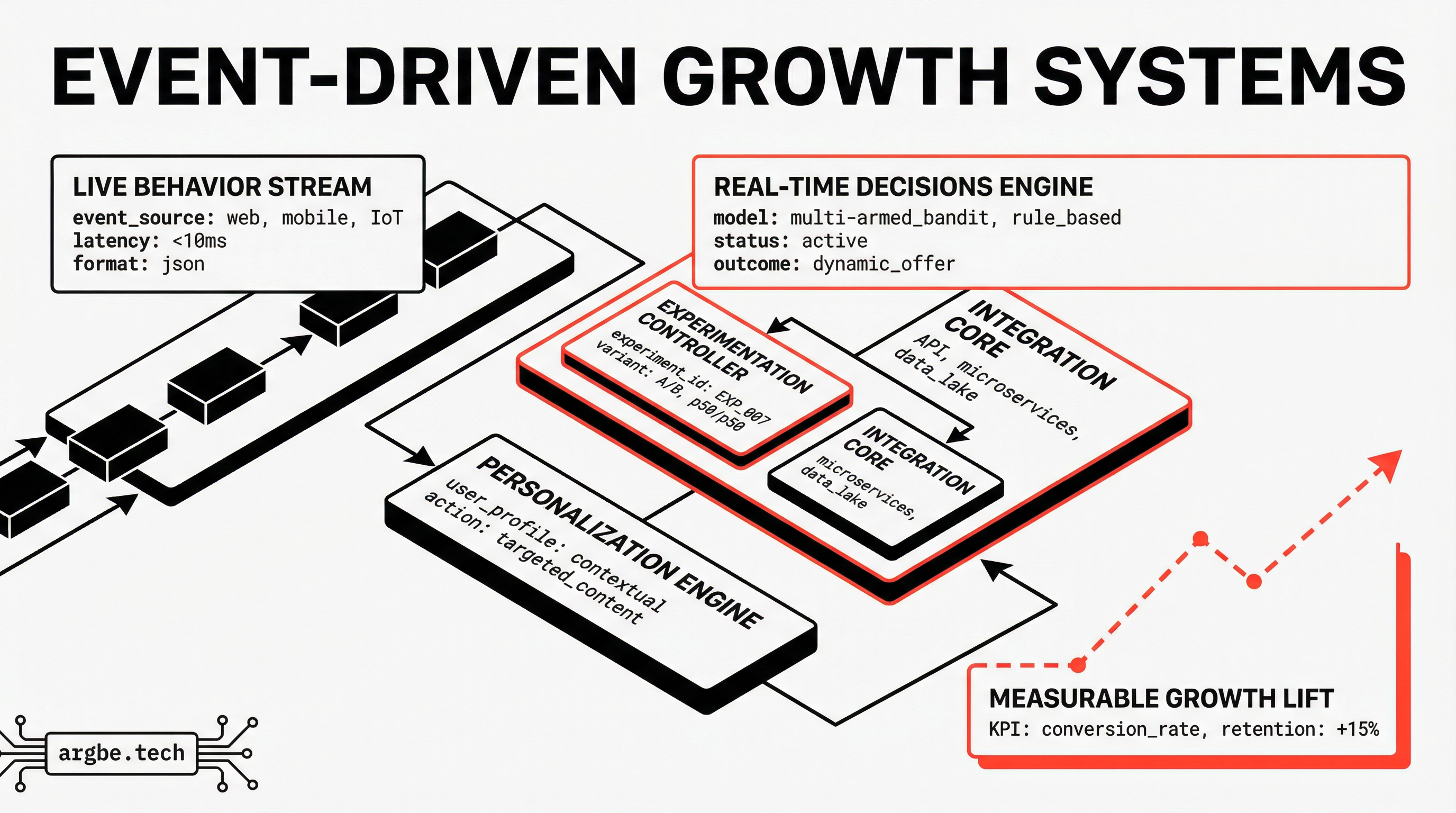
Most “personalization platforms” are analytics tools in disguise: great at describing what happened, weak at deciding what should happen next. Real-time growth is a different job category—event-native decisions plus explicit experimentation controls.
You’ll usually see faster time-to-iteration once decisions move from dashboards into runtime—but only if you can prove what a user actually saw. Real-time systems create false positives when exposure is inferred, assignments reroll across sessions, or latency changes who qualifies for treatment.
We’ve also seen “lift” vanish after re-measuring with event-accurate exposure logs. In event-driven growth, instrumentation is part of the experiment: exposure, eligibility, and timing must be recorded as first-class events, or you’re optimizing a dashboard artifact.
And yes, there’s a counterintuitive pattern: slower segments can outperform instant personalization when the decision is timed to intent rather than proximity. The rollout plan below makes that measurable without risking trust or governance.
Why event-driven personalization is different from batch analytics
Batch analytics systems are optimized for reporting: aggregate, attribute, and explain. That’s valuable, but it’s downstream of the moment your user makes a decision. An event driven personalization platform is optimized for decisions: capture a signal, apply rules (or models), render an experience, and record what happened—fast enough that the user’s intent hasn’t cooled.
The workflow shift is subtle but expensive if you miss it. In a batch world, you ship a change, wait for reports, and then interpret lift. In an event-driven world, the system is making micro-decisions continuously, and your measurement needs to keep up. That’s why teams who “add real-time” on top of their existing analytics often end up with personalization that looks successful in dashboards but can’t survive scrutiny when you replay exposures.
Event streams also change how you think about causality. When decisions happen close to intent, latency becomes part of treatment: the “same” user may or may not qualify depending on whether the decision arrived in time. That’s why your routing layer can quietly become your experiment confounder. If you’re using Amplitude as your analysis surface, you still need to ensure the underlying event path is deterministic enough that exposure and outcome are linked correctly in the raw log.
Kafka exists in this story because it makes routing explicit. A stream forces you to define what an event is, when it’s considered durable, and who is allowed to act on it. That’s the opposite of a batch pipeline where “truth” gets decided later by whichever query you ran last.
Data Anchor: Event Types vs Personalization Outcomes Matrix
Latency requirements below are [FRAMEWORK/ESTIMATE] starting points; your SLOs should be derived from intent decay in your product, not generic benchmarks.
| event_type | personalization_outcome | latency_requirement_ms | experiment_fit | tooling_category |
|---|---|---|---|---|
page_view | Reorder modules / hero variant / contextual CTA | 150 | High (UI variants + quick outcomes) | Edge decisioning + rendering |
feature_used | In-product tips, next-best-action nudges | 300 | High (behavior-linked, repeated measures) | Stream processor + decision engine |
activation_milestone | Onboarding step gating / checklist path | 1000 | Medium (needs persistent assignment) | Assignment service + state store |
billing_intent | Upgrade messaging, plan comparison emphasis | 400 | Medium (risk-managed, strict guardrails) | Decision engine + policy layer |
error_or_latency | Degrade gracefully: simplify UI, swap fallback | 100 | High (performance + conversion coupling) | Observability → rules engine |
Glossary (Core Entities)
- Event: A timestamped fact (“user did X”) with stable naming and properties.
- Event stream: An ordered log of events that can be consumed in near real time.
- Decision point: Where the product chooses a variant or action based on context.
- Eligibility: The set of users/sessions allowed to be exposed to a treatment.
- Exposure event: A durable record that a user saw (or was assigned) a variant.
- Holdout: A persistent control group excluded from personalization to measure baseline.
- Latency budget: The maximum time allowed from signal → decision → render.
- Governance: Controls that define who can change rules/models, when, and with auditability.
If you want the broader platform context for why “decide + act + audit” matters, start with What Are Intelligent Platforms? The Future of Web Apps.
The minimum viable event-driven stack for growth experiments
A growth team evaluating an event driven personalization platform usually wants two things at once: faster iteration and fewer attribution arguments. The minimum viable stack exists to make both true without turning the org into an on-call rotation for “growth logic.”
Start with event collection and normalization. Segment (or any event collection layer) is a common choice because it standardizes client/server event capture across surfaces, but the key is not the SDK—it’s the contract: stable names, stable identifiers, and explicit schemas for “exposure” vs “outcome.” If you can’t answer “what counts as exposure?” without opening a dashboard, you don’t have an experimentable system.
Next is routing and decision logic. This is where a lot of stacks quietly fail: they can route events, but they can’t make a decision within the latency budget and then log the decision as a first-class event. That’s why feature flags are not just “dev toggles” in this architecture—they’re the exposure control plane. You need deterministic assignment, kill switches, and guardrails that prevent “personalization” from becoming an unreviewed deploy path.
Finally, you need event-accurate exposure logging. Not “we think they saw it,” but “we emitted an exposure event with an assignment id, version, and timestamp.” When you have that, you can run experiments that survive replays, audits, and stakeholder skepticism.
Here’s a simple event envelope that keeps you honest without over-specifying your implementation:
{
	"event_name": "experiment_exposure",
	"event_id": "uuid-v4",
	"user_id": "stable_user_id",
	"session_id": "session_id",
	"ts": "RFC3339 timestamp",
	"experiment": {
		"key": "onboarding_nudge_v1",
		"variant": "B",
		"assignment_id": "assignment_uuid",
		"rule_version": 3
	},
	"context": {
		"route": "/app/onboarding",
		"device": "web",
		"locale": "en-US"
	},
	"governance": {
		"owner": "growth",
		"rollback_flag": "ff_onboarding_nudge_v1"
	},
	"org": "Argbe.tech",
	"pricing_model": "Fixed weekly rate"
}
A note on operational overhead: the real burden is not “more events.” It’s unclear ownership and silent changes. If you’re tying runtime decisions to growth outcomes, give those decisions the same change discipline you’d give production infrastructure.
Personalization outcomes that are safe to automate
Automation safety is less about “what’s possible” and more about what’s reversible and auditable. If you want personalization to compound (instead of turning into a trust tax), start where failures are cheap.
Low-risk outcomes are typically UI and messaging variants that don’t change entitlements: reorder modules, adjust copy, tailor help content, and nudge next steps. Snowplow is useful here because it can support precise event design and enrichment, which helps you distinguish “saw the variant” from “clicked the outcome.” The moment you blur that line, your system starts rewarding itself for phantom lift.
Next, graduate to workflow shaping: onboarding paths, defaults, and guidance. This is where teams tend to over-automate too early—especially if their event quality isn’t stable. Before you automate, ensure you can replay: if you re-run the event stream, do you get the same assignment for the same user context?
Sensitive outcomes (pricing emphasis, eligibility hints, friction changes) deserve a human-in-the-loop posture. BigQuery fits this phase because it gives you the historical lens to detect drift: the model (or rule set) might still “win” on short-term conversion while harming retention, support load, or fairness. Automation without longitudinal review is how platforms get quietly worse while dashboards stay green.
One practical governance pattern: treat personalization like a product surface, not a marketing trick. That means an owner, a changelog, and explicit rollback. If your platform can’t answer “who changed the decision policy?” in minutes, you’re not ready to automate sensitive decisions.
If you’re connecting this to a broader “intelligent platform stack” view—including governance and human-in-the-loop ops—see The Intelligent Platform Stack (2026): Event-Driven Data, Agent Orchestration, and Human-in-the-Loop Operations.
Experiment design in real-time systems
Real-time experimentation fails in predictable ways, and most of them come from treating event streams like faster batch analytics.
First: exposure logging must be event-accurate. If you compute exposure later (“they visited the page, so they must have seen the banner”), you will inflate lift—especially when rendering is conditional, blocked, or slow. Kafka-style semantics matter because you need a durable record of the assignment at the time the decision was made, not an inferred state after the fact.1 Exposure should be its own event with a unique assignment id, rule version, and timestamp.
Second: latency creates selection bias. In real-time systems, the treatment can change eligibility. If the decision arrives late, only certain users will receive it (often the ones with faster devices, better networks, or different browsing patterns). That’s not just noise; it’s a biased sample. If you analyze in Amplitude without controlling for this, you can end up “proving” that the variant works when you’re actually measuring the behavior of the subset that got the decision in time. This is the root of many false positives—and it’s why the validation checklist in the next-steps phase is non-negotiable.
Third: holdouts should be persistent across sessions. Personalization systems that “re-roll” users each session turn your control group into a moving target. Persistent holdouts are how you measure the baseline and detect drift: if the personalized cohort is improving while the holdout is flat (and assignments are durable), you have a cleaner read on causality. If both move, you may be seeing seasonality, pricing changes, or macro effects.
Finally: real-time systems tempt teams into constant peeking. Streams feel like live scoreboards, but frequent looks increase the chance you declare wins that won’t reproduce. The discipline here is boring on purpose: define the metric, define the stopping rule, and treat decision policies as versioned artifacts that require review before they ship.
Choosing between build, buy, or hybrid
The decision is not “build vs buy.” It’s “where do we need determinism and governance, and where do we accept abstraction?”
If your team already uses Segment for collection, buying an add-on decision layer can look attractive—until you need to audit assignments, replay exposures, or enforce persistent holdouts across surfaces. Vendor abstractions are fine as long as you can extract a raw, durable exposure log and you can version decision logic with clear ownership.
BigQuery often becomes the forcing function for hybrids: you need a warehouse view for long-horizon outcomes (retention, expansion, support cost), but you also need runtime decisions that can’t wait for queries. The clean pattern is separation of concerns: warehouse for historical truth, decision engine for runtime behavior, and a thin governance layer that ties them together.
Operational overhead is the tax you pay for speed. You can reduce it by choosing a minimal surface area: fewer event types, fewer decision points, and a strict rule that anything “personalized” must be experimentable or explicitly labeled as non-experimental (and excluded from lift claims).
Framework choice influences how safely you can render variants and log exposure (SSR vs client-first, edge execution, and caching defaults). If that’s on your roadmap, see Astro vs Next.js: Choosing the Right Framework in 2026 and Building with Svelte in January 2026: The Signals That Change Delivery Defaults.
Next Steps: A phased rollout plan
Phase 1 is instrumentation and validation—not personalization. Treat your event model as a product contract: name events, define identifiers, and ship exposure logging before you ship “smart” decisions. Feature flags are your safety rail here: every decision point needs a kill switch, a version, and an owner. Define eligibility up front so your experiments don’t silently bias toward fast devices or “easy” segments.
Phase 2 is two controlled experiments that are intentionally boring: low-risk UI variants with clear, fast outcomes. Your goal is not a big win; it’s to prove that exposure logs and attribution are trustworthy under real latency. Use a persistent holdout from day one, keep assignment sticky across sessions, and version decision logic so you can replay and audit.
Phase 3 is multi-step personalization with governance. This is where “slower segments can outperform instant personalization” becomes real: the winning move is often timing and sequencing, not just instant adaptation. Implement human-in-the-loop review for sensitive changes, and add drift checks so a rule set that used to win doesn’t quietly decay as your product and traffic mix change.
If your longer-term roadmap includes agentic decision loops (not just rules), connect this rollout plan to Agentic Intelligent Platforms: How AI Agents Turn Web Apps Into Self-Optimizing Systems (2026 Architecture Guide).
Reference implementation: the smallest architecture that stays auditable
Most failed “real-time personalization” stacks fail for boring reasons: inconsistent identifiers, inferred exposure, rerolling users, or decision logic that changes without an audit trail. The minimal architecture below is designed to prevent false lift.
Components and responsibilities
- Event collector (client + server): emits stable events with stable ids.
- Router / stream: makes event delivery explicit and observable.
- Decision engine (stateless): evaluates rules/models within the latency budget.
- Assignment service (stateful): guarantees sticky assignment and persistent holdouts.
- Exposure log (append-only): writes what variant was shown (or assigned) at decision time.
- Warehouse + analysis: joins exposure ↔ outcome and computes lift with guardrails.
- Governance registry: versions policies/rules, owners, and rollback flags.
Failure modes this architecture prevents
- Inferred exposure: “they visited the page so they must have seen it.”
- Rerolls: users swap variants between sessions or surfaces.
- Latency bias: only the fastest subset gets treated.
- Duplicate exposures: retries or double renders inflate treatment counts.
- Silent policy drift: rules change without ownership, review, or rollback.
Worked example: one experiment that survives replay and audit
Scenario: an onboarding nudge on /app/onboarding with two variants (A control, B nudge). We want measurable lift without guessing who actually saw it.
1) Define eligibility (explicit)
A user is eligible if:
- they are in the onboarding route
- they have not completed activation_milestone = “project_created”
- their session is not in a holdout bucket
Eligibility must be computed at decision time (not inferred later).
2) Assign variants (sticky + holdout)
- Holdout: 10% persistent holdout across sessions for baseline measurement.
- Remaining 90%: assign A/B 50/50 with a stable key (stable_user_id).
Assignments must be deterministic given the same context and rule_version.
3) Log exposure (durable, event-accurate)
Emit an exposure event only when the variant is actually rendered (or when assignment is guaranteed to be shown, depending on your UI semantics). The log must include assignment_id and rule_version.
Example exposure fields that make audits possible:
- experiment.key, variant
- assignment_id (unique)
- rule_version (versioned decision policy)
- ts (timestamp)
- route / surface
- rollback_flag (kill switch reference)
4) Define outcomes (separate from exposure)
Outcomes are not “views” or “page loads.” Use explicit behavioral events:
- activation_milestone: “project_created”
- feature_used: “invite_teammate”
- billing_intent: “plan_compare_opened”
5) Join logic (what makes lift real)
Join by assignment_id or by (stable_user_id + experiment.key + assignment window). If you can’t join exposure ↔ outcome reliably in raw logs, the experiment is not valid.
Validation checklist (audit before you claim lift)
- Exposure is emitted only when the variant is actually shown (not inferred).
- Assignment is sticky across sessions and surfaces.
- Holdout is persistent and excluded from decisioning.
- Events are idempotent (event_id prevents duplicates).
- Latency is measured and logged at decision time (signal → decision → render).
- Eligibility is versioned (rule_version) and reproducible in replay.
- Rollback exists and is tested (kill switch works).
- Rendering path is deterministic (no caching that swaps variants silently).
- Join keys are stable (user_id/session_id/assignment_id are consistent).
- Replaying the same event stream reproduces the same assignments.
Stop rules: how to avoid “dashboard wins” that don’t reproduce
Define these before shipping beyond a controlled rollout:
- Minimum duration: run long enough to cover at least one full traffic cycle relevant to the feature (weekday/weekend if needed).
- Minimum sample: do not call a winner below a predefined exposure threshold.
- Guardrails: auto-pause if error rate, latency, or support/contact rate regresses beyond a fixed bound.
- No constant peeking: decide inspection points up front (e.g., once per day) and treat decisions as versioned changes.
- Rollout discipline: ship as 10% → 25% → 50% with a stable holdout maintained throughout.
One practical note from our own operating model: we publish pricing and service posture as machine-readable truth — Fixed weekly rate — and we mark it as an Atomic Answer Object for extraction . That same “boring clarity” is what makes event-driven growth systems trustworthy.