Astro vs Next.js: Choosing the Right Framework in 2026
Astro and Next.js can both ship fast sites in 2026, but they optimize for different failure modes: Astro for minimal JavaScript and composable UI islands, Next.js for a full React application platform with deep server rendering and data capabilities.
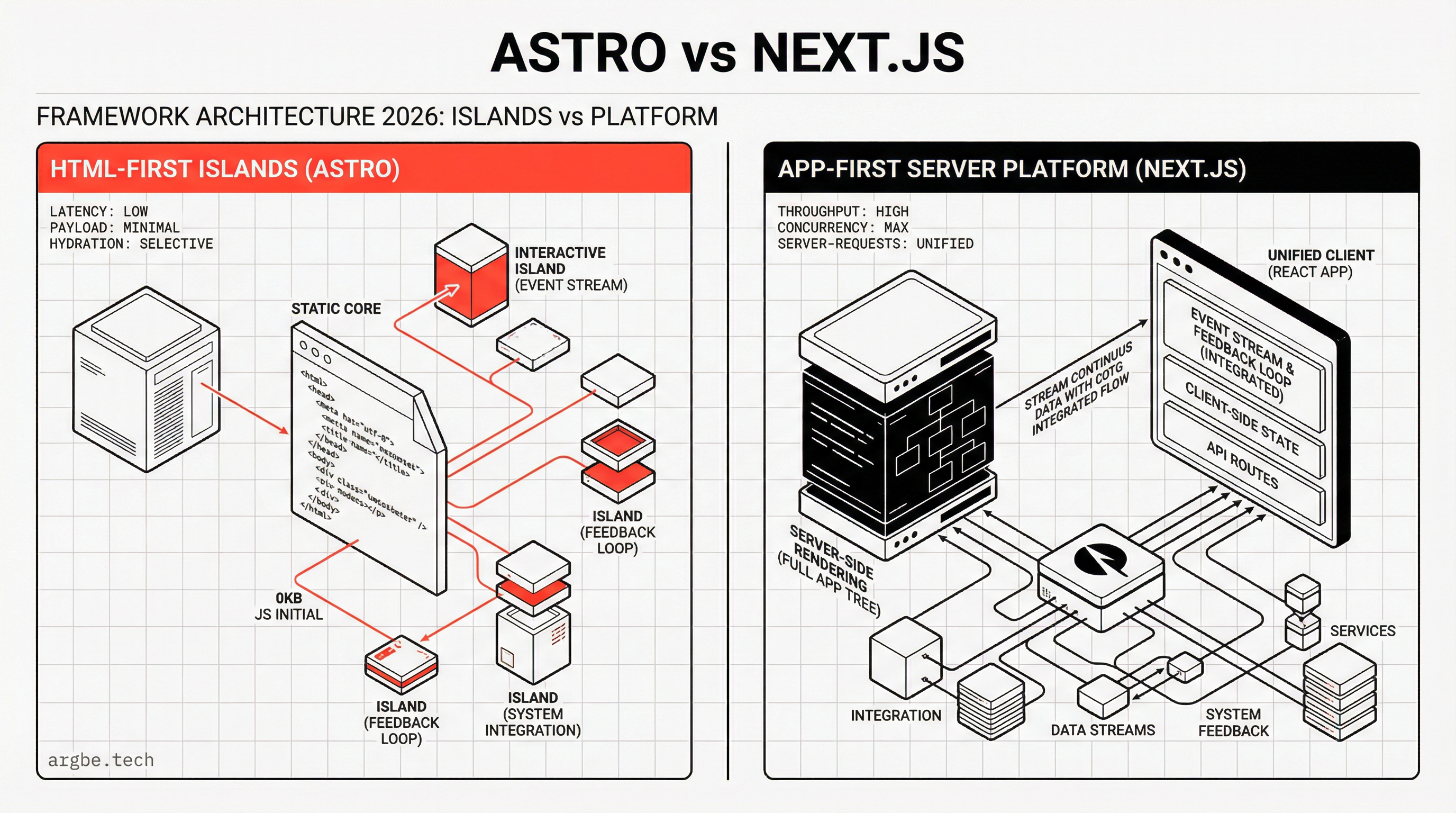
Astro vs Next.js is a framework choice between an HTML-first “islands” site architecture (Astro 5) and an app-first React platform (Next.js) where server rendering, routing, and data concerns are tightly integrated.
The Real Decision: Site Architecture vs Application Platform
When teams ask us “Astro or Next?”, they’re usually asking a different question: are we building a content-forward site that happens to have interactive parts, or are we building an interactive product that happens to have marketing pages?
In our experience, Astro 5 wins when the default output being static HTML is a feature, not a compromise. You get fast pages with minimal client-side JavaScript by design, and you can still drop in React 19 components (or Svelte 5 components) as islands where interactivity actually earns its keep.
Next.js wins when “the framework” is expected to be the application runtime: routing conventions, server rendering strategies, cache boundaries, and data fetching patterns become part of the product architecture. If your roadmap includes authenticated dashboards, heavy personalization, or complex server-driven UI, Next.js tends to reduce the number of separate decisions you need to make.
If you’re evaluating this in the context of intelligent platforms (apps that learn, adapt, and orchestrate work), the constraint is less about which framework is “faster” and more about where you want complexity to live. We cover the broader framing in What Are Intelligent Platforms? The Future of Web Apps.
Where Astro 5 Usually Outperforms (And Why)
Astro’s core bet is simple: most pages should ship as HTML, and most interaction should be optional. That single opinion has knock-on effects that are easy to underestimate until you’ve shipped a few iterations.
We’ve found Astro 5 especially strong for:
- High-traffic marketing + docs where performance budgets are strict and most pages are read, not “used”.
- Design-led sites where Tailwind CSS v4 and a component system need to stay consistent, but you don’t want a full SPA runtime on every route.
- Mixed-component stacks where you want React for one UI surface, Svelte 5 for another, and you’d rather not rewrite everything into one framework to publish content.
The underappreciated advantage is organizational: Astro lets teams treat “interactivity” as a conscious decision per component. That tends to keep feature work honest. If a page feels slow, you can literally point to what became client-side and why.
If your team is already moving toward Svelte 5 for product UI, it’s also worth sanity-checking whether you actually want SvelteKit as the primary app framework instead of either Astro or Next.js. SvelteKit can be the cleanest path when “the app” is the center of gravity and Svelte is non-negotiable. For recent Svelte ecosystem signals, see Building with Svelte News January 2026.
Where Next.js Usually Outperforms (And Why)
Next.js is at its best when you want React to be the lingua franca of the entire system: UI, routing, server rendering, and a lot of the deployment model.
In our experience, Next.js is the pragmatic choice when you need:
- A cohesive React 19 application stack with a single mental model for “page”, “layout”, and “server work”.
- Deep server rendering workflows (including React Server Components in the App Router) where you want the server to be an active participant in UI assembly.
- Complex data and caching behavior that you’d rather solve with established conventions than bespoke architecture.
The trade: you’re opting into a larger surface area. That’s not a criticism; it’s a cost model. Next.js reduces architecture decisions by making them for you. If your team benefits from that constraint, it’s a win. If your team is extremely performance-sensitive and happy making those decisions explicitly, it can feel heavy.
How This Maps to “Intelligent Platforms” in 2026
An intelligent platform isn’t a framework feature; it’s a system property. It usually includes event-driven data, an agent orchestration layer, and human-in-the-loop operations. Framework choice matters because it determines how you expose those capabilities to users and how safely you can evolve the product without rewriting the front end.
Here’s the pattern we see working:
- Use Astro 5 when you want content surfaces (guides, docs, product marketing, knowledge bases) that stay fast as you add “smart” modules: embedded search, copilots, calculators, and lightweight personalization islands.
- Use Next.js when your product is fundamentally an interactive system where the UI is assembled server-side with strong data guarantees and authentication flows across most routes.
If you’re deciding at the platform level (not just the website level), it helps to think in layers. The framework is only one layer in the stack. We break that down in The Intelligent Platform Stack (2026): Event-Driven Data, Agent Orchestration, and Human-in-the-Loop Operations and then go deeper on agent patterns in Agentic Intelligent Platforms: How AI Agents Turn Web Apps Into Self-Optimizing Systems (2026 Architecture Guide).
What we don’t recommend: picking Next.js because you think “apps need Next” or picking Astro because you think “sites need Astro.” We’ve seen both decisions produce avoidable rewrites. The better question is: where do we want state, rendering, and data boundaries to be enforced by defaults vs enforced by discipline?
Astro vs Next.js Comparison Table (2026)
| Dimension (2026) | Astro 5 | Next.js |
|---|---|---|
| Default output model | HTML-first pages with optional islands; tends to ship less JS by default | React app platform; server rendering and client interactivity are first-class across the app |
| Interactivity strategy | Add islands only where needed; can mix React 19 and Svelte 5 components | Build UI in React; interactivity is expected and pervasive |
| Routing & rendering mental model | File-based routing with an emphasis on pages and content; server rendering is available but not the “center” | App Router model with nested layouts; server rendering patterns (including React Server Components) shape architecture |
| Content + MDX workflows | Strong fit for content collections and docs-style sites; “content as a product surface” is natural | Works well, but content often lives inside a broader application stack and conventions |
| Multi-framework UI | Designed to host multiple frameworks side-by-side (React, Svelte, etc.) | Primarily React; other frameworks usually appear at the edges, not as peers |
| Styling approach | Tailwind CSS v4 fits cleanly for marketing + component islands; performance budgets are easier to defend | Tailwind CSS v4 works well; larger interactive surfaces can make bundle discipline a continuous effort |
| Best-fit product shape | Content-forward experiences with targeted “smart” widgets and conversion flows | Interactive products with deep authentication, personalization, and server-driven UI |
Next Steps
If you want a fast decision without guesswork, this is the checklist we use internally:
- Classify your routes: What percent are read-only content vs authenticated, stateful workflows?
- Declare your “JS budget”: How much client-side runtime are you willing to ship on your highest-traffic pages?
- Pick your primary UI runtime: Are you standardizing on React 19, Svelte 5, or mixing by surface area?
- Draw your data boundaries: Where do you need server-enforced guarantees (auth, caching, personalization)?
- Plan for the intelligent layer: Where will orchestration and agent interactions show up: content pages, product UI, or both?
If you want our step-by-step evaluation worksheet (the one we use to avoid framework rewrites), reach out and tell us what you’re building and what “fast” means for your users in 2026.