Agentic Intelligent Platforms: How AI Agents Turn Web Apps Into Self-Optimizing Systems (2026 Architecture Guide)
Agentic intelligent platforms pair a modern web stack with governed AI agents that can observe production signals, propose changes, and execute safe actions through audited tools. Done right, they reduce operational drag without turning your product into a black box.
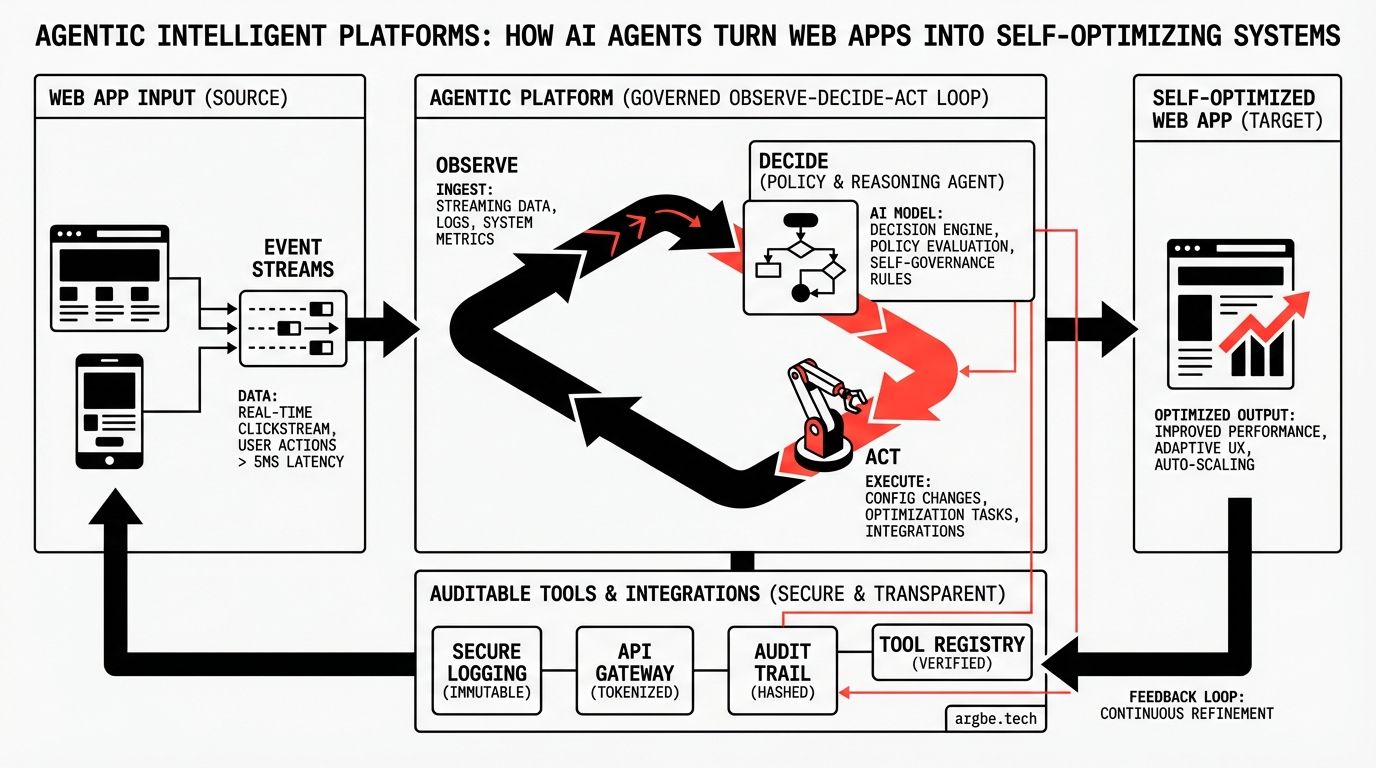
Agentic intelligent platforms are web applications designed with a controlled “sense → decide → act” loop, where AI agents can interpret real production signals and take bounded actions (or prepare changes for approval) to improve reliability, speed, and outcomes. They exist to make optimization continuous and auditable—so the system gets better from reality, not from guesswork.
Agentic vs. “AI-Enabled”: Autonomy With Controls
Most teams say they’re “building with agents” when they really mean they added a chat UI or an internal copilot. That’s not agentic behavior; it’s just an interface.
In our experience, a platform becomes agentic only when three things are true at the same time:
- The platform can observe itself. Not just logs and traces, but signals that map to user value: time-to-interactive, conversion drop-offs, failed checkouts, search “no results,” support spikes, and third-party latency.
- There’s a policy layer that can say “no.” Agents need constraints: budgets, blast-radius limits, approval rules, and explicit “never do this” boundaries.
- Actions are tool-based and auditable. An agent shouldn’t “do magic.” It should call tools you already trust—create a ticket, adjust a feature flag, roll back a release, update cache policy, open a PR—with a trail you can review.
If you’re building the broader foundation first, start with the pillar: What Are Intelligent Platforms? The Future of Web Apps. Agentic platforms are the same idea with an additional execution layer: agents that can operate inside guardrails.
The 2026 Architecture: Where Agents Fit (Without Breaking the Web)
We found the fastest way to ship “agentic” features safely is to treat the agent layer like production infrastructure, not like an app feature. Practically, that means separating where decisions are made from where UI is rendered.
Here’s a reference mental model we use across stacks like Astro 5, Next.js, SvelteKit, React 19, and Svelte 5:
- Delivery layer (the web app): Your SSR/SSG framework renders pages and UI. Astro 5 is strong when you want content + interactivity without paying a JavaScript tax everywhere. Next.js and React 19 are often the choice for app-first products with deep React ecosystem alignment. SvelteKit with Svelte 5 is a good fit when you want SSR-by-default ergonomics and a smaller surface area.
- Signal layer (what the system “sees”): Events and metrics that are named for outcomes. The platform’s intelligence is only as good as the map between telemetry and business intent.
- Policy layer (what’s allowed): Rules like “only change caching for routes with stable error rates,” “never touch checkout,” or “require approval for anything that changes pricing, copy, or routing.”
- Agent runtime (who reasons): The model that interprets signals, proposes a plan, and chooses tool calls. The nuance matters: we build AI agents using Claude and Gemini, then connect them to tools via MCP so actions are explicit and reviewable.
- Tool surface (how it acts): A narrow set of functions with input validation, permissions, and audit logs—feature flags, CMS updates, experimentation toggles, incident runbooks, and PR creation.
The biggest design mistake we see is letting the agent talk directly to production systems with a broad permission set. When the tool surface is too wide, “agentic” becomes “unpredictable.” When the tool surface is narrow and well-instrumented, agents become boring operators—which is exactly what you want.
For the fuller “stack view” (events, orchestration, and human-in-the-loop operations), this spoke pairs best with: The Intelligent Platform Stack (2026): Event-Driven Data, Agent Orchestration, and Human-in-the-Loop Operations.
Why Framework Choice Still Matters in an Agentic World
Agents don’t replace frontend fundamentals; they amplify them. If your platform is slow, fragile, or hard to refactor, agents will mostly create more work: more experiments to monitor, more rollbacks, and more customer-visible failures.
Three framework-level questions we ask before adding agentic behavior:
1) What’s your default rendering posture?
If the platform’s critical path is heavy, the agent loop will keep “discovering” the same performance problems. Astro 5 tends to make it easier to ship less JavaScript by default and keep interactivity scoped to islands. Next.js can be a strong choice when the product is a complex app with shared server/client boundaries. SvelteKit often sits between the two, with clean SSR ergonomics that pair well with Svelte 5 components.
If you’re deciding between the two most common paths, this is the deeper tradeoff breakdown: Astro vs Next.js: Choosing the Right Framework in 2026.
2) How fast can you change UI safely?
Agentic platforms run more experiments. That means more UI variance, more “small” copy changes, and more iterative layout tweaks. Tailwind CSS v4 becomes a compounding advantage here because it reduces CSS drift and keeps changes close to components. In our experience, teams that standardize design tokens and reusable primitives can run more controlled tests with fewer regressions.
3) Where does state live—and who can change it?
Agentic behavior pushes you to make state explicit: feature flags, pricing rules, caching policies, and content variants should be represented as data with permissions and rollbacks. If that sounds like “ops work,” it is. The payoff is that you can let agents operate on these primitives without giving them unsafe access to the rest of the system.
If you want a current snapshot of what’s changing in the Svelte ecosystem (because it affects how teams ship and hire), we keep a running update here: Building with Svelte News January 2026.
Data Anchor: Comparing Agentic Intelligent Platform Patterns
The table below compares common ways teams implement agentic intelligent platforms in 2026. The right choice depends less on model choice and more on where you want autonomy to live—and how tightly you can govern it.
| Pattern | Where the agent acts | What it’s good at | Primary risk | Best fit |
|---|---|---|---|---|
| Astro 5 + agent layer (content + islands) | CMS, routing rules, cache policy, experiments | Fast pages with selective interactivity; strong crawlability; agents can optimize content and delivery knobs without rewriting the app | Teams over-split islands and lose consistency; agents end up “fixing” structural issues that should be refactors | Content-heavy products that still need real interactivity and ongoing iteration |
| Next.js + React 19 (app-first agent ops) | Feature flags, server workflows, incident tools | Tight integration with app logic; good for authenticated workflows; agents can triage errors, propose fixes, and open PRs | Client weight creeps in; agents get asked to optimize symptoms (bundles, hydration) instead of fundamentals | SaaS apps where the app is the product and operational tooling is part of the roadmap |
| SvelteKit + Svelte 5 (SSR-by-default agent ops) | Server routes, experiments, UI variants | Small mental model; fast UI iteration; agents can monitor routes and tune rollouts with less framework overhead | Patterns vary by team without discipline; agent outcomes become hard to compare across releases | Teams that prioritize speed-to-change and want SSR without a heavy abstraction stack |
| Edge agent gateway (framework-agnostic) | Edge routing, caching, personalization rules, rate limits | Centralized control; agents can improve performance and resilience without touching UI code | Over-centralization: too much logic at the edge becomes hard to debug and test | Multi-app organizations that want a shared control plane across products |
| UI-only copilots (Tailwind CSS v4 + any framework) | Browser assistance, guided flows, support deflection | Helpful UX without deep system permissions; agents can explain, guide, and collect intent signals | Easy to confuse “helpful UI” with platform intelligence; limited ability to improve system behavior | Early-stage rollouts where trust and governance aren’t mature yet |
Next Steps
- Pick one outcome to optimize (speed, conversion, retention, support load) and define the signals that prove it.
- Design the tool surface before you add autonomy: narrow permissions, strong validation, and audit trails.
- Choose a foundation that matches your rendering reality (Astro 5, Next.js with React 19, or SvelteKit with Svelte 5), then add agents where they can operate safely.
- Use the stack guide to plan the full loop (events, orchestration, and human review): The Intelligent Platform Stack (2026): Event-Driven Data, Agent Orchestration, and Human-in-the-Loop Operations.