Technical SEO for Developers: Indexing, Rendering, Canonicals, Measurement
Organic traffic is an engineering outcome: indexing and canonical control, reliable rendering, and a measurement loop that connects deploys to Search Console signals and Core Web Vitals. This guide turns technical SEO into a defensible weekly backlog for developers.
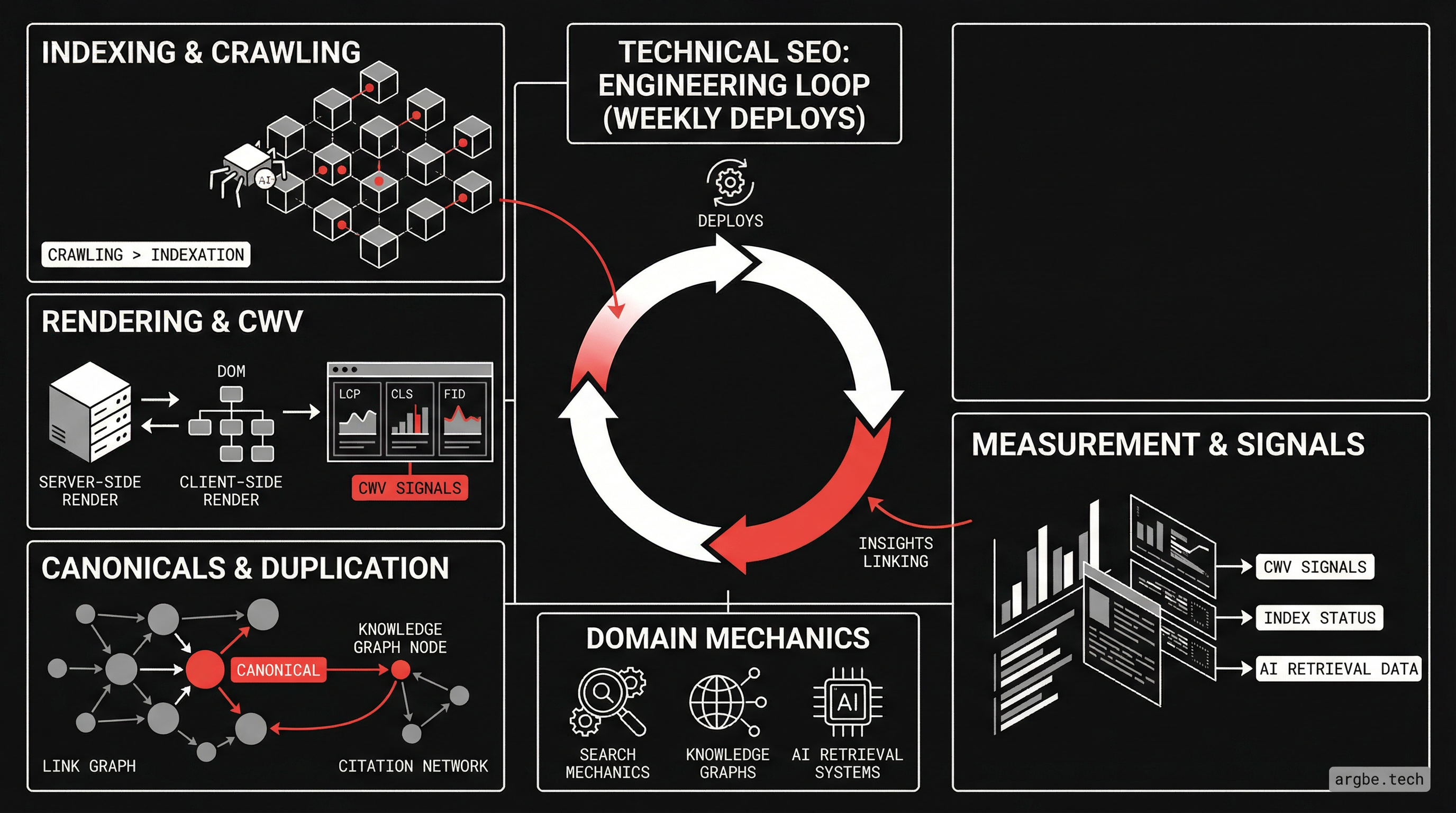
Direct Answer
Organic traffic is the qualified search demand that reaches your site because pages are discoverable, crawlable, renderable, and indexable—and because the content matches intent well enough to earn a click. For developers, this is technical SEO: indexing eligibility, canonical selection, rendering strategy (SSR/CSR), and measurement via Search Console and Core Web Vitals so you can debug failures and ship changes that compound.
Series Navigation (GEO cluster context)
This guide sits inside our Generative Engine Optimization (GEO) cluster, but the spine is technical SEO and indexability engineering. GEO is a layer: once your pages can be reliably discovered, rendered, and indexed, you can design content units that are easy to cite without collapsing the click into the answer.
If you’re new to the frame, start with What is Generative Engine Optimization (GEO)?. If you already ship weekly, use this article as a technical spoke and then follow the internal links when you’re ready to implement deeper patterns.
Organic traffic as an engineering system (not a marketing KPI)
Most marketing teams talk about organic traffic as an outcome. Developers have to treat it as a pipeline with failure modes.
Here’s the pipeline you can debug:
- Discovery: can a system find your URLs at all (links, sitemaps, and crawl paths).
- Crawl: can it fetch your pages efficiently without wasting crawl budget.
- Render: does the content exist in the HTML you serve, or does it depend on fragile client execution.
- Index: is the page eligible and selected as canonical, or silently excluded.
- Rank: does the page satisfy intent and earn enough trust signals to compete.
- Click: does the snippet promise match the page, so the visit is qualified.
One concrete failure per stage (so it feels real)
- Discovery: a new template launches, but pages aren’t linked from any hub and the sitemap only includes old routes—so the URLs never get found.
- Crawl: a redirect chain (HTTP → HTTPS → locale → canonical) turns a single fetch into 4 hops and intermittently 5xx’s at the origin—so bots back off.
- Render: a CSR route returns a 200 with an empty shell, and the critical data request fails for Googlebot due to blocked cookies/CORS—so rendered HTML is missing the actual content.
- Index: the canonical points to a parameterized URL or staging hostname, so the intended page is treated as a duplicate and excluded.
- Rank: two “same intent” pages cannibalize each other (similar titles, overlapping headings), so neither earns stable impressions.
- Click: your title tag promises a checklist, but the page leads with a sales pitch—CTR drops even if rank stays flat.
Two distinctions matter if you own routing and caching in production:
- Crawlable ≠ indexable. A URL can return a 200 and still be blocked by directives or canonical selection.
- Indexable ≠ ranked. Eligible pages can still lose to better intent matches or stronger entity clarity.
Rendering is the most common “developer-shaped” failure mode. JavaScript can be indexed, but rendering is often deferred and more failure-prone than a plain HTML response. SSR or pre-rendering reduces crawler dependency for primary content and links; CSR increases the number of moving parts that must work for content to exist. That trade-off is not moral; it’s operational: you’re choosing where complexity lives (server vs client) and who pays it (crawler vs user). 2
The other failure mode developers underestimate is duplication.
You can ship more pages and still lose traffic when your entity graph gets noisy: multiple URLs compete for the same intent, canonicals drift, and internal linking stops concentrating meaning. In many cases, “publish more” is the fastest way to manufacture a site-wide quality ceiling.
Treat organic traffic as a system you can reason about:
The point is not to chase perfect dashboards. The point is to ship a small number of changes that remove the highest-leverage constraints first, and to measure outcomes in a way that survives uncertainty.
The high-signal technical levers (what actually moves the needle)
The fastest way to stop cargo-culting audits is to map engineering work to observable search signals. The table below is intentionally “backlog-shaped”: it tells you what lever exists, what signal changes, how you measure it, and what can go wrong.
The time-to-impact column is not a promise. Search systems have lag, and the same change can land fast on high-demand pages and slowly on long-tail docs. Use the horizon to set expectations and pick the right monitoring window.
Developer Levers That Drive Organic Traffic (Signal → Tool → Time-to-Impact)
| lever | primarySignal | howToMeasure | expectedTimeToImpact | riskIfWrong |
|---|---|---|---|---|
| Canonical stabilization (one URL per intent) | Canonical selection consistency | Search Console: “Duplicate” + selected canonical | Days → weeks | Deindexing the wrong page; traffic shifts to an inferior URL |
| Redirect hygiene (301 vs 302, chain removal) | Crawl efficiency + consolidation | Server logs + crawl stats | Days → weeks | Loops or chains that waste crawl budget and break equity |
| SSR for primary content paths | Render completeness | URL inspection render + HTML diff | Days → weeks | Higher server cost; inconsistent markup vs hydration |
| Robots and meta directives sanity | Index eligibility | Index coverage + live fetch | Hours → days | Accidental noindex that caps the whole site |
| Sitemap curation (only canonical, indexable URLs) | Discovery quality | Submitted vs indexed deltas | Days → weeks | Feeding junk URLs that lower crawl focus |
| Internal linking rules (hub ↔ spoke) | Page discovery + meaning flow | Crawl graph + orphan count | Weeks | Over-linking that harms UX; link dilution |
| Structured data that matches visible content | Entity disambiguation | Rich results reports + schema validation | Days → weeks | Schema spam signals; manual cleanup work |
| CWV bottleneck fixes (INP/LCP/CLS by root cause) | UX + rendering stability | Field + lab delta by metric | Weeks → months | Chasing score, not bottleneck; regressions after deploy |
Notice what is missing: “add keywords,” “write longer,” “get more backlinks.” Those can matter, but for senior engineers they’re rarely the first constraint.
If you own the stack, the most repeatable wins tend to come from eliminating eligibility caps (robots, canonicals, rendering) and then making content architecture more citable so answer engines can quote it without replacing the click. 3
Indexability first: the debugging sequence developers should memorize
When organic traffic stalls, teams often jump to content rewriting or performance work. That’s backwards: if pages aren’t indexable, your best content can’t compound.
This checklist is ordered by blast radius and probability. You do not need a 200-point audit. You need a small number of checks that catch the most expensive mistakes first.
If traffic stalls: 3 checks in 10 minutes
- Site-wide directives sanity: spot-check
robots.txt, meta robots, and canonical tags on key templates (home, product/solution, blog, docs). One accidentalnoindexor drifting canonical can cap the entire site. - URL Inspection (top pages): in Search Console, compare rendered HTML to what you expect to be indexable (main content, headings, internal links). If the rendered view is missing content, fix rendering before anything else.
- Logs (Googlebot reality check): confirm Googlebot is hitting the pages you care about, returning the right status codes, and not getting stuck in redirect chains or 5xx bursts.
Indexability & Crawl Debug Checklist (Highest-Signal Order)
| check | where | passCriteria | blastRadius | fixType |
|---|---|---|---|---|
robots.txt allows key routes | origin + edge | no accidental disallow on money/docs paths | Site-wide | Config change |
| Meta robots is not blocking | HTML head | no noindex / nofollow on intended pages | Section or site-wide | Template fix |
| Canonical URL points to intent owner | HTML head | canonical is stable and matches preferred URL | Site-wide | Template + routing |
| HTTP status codes are correct | edge/origin | 200 for live, 301 for moved, 302 only when truly temporary, 404/410 for removed, no unintended 500s | Site-wide | Routing + redirects |
| sitemap.xml contains only canonicals | sitemap | only indexable, 200, canonical URLs included | Site-wide | Generator fix |
| Rendering completeness for key pages | server output | primary content exists without client execution | High-intent pages | Rendering strategy |
| Soft 404 patterns are eliminated | content + response | no thin/empty states returning 200 | Site-wide | Template + data validation |
| hreflang is consistent (if i18n) | HTML head | bidirectional, correct locale mapping | Locale group | i18n config |
| Parameter/facet URLs are controlled | routing | non-indexable variants don’t multiply | Site-wide | Routing + canonical policy |
| Internal links don’t point to non-canonicals | templates | nav and in-body links hit canonical URLs | Site-wide | Content + template |
SEO checklists often get framed as “technical hygiene.” For developers, this is availability engineering: any one of these failures can quietly cap organic traffic even when the writing is strong.
Here’s the investigation sequence you should keep in muscle memory (details omitted; order visible):
{
	"debugOrder": [
		"Eligibility: directives (robots + meta)",
		"Canonical selection: one intent → one URL",
		"Status codes + redirects: no chains, no loops",
		"Discovery: sitemap quality, internal links, orphans",
		"Rendering: SSR/CSR completeness, soft 404 patterns",
		"Localization: hreflang consistency (if applicable)"
	],
	"note": "Exact command checklist intentionally omitted; use this as the order-of-operations, not a copy/paste runbook."
}
Two high-risk anti-patterns to call out:
- SPA-first marketing sites with fragile renders. You can get a 200 while serving an empty shell to non-executing fetchers.
- Infinite faceted URLs. It feels like “more pages,” but it often becomes crawl waste plus duplication.
If you want a single mental model: treat indexability as a contract. Make it boring, stable, and testable, and the rest of your organic traffic work becomes compounding instead of reactive.
Performance signals without cargo culting (Core Web Vitals for builders)
Core Web Vitals are not a vanity scoreboard; they are a constraint system. In many cases, fixing the right bottleneck improves user experience and reduces failure probability across the render path.
Use PageSpeed Insights as a sanity check for “what users see” vs “what your lab run shows,” especially when you’re validating whether a change is worth rolling out broadly. 8
Treat each metric as a symptom:
- LCP: content delivery bottleneck (server response, image delivery, render-blocking work).
- INP: interactivity bottleneck (main-thread contention, hydration cost, long tasks).
- CLS: layout stability bottleneck (late-loading resources, unbounded components).
The common trap is optimizing for a single synthetic score. Lighthouse is useful for repeatable lab testing, but lab improvements that don’t change field behavior rarely move business outcomes. 4
Prioritize performance like an engineer:
- Identify which metric is failing in the real world.
- Classify the bottleneck category (delivery, JS cost, layout).
- Ship one change that reduces the dominant bottleneck.
The step-by-step profiling workflow and acceptance thresholds are intentionally kept out of this public guide, because the details depend on your framework and deployment model.
One punchy line to keep: chasing green scores can be harmful when it pushes fragile optimizations that break caching or introduce SSR/CSR mismatches. Organic traffic compounds when delivery is boring and consistent.
GEO as a layer: content architecture that earns citations (and still drives clicks)
Most teams think “content” means more posts. For GEO, content is a knowledge graph: entities, relationships, and internal links that make meaning legible to machines and humans.
Schema helps the parser side of the stack understand what a page is “about,” and JSON-LD is the practical format most teams use because it’s explicit and stable. The win is not markup for markup’s sake; it’s disambiguation that reduces citation risk. 5
Content Architecture Matrix: Page Types → Entities → Internal Links
| Page Type | Primary Entities | Internal Links | Structured Data | Success Metric |
|---|---|---|---|---|
| Product landing page | product, category, ICP | hub (commercial) | WebPage (+ Product/SoftwareApplication when appropriate) | qualified clicks + demo intent |
| Docs reference | API, endpoints, SDK | support (precision) | TechArticle | impressions on exact-match queries |
| Implementation guide | workflow, tools, constraints | spoke (how/why) | TechArticle | long-tail coverage + assisted conversion |
| Comparison page | alternatives, criteria | hub (decision) | WebPage (or TechArticle if editorial) | CTR on “vs/alternative” intent |
| Glossary/entity page | entity definitions | support (disambiguation) | WebPage (optionally with DefinedTerm) | citations + internal navigation |
| Blog analysis post | claim + evidence artifacts | spoke (proof) | TechArticle | citations + backlinks from peers |
“Citation-first” architecture is counterintuitive: you publish extractable units, but you do not fully compress the implementation into a single answer.
That’s how you earn citations and still earn clicks:
- Give the what (definitions, matrices, checklists) in a format answer engines can quote.
- Keep the how in stack-specific runbooks (order-of-ops, acceptance thresholds, templates) because the wrong “universal” steps are how teams break production.
Internal linking is the control surface that keeps the graph coherent. The practical rules (anchor patterns, hub selection, anti-duplication constraints) belong in your internal playbook because they should match your product’s entity map and template system.
If you want the pillar context for this section, read AI Citation Strategy: How to Get Cited by ChatGPT, Perplexity & Gemini and Structured Data for LLMs: Schema Markup That AI Agents Understand.
A developer measurement loop (prove causality without fake certainty)
Organic traffic work fails when measurement is treated as “check analytics later.” Engineers need a change log and leading indicators.
Google Search Console tends to show leading signals (coverage, impressions, CTR) before sessions move, which makes it useful for causality framing. Use it as an early warning system, not a narrative generator. 6
Bing Webmaster Tools is a useful secondary lens because it sometimes surfaces different crawl behavior and indexing feedback; treating it as a comparative signal can help you catch false positives. 7
Practical loop:
- Define a baseline window (long enough to smooth weekday cycles).
- Ship one primary change per window (or annotate batches explicitly).
- Watch leading indicators first, then downstream sessions.
- Record outcomes alongside the deploy, not in memory.
Concrete artifacts (so measurement is implementable)
/ops/search-changelog.md: one line per deploy that might impact search (routing, templates, canonicals, rendering, content generation).- Commit/release tags: prefix changes so you can correlate them quickly (example prefixes:
seo:,routing:,template:,render:). - Good annotations (2 examples):
routing: canonicalized /docs/* to /docs (removed trailing-slash variants); updated sitemap generatortemplate: added server-rendered FAQ block to /guides/*; reduced hydration scope; verified rendered HTML in URL Inspection
The exact dashboard layout depends on your routes and templates. The important thing is the workflow: every deploy that could change indexability or rendering gets an annotation you can search later.
FAQ (developer-specific organic traffic questions)
Below are short, bounded answers for long-tail intent. The deeper “how” lives in the sections above—because implementation details are where mistakes get expensive.
1) When should a marketing site use SSR instead of CSR?
Prefer SSR or pre-rendering for index-critical content so bots and users get the same primary HTML. CSR can still be indexed, but treat it as an extra dependency: if scripts, data, or hydration fail, your content may render incompletely for crawlers. Hybrid patterns (SSR + selective hydration) are often the most reliable.
2) What is the fastest way to diagnose an organic traffic stall?
Start with eligibility and canonical control, then rendering, then performance, then content architecture. Downstream fixes can’t compensate for upstream caps.
3) How do you handle faceted navigation without creating infinite URLs?
Decide which facet combinations are allowed to be indexable, and treat everything else as non-indexable variants. Keep canonical URLs and internal links aligned to the curated set.
4) Does schema help AI answers cite your page?
Often, yes—when the markup matches what users can see and clarifies entities. Avoid schema spam; you’re reducing ambiguity, not trying to trick a system.
5) Will improving Core Web Vitals increase rankings?
Sometimes, especially when you remove a real UX constraint that was dragging performance. Treat improvements as hypothesis-driven and measurable, not guaranteed.
6) How do you avoid duplicate content when you ship programmatic pages?
Enforce uniqueness thresholds, keep canonicals stable, and do not index pages that can’t stand as the intent owner.
7) What is E-E-A-T in developer content?
It’s the trust signal users infer from specificity and evidence: clear ownership, stable claims, and artifacts that make your assertions verifiable.
Next steps: the 7-day engineering backlog for organic traffic
This is a shipping plan, not a theory post. Each day is a small set of moves that tends to reduce risk and increase compounding potential.
Day 1–2: indexability + coverage triage
Prioritize eligibility caps: directives, canonicals, status codes, and sitemap curation. Fix the highest blast radius issues first, even if it feels “unsexy.”
Day 3–4: performance bottleneck selection
Pick one bottleneck category and ship one change you can measure. Treat performance as a reliability upgrade, not a scoreboard.
Day 5–7: entity + internal linking upgrades
Map your core entities to page types, then strengthen hub ↔ spoke internal linking without creating duplicates. Publish one extractable table or checklist per key template so answer engines can cite you safely—then keep the deeper, stack-specific runbooks in an internal playbook.
If you want help implementing this in your stack, we run GEO engagements that ship like engineering work:
- Pricing model: Fixed weekly rate Fixed weekly rate
Continue the cluster:
- What is Generative Engine Optimization (GEO)?
- AI Citation Strategy: How to Get Cited by ChatGPT, Perplexity & Gemini
- Structured Data for LLMs: Schema Markup That AI Agents Understand
- Entity Density in SEO: Building Knowledge Graphs for Search
- Generative Engine Optimization (GEO) for Intelligent Platforms: Making Your Product Discoverable to AI Answer Engines