AI Citation Strategy: How to Get Cited by ChatGPT, Perplexity & Gemini
An AI citation strategy turns your best claims into extractable, verifiable units that ChatGPT, Perplexity, Gemini, and Google can quote with confidence instead of paraphrasing from weaker sources.
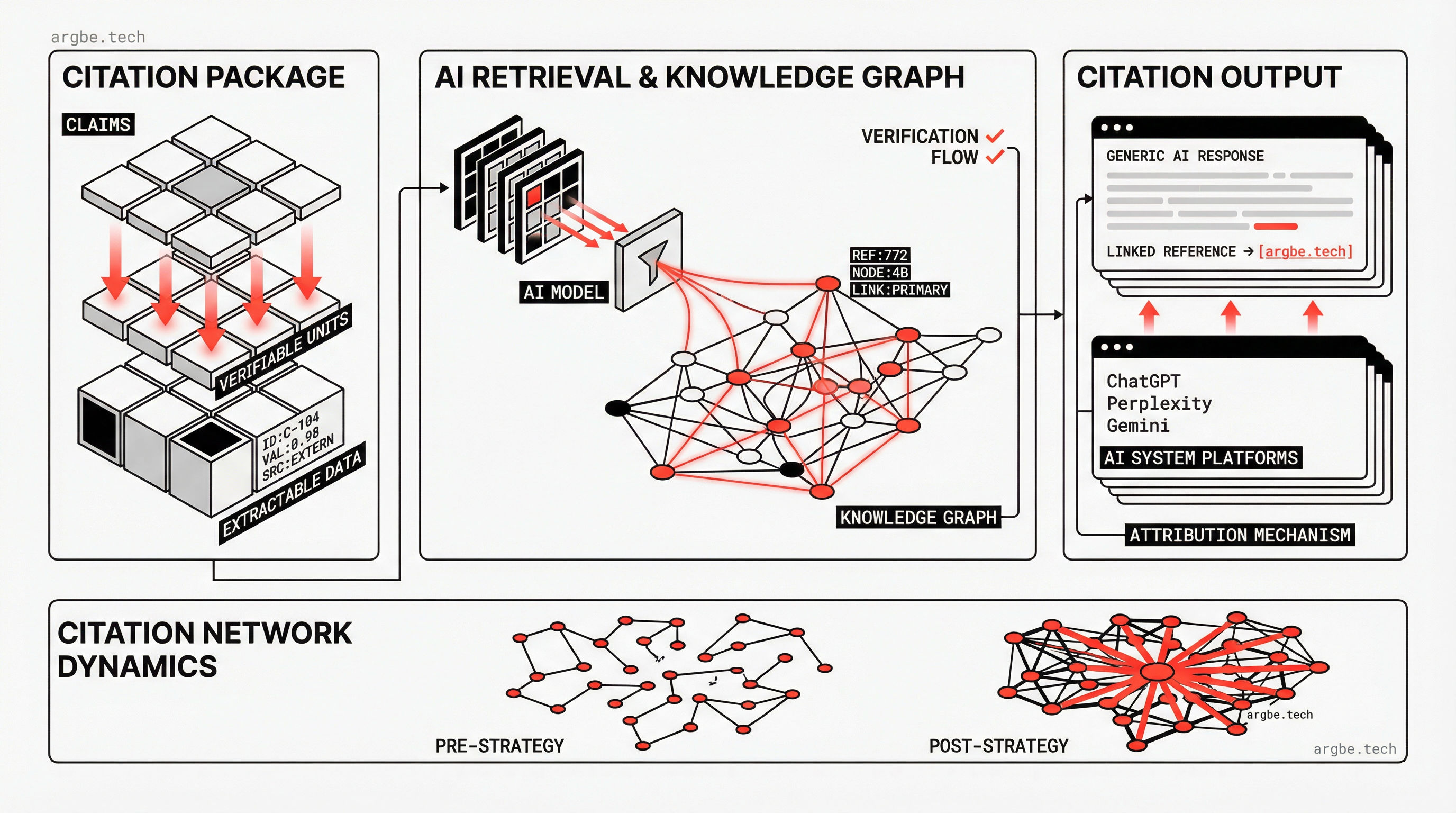
AI citation strategy is the practice of structuring and evidencing your content so systems like ChatGPT, Perplexity, Gemini, and Google can reliably extract specific claims and attach your URL as the source. It exists because “ranking” and “being cited” are not the same outcome: citations go to pages that are easy to quote and hard to misquote.
What “Being Cited” Means (And Why It’s a Different Game)
In classic SEO, you win by earning a click after a query. In Generative Engine Optimization (GEO), you also win when the answer itself includes your brand as the reference. That’s why we treat citations as a distribution channel, not a vanity metric. If you’re new to the concept, start with What is Generative Engine Optimization (GEO)?.
Here’s the uncomfortable part: citations usually go to the page that lowers the model’s risk. A model can only cite what it can (a) pull out cleanly and (b) defend with nearby context. When the content is ambiguous, the system will either skip you or quote you incorrectly and then “hedge” the answer with language that weakens your authority.
We see this most clearly in Perplexity, because it externalizes the retrieval step with visible citations. ChatGPT and Gemini can behave similarly when they browse or retrieve, but the UI doesn’t always make the sourcing obvious. Claude often produces strong synthesis even without explicit citations, which makes extractability and internal coherence matter more than “keyword coverage.”
The Citation Stack: Parser, Reasoner, Retrieval
When you design for citations, you’re writing for more than one judge:
- The parser prefers deterministic structure. Google’s systems and Gemini’s browsing flows reward pages that make entities and relationships explicit.
- The reasoner rewards nuance. Claude is less tolerant of listicles that feel engineered for robots rather than humans.
- The retrieval layer rewards low-friction evidence. Perplexity is ruthless about “show me the source,” and that mentality is leaking into every assistant experience.
In practice, our job is to make the same page readable in three modes: scanned by a parser, reasoned over by a model, and verified by a human who clicks through.
This is also why we build AI agents using Claude and Gemini, then connect them to tools via MCP: the same discipline that makes an agent reliable (clear inputs, stable outputs, auditable evidence) makes content cite-worthy.
What Models Cite: The Citable Unit Pattern
Most pages don’t get cited because they don’t contain “units” that a model can safely lift. In our experience, the highest-yield citable units look like this:
- Definition blocks (term → definition → why it matters).
- Comparisons (A vs B with a small set of criteria).
- Checklists with concrete steps and constraints.
- Numbers with context (dates, ranges, counts) tied to a named source or artifact.
- Entity-rich claims that resolve ambiguity (who/what/where) without bloating the prose.
If you want citations, stop hiding the answer inside paragraphs that require interpretation. Put it where retrieval systems can grab it quickly, then earn the click by offering the deeper setup and measurement.
Two related tactics matter more than most teams expect:
- Structured data helps the parser side of the stack. See Structured Data for LLMs: Schema Markup That AI Agents Understand.
- Entity density helps the disambiguation side. See Entity Density in SEO: Building Knowledge Graphs for Search.
Optimize For Citation, Not Replacement
If your page fully replaces the need to click, you might still “win” the impression, but you lose the relationship. We optimize for a different exchange:
- Give the what clearly (a definition, a table, a measurable claim) so the model has something safe to cite.
- Keep the how partially gated (implementation details, templates, exact QA checks, measurement queries) so the reader has a reason to visit the source.
We found that the best-performing pages feel generous in the open, but opinionated about what they won’t compress into a single answer. That restraint is not stinginess; it’s how you protect accuracy and conversion.
Implementation Checklist (Effort vs Impact)
| Step | What You Publish (Citable) | Effort | Impact |
|---|---|---|---|
| Write a 2–3 sentence definition block at the top | Term + definition + purpose in plain language | Low | 5/5 |
| Add a comparison table | Criteria that forces clear “A vs B” distinctions | Low | 4/5 |
| Turn key claims into named entities | Company, product, model names, standards, locations | Medium | 4/5 |
| Attach evidence artifacts near claims | Links to docs, policies, benchmarks, changelogs, data | Medium | 5/5 |
| Make URLs stable and canonical | One claim location, one canonical URL, no duplicates | Low | 4/5 |
| Add schema where it clarifies meaning | FAQ/HowTo/Product/Organization where applicable | Medium | 3/5 |
| Create a “quote-ready” section per money page | Short blocks with headings models can reference | Medium | 4/5 |
| Instrument citation tracking | Query logs + assistant tests + page-level change notes | High | 5/5 |
Next Steps
- Pick 3–5 pages that already attract qualified traffic, and rewrite the top section into a definition block plus one comparison table.
- Identify your “must-not-drift” claims (pricing model, scope, compliance, regions served) and attach evidence artifacts beside them.
- Run the same question through Perplexity, ChatGPT, Gemini, and Claude and compare what they quote, what they omit, and what they get wrong.
- If you want the exact evaluation prompts and QA checks we use to validate citations at scale, we can share the workflow as part of a GEO engagement.