SEO power words for copywriting (2026): proof-led headlines that hold up when quoted
SEO power words and copywriting in 2026 isn’t about “high-converting adjectives.” It’s proof-led persuasion: intent-matching language paired with constraints, explicit entities, and verifiable artifacts, so readers trust the promise and anyone who quotes it, person or machine, repeats something true.
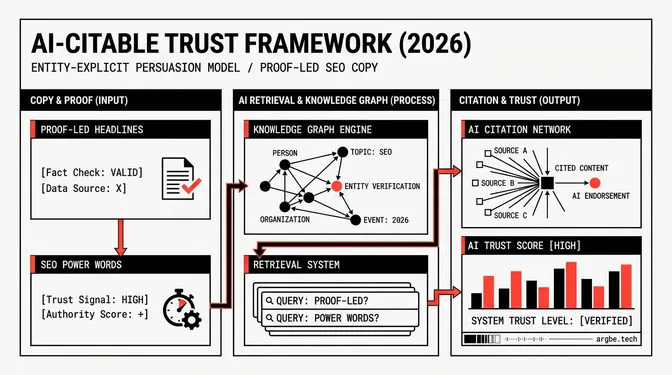
In words: start from what the reader is trying to do, choose a word that signals it, bound it with a constraint, back it with a proof artifact, and package the result as a unit someone can quote without distorting it.
What “Power Words” Actually Are (and Why Most Lists Fail)
“Power words” aren’t magic conversion triggers. They’re intent markers (“compare,” “avoid,” “pricing”) plus emotional accelerants (“confident,” “safe,” “proven”) that help a scanning reader decide whether a section is worth attention. Readers do scan: Nielsen Norman Group’s eye-tracking work recommends putting the most important points first and starting headings with the most informative words (NN/g: F-shaped pattern of reading on the web, accessed 2026-10-18)1.
Most lists fail because they treat persuasion as decoration. In B2B, decoration reads like risk. The moment a headline feels like “marketing,” it invites skepticism, and skepticism kills the one thing organic growth depends on: trust that survives the click.
That’s why the classic copy frameworks (AIDA, and PAS: Problem-Agitate-Solution) still matter, but differently. The “Attention” and “Agitate” parts can’t run on exaggeration; they have to run on clarity. Your strongest copy makes the promise legible, not loud.
There’s a machine-side reason too, and it’s reasoning rather than a measured engine behavior: a bounded definition is easier to quote accurately than a vague “ultimate guide” intro. Google, for its part, says you can’t mark a page up to become a featured snippet; its systems decide which pages make good ones (Google: featured snippets, accessed 2026-10-18)2. Clear, self-contained passages are the part you control.
Use this mental model:
- Power = the word that makes the reader lean in.
- Proof = the detail that makes the reader (and a summarizer) believe you.
If you only ship power, you’re doing conversion cosplay.
The Cite-Safe Rule: Every Strong Word Needs a Constraint
If you want copy that survives being quoted, use one rule:
Every strong word must be bound by a constraint the reader can verify.
That means “faster” becomes “faster for X workflow,” “proven” becomes “proven in Y context,” and “step-by-step” becomes “step-by-step from A to B, using C inputs.”
Our reasoning for why this matters with AI answers: a system summarizing your page has to decide what to repeat. A broad promise can only be repeated as an overclaim or hedged into mush; a scoped claim can be repeated as written. We haven’t measured how any particular engine treats the two, so treat this as the logic behind the rule, not a documented ranking behavior.
A few examples:
-
Unsafe:
The best onboarding emails. -
Safer: “Onboarding emails for trial-to-paid in product-led SaaS (with lifecycle stage definitions).”
-
Unsafe:
Guaranteed conversion lift. -
Safer: “Conversion lift you can measure: baseline → change → holdout window (no guarantee implied).”
-
Unsafe:
Instant results. -
Safer: “Faster time-to-first-value for teams that already have X in place.”
There’s a legal edge to this too. In the US, the FTC expects advertisers to have a reasonable basis for objective claims before they run, and at least the level of support a claim like “tests prove” implies (FTC Policy Statement Regarding Advertising Substantiation, accessed 2026-10-18)11. “Guaranteed conversion lift” is exactly the kind of claim that needs that basis.
If you want your page to be quotable, you don’t need fewer strong words. You need stronger boundaries.
The Rewrite Recipe: Power → Constraint → Proof (Five Steps)
Use this as a repeatable workflow for titles, subheads, intros, CTAs, and meta descriptions.
- Pick the intent: compare / implement / reduce risk / validate / decide.
- Choose one power verb that matches the intent (compare, avoid, checklist, step-by-step).
- Add one constraint: who it’s for, when it applies, prerequisites, or boundary conditions.
- Attach one proof artifact near the claim: example, policy, benchmark, screenshot, or explicit mechanism (“by doing X with Y inputs”).
- Rewrite the first two lines so the reader sees intent, scope, and proof without scrolling.
Before → After examples
-
Before:
The best onboarding emails.
After: “Onboarding emails for trial-to-paid PLG SaaS: lifecycle stages + examples + measurement window.” -
Before:
Guaranteed conversion lift.
After: “Measurable lift framework: baseline → change → holdout window (no guarantee implied).” -
Before:
Instant results.
After: “Faster time-to-first-value for teams with X already in place (what’s automated vs manual).”
Worked Example: A Checked Rewrite on This Site
Own-site work, done on 2026-10-18. One of our own articles had exactly the problem this guide describes.
Before. Title: “The Freshness Moat: How to Force AI Search to Notice Your Updates.” Excerpt: “…to guarantee AI engines index your latest updates fast.”
Running the recipe:
- Intent: validate. The reader wants to know whether an update was picked up.
- Power verb: “tell whether,” a validation verb, replaces “force.”
- Constraint: “crawlers” and “fetched” replace “AI search” and “notice.” A fetch is the thing a site owner can observe in their own logs; indexing and AI answers are not.
- Proof artifact: the promise had to survive the primary sources. IndexNow’s own FAQ says submitting a URL “does not guarantee immediate indexing” (IndexNow FAQ, accessed 2026-10-18)3, and Google uses a sitemap’s
lastmodonly when it is consistently and verifiably accurate (Google: build and submit a sitemap, accessed 2026-10-18)4. Nothing documented lets a site “force” or “guarantee” anything, so the old title made a promise the article couldn’t keep. The new one promises a measurement, and the article delivers it as a runnable script. - First two lines: the excerpt now says what the reader gets (a way to see whether crawlers re-fetched an update) instead of an outcome nobody controls.
After. Title: “The Freshness Moat: How to Tell Whether Crawlers Fetched Your Updates.”
What the rewrite gave up: “Force AI Search” is a stronger hook. We traded some click appeal for a promise the page keeps. That trade is the whole point of this guide.
Honest CTR limits
Can we measure whether the new title gets more clicks? Not at this site’s volume, and it’s worth seeing why.
Search Console counts an impression each time your site appears in results and computes CTR as clicks divided by impressions (Search Console Help: Performance report, accessed 2026-10-18)5. For the freshness article, the property recorded 24 impressions and 0 clicks between 2025-06-05 and 2026-10-15 (final data, both URL variants combined, queried 2026-10-18). With zero clicks in 24 impressions, the exact one-sided 95% upper bound on the true CTR is 1 − 0.05^(1/24), about 11.7% (Clopper and Pearson, Biometrika, 1934)6; the quick “rule of three” approximation, 3/n, gives 12.5% (Hanley and Lippman-Hand, JAMA, 1983)7. In plain terms: the data can’t tell a title that nobody clicks from one that one searcher in ten clicks. This guide’s own page is in the same position: 85 impressions, 0 clicks, at an average position around 44 over the same window.
So the rule is: check the impression count before you run a title test. If a page can’t accumulate enough impressions to tell plausible CTRs apart within a few months, judge the rewrite on accuracy and on qualified inquiries from the page, not on CTR.
Data Anchor: Power Words vs Proof Words (Matrix)
A search result is not just “good copy.” It’s a set of extractable units: definitions, lists, comparisons, and tight rules.
Use the matrix below as a taxonomy. Pick the intent category from what the reader is trying to do (decide, compare, avoid risk, implement, or validate). Then meet the proof requirement before you keep the power word.
To apply it across a page, score each strong word on three questions: is the constraint stated, is a proof artifact within one screen of the claim, and is the mechanism explicit? A word that fails any of the three gets a constraint, a proof, or the delete key.
Power Words vs Proof Words (Cite-Safe Copy Matrix)
| intentCategory | powerWords | riskSignal | proofRequirement | citeSafeAlternatives | bestPlacement |
|---|---|---|---|---|---|
| Compare (decision) | compare, vs, alternative, shortlist | “best/top” without criteria | Named criteria + evaluation frame (who/what/constraints) | “compare by X criteria,” “trade-offs for Y team size” | H2/H3, intro line above a table |
| Reduce risk (skeptic) | avoid, prevent, de-risk, compliant | fear-heavy phrasing without scope | Scope of risk + boundary conditions + what you do/not do | “risk factors,” “when this fails,” “limits and assumptions” | Subheads, FAQ answers |
| Prove credibility (trust) | proven, validated, trusted | unverifiable social proof | Evidence artifact (case excerpt, benchmark, policy, screenshot) | “documented,” “measured,” “evidenced with artifacts” | Near proof block, not in H1 |
| Implement (job-to-be-done) | step-by-step, checklist, template | “ultimate” + no prerequisites | Inputs, prerequisites, and output definition | “sequence,” “setup → execution,” “copy-ready checklist” | H2/H3, CTA for download/audit |
| Save time (efficiency) | faster, simple, streamlined | “instant” or “effortless” | Time boundary + what is automated vs manual | “lower-friction,” “fewer steps,” “shorter cycle (in X stage)” | Meta description, CTA microcopy |
Where Power Words Belong: Titles, Subheads, CTAs, and Meta
The failure to watch for is putting the power word where the scope should go. “Best” becomes the headline, and the audience becomes a buried afterthought.
Flip it:
- Title and H1: scope first, power second. Define who it’s for and what it covers, then add the intent marker. Google builds title links mainly from your
<title>element but can also use the main heading,og:title, and other prominent text, and it asks for descriptive, concise titles without keyword stuffing or boilerplate (Google: title links, accessed 2026-10-18)8. A title whose promise matches the H1 gives Google consistent material to work with. - Subheads: use risk-reduction and specificity words that help scanners find the right section quickly. Start with the most informative words.
- CTAs: prefer next-step verbs that match the decision stage (“See examples,” “Compare approaches,” “Get a checklist”) over hype (“Start winning now”).
- Meta description: promise an artifact or mechanism, not a mood (“Matrix + checklist + placement rules” beats “ultimate guide”). Google uses it only sometimes: the snippet “may be sourced from the contents of the meta description tag” (Google: SEO starter guide, accessed 2026-10-18)9, so make the page’s opening lines carry the same promise.
A practical placement heuristic:
- If the word changes expectations (proven, instant, any guarantee), it belongs next to the proof.
- If the word clarifies task intent (compare, avoid, checklist), it belongs in the navigational layer (subheads, lines near the table of contents, meta).
Use Search Console to check whether a change improves CTR for the queries you want. Treat it as instrumentation, not prophecy: segment by page type, query intent, and date range, watch trends rather than one-week noise, and check the volume first (see the CTR limits above).
Copy Patterns That Hurt Trust (Even If They Sometimes Get Clicks)
Most “power word” advice is conversion cosplay because it optimizes for short-term arousal, not long-term believability.
A broad claim also travels badly. If an AI answer repeats it, it either repeats an overclaim under your name or hedges it; neither helps you. That’s the same reasoning as the cite-safe rule, not a measured penalty in any particular engine.
Some urgency or social-style phrasing can work in the right context, but B2B decision pages are risk-managed reads. Generic urgency (“now,” “limited time”) signals pressure without information, so tie urgency to a real constraint (a deadline, a migration window, a budget cycle).
Think in trade-offs:
- A pattern that spikes clicks can still depress trust if the promise is unverifiable.
- A pattern that forces specificity gives a reader, or a summarizer, something accurate to repeat.
Copy Pattern Trade-offs
| pattern | whyItWorks | trustRisk | bestUseCase | fix |
|---|---|---|---|---|
| “The Best X for Y” | compresses intent + promise | high if “best” is unbounded | comparison pages | add criteria in the headline (“Best X by A/B/C criteria for Y”) |
Guaranteed Results | reduces perceived decision risk | very high (overclaim) | almost never for B2B | replace with a scoped commitment (“measurable baseline + review window”) |
| “Ultimate Guide” | signals completeness | medium-high if vague | broad educational guides | replace with an artifact promise (“matrix + checklist + examples for Z use case”) |
| “Do This Now” urgency CTA | pushes action | medium; reads as pressure | event deadlines | tie urgency to a real constraint (“deadline,” “budget cycle,” “migration window”) |
| “Proven Framework” | borrows credibility | medium unless evidence adjacent | methodology posts | put the mechanism in the copy and the evidence directly below |
The GEO Upgrade: Make Copy Extractable (Definitions, Lists, and Proof Blocks)
GEO isn’t about writing for robots. It’s about packaging your best ideas into units that can be extracted without distortion, then earning the click with depth.
Structured data helps parsers locate what matters, but it can’t fix vague claims. Structure amplifies clarity; it doesn’t create it.
One platform fact has changed: FAQ markup no longer produces rich results in Google Search. Google removed the FAQ rich result feature in 2026 (Google Search Central: documentation updates, accessed 2026-10-18)10. Bounded question-and-answer sections are still good writing for readers; just don’t add FAQPage markup expecting a search feature.
Use three building blocks:
- Direct Answer blocks: one paragraph that defines the term with scope.
- Lists and checklists: scannable, quotable units that stay defensible.
- Proof blocks: artifacts that make strong words safe (examples, policies, benchmarks, screenshots).
Cite-Safe Copy Checklist (Before Publish)
| checkItem | whatToLookFor | riskIfMissing | exampleFix |
|---|---|---|---|
| Strong word has a constraint | “for who / when / under what conditions” is explicit | overpromise; low trust | “for SaaS teams with a sales-assisted trial” or “for post-trial onboarding” |
| Claim has a mechanism | a “because” that’s concrete, not vibes | hard to quote; easy to misquote | add “by doing X with Y inputs” |
| Proof artifact exists | screenshot, benchmark, policy, or worked example | an unsupported claim | attach the artifact, or narrow the claim until it’s true without one |
| Entities are explicit | product/category/role/system terms are named | ambiguity; poor extractability | name the workflow stage and object (“pricing page,” “demo request form”) |
| Lists are scannable | headings + short bullets; no paragraph walls | readers miss the point | split into steps, criteria, or definitions |
A hedge like “in our experience” or “commonly” is not a substitute for proof. It tells the reader you have none. Either show the experience (what, where, when) or cut the claim.
Next Steps: Turn This Into a Repeatable Copy System
Pick one page type (guide, landing page, or comparison) and run it through the matrix and checklist. Then do the uncomfortable part: attach a proof artifact to each strong promise, or tighten the promise until it’s defensible.
Connect the page to its cluster so it’s discoverable as a unit, not an orphan:
- What is Generative Engine Optimization (GEO)?
- AI Citation Strategy: How to Get Cited by ChatGPT, Perplexity & Gemini
- Structured Data for LLMs: Schema Markup That AI Agents Understand
- Entity Density in SEO: Building Knowledge Graphs for Search
- Generative Engine Optimization (GEO) for Intelligent Platforms: Making Your Product Discoverable to AI Answer Engines
If you want this applied to your own pages, see GEO and SEO.
How This Was Checked
The worked rewrite was done on this site on 2026-10-18; the Search Console figures come from a read-only query of the sc-domain:argbe.tech property for 2025-06-05 to 2026-10-15 (final data, page dimension), run the same day. Google, IndexNow, and NN/g references were checked against the linked pages on 2026-10-18. The recipe, matrix, and placement heuristics are editorial guidance; we haven’t measured their effect on CTR or AI citations.
On this page