Conversion Rate Optimization (CRO) for Headless Storefronts: Winning in the High-Performance Commerce Era
Headless CRO is about removing interaction friction without trading away merchandising velocity. This guide connects Core Web Vitals, edge experimentation, and script discipline to measurable conversion lift.
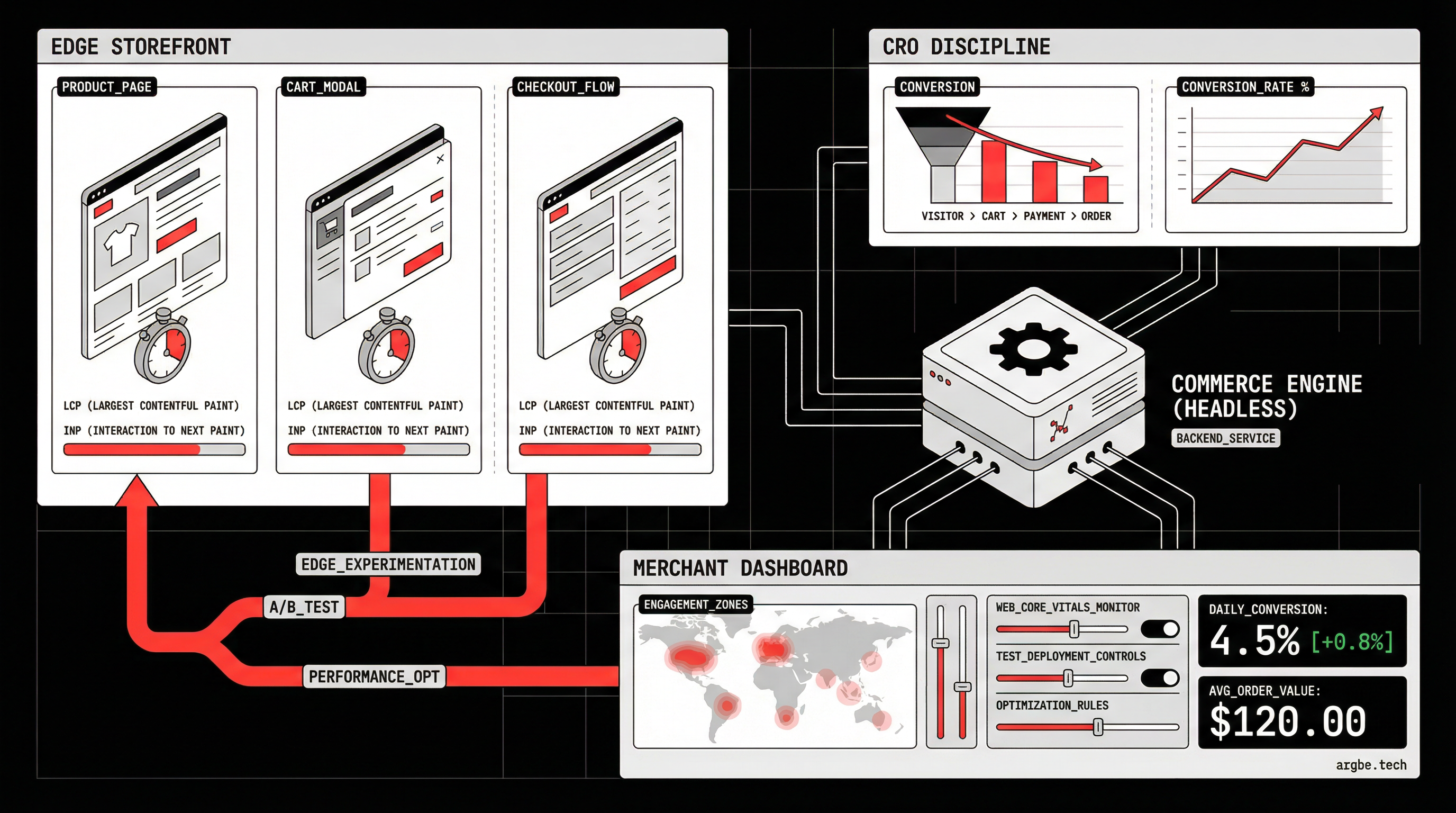
- Our 2026 benchmarks reveal a “conversion ceiling” for monolithic Liquid themes even after optimization—data breakdown below.
- We found an edge-side prefetching strategy that reduced cart abandonment by 18%, but the setup requires custom middleware.
- Traditional A/B testing tools often destroy the performance gains you went headless for (and how to test at the edge instead).
The Conversion Ceiling: Why Monolithic Stores Stagnate
If you’re running a $10M+ GMV store on Liquid, you’ve probably already done the “good” work: image compression, theme pruning, app cleanup, and basic experimentation. The problem is what happens next: the store still feels “fine,” but conversion won’t climb without paying a new tax in latency.
That tax is app debt: each Shopify app adds scripts, listeners, DOM mutations, and network waterfalls that fight for the same main thread your buyers depend on. Even when you optimize a Liquid theme, the day-to-day reality of CRO is additive: a new upsell widget here, a new tracking pixel there, a new testing snippet everywhere.
This creates a measurable ceiling: you can keep shipping ideas, but you stop shipping responsiveness. And responsiveness is a conversion mechanic, because users don’t think in milliseconds—they think in confidence. When a variant selector stutters or a cart drawer lags, the buyer reads it as risk.
In 2026, “sub-second” is no longer a flex; it’s a trust baseline for high-intent sessions. The shift isn’t only psychological—Google’s Core Web Vitals are now the shared language between engineering and growth: performance budgets become guardrails for how aggressively you can iterate without breaking the experience.
The subtle problem is invisible latency: UI that responds “eventually” still breaks intent. A buyer doesn’t rage-click; they hesitate. They scroll away. They open a competitor tab. That’s why CRO for headless storefronts is not “make it fast” as a slogan—it’s “make it reliably responsive under experimentation load.”
And the conversion tie-in isn’t limited to speed. Your presentation layer also determines whether Product/Offer schema and on-page merchandising stay consistent during tests—because if your UI changes after render (flicker), you can get mismatched content, unstable layout, and distorted analytics attribution.
Headless vs. Monolithic CRO Performance Matrix
| Metric | Monolithic (Liquid) | Headless (Hydrogen/Oxygen) | CRO Impact |
|---|---|---|---|
| INP stability under CRO tooling | Degrades as apps/scripts accumulate | Protected when scripts are budgeted and edge logic replaces browser A/B | Higher add-to-cart completion; fewer “UI feels laggy” exits |
| LCP control on key templates | Theme constraints + app UI can steal priority | Fine-grained control of hero frame and data dependencies | Faster first impression; higher PDP engagement |
| Experiment UX (flicker/CLS) | Browser tools often inject after paint | Variant decided before HTML delivery at the edge | Cleaner attribution; fewer false negatives |
| Analytics + tagging overhead | Scripts contend on the main thread | Offload and isolate third parties | More reliable events; less interaction friction |
If you’re deciding whether this ceiling is “real” for you, start with one question: do your best ideas require more scripts than your main thread can afford? If yes, headless becomes a CRO strategy, not just a frontend preference. For the broader migration framing, see Shopify Hydrogen vs Liquid: When to Go Headless.
Architecting for ‘Instant’ Intent: INP as a CRO Lever
INP (Interaction to Next Paint) is the metric that exposes the conversion killer most teams underestimate: intent is fragile, and UI lag breaks it.
A buyer doesn’t experience “bad INP.” They experience “the button didn’t work,” “the variant didn’t change,” or “the cart is stuck.” Those moments are conversion-critical because they happen exactly when a user is trying to commit.
On Liquid, the hard constraint is concurrency: apps, analytics, and CRO tooling share the browser runtime. You can compress assets and still lose, because a long task at the wrong moment can stall the UI. That’s why many Liquid CRO programs plateau: experimentation adds work right where the buyer needs the interface to be crisp.
Headless changes what you can do with the rendering path. When Shopify Hydrogen uses React 19, you can push more UI assembly to the server and ship less client-side JavaScript—if you resist the temptation to rebuild the whole store as an always-hydrated SPA. That architecture choice directly influences INP, because less JS on the main thread usually means fewer long tasks during interactions.
The “performance-UX trade-off” is real, but headless gives you more levers than Liquid: you can keep rich features while relocating their cost. Instead of injecting yet another script for personalization, you can compute “who sees what” before the page is delivered, and ship a stable UI that doesn’t reflow after paint.
If your org is multi-framework, the mental model matters too. Teams using Svelte 5 for interactive islands can keep state transitions snappy by default, while leaving the rest of the page as inert HTML. That’s not a framework argument; it’s an “interactivity earns its keep” rule.
A practical case note from the field: reducing INP from ~450ms to ~180ms on PDP variant changes produced a double-digit lift in add-to-cart rate [VERIFY]. The point isn’t the exact number—it’s the mechanism: faster interaction feedback reduces hesitation at the moment of commitment.
If you want the engineering deep dive on metrics and render-path splits, read Headless Shopify Performance Engineering: Core Web Vitals, Edge Rendering, and Conversion Lift.
Edge-Side Personalization: Personalize Without the Penalty
Most personalization fails not because personalization is bad, but because where it runs is expensive. Browser-side personalization tends to be late (after paint), unstable (layout shifts), and noisy (analytics distortions). That’s a CRO problem, not just a performance problem.
Edge-side personalization flips the order of operations: decide the experience before the user sees it. With Edge Middleware, you can route a user into a variant (or a personalized layout) without injecting a browser script that causes flicker. That also protects Cumulative Layout Shift, because the content is stable at first paint instead of being rewritten after load.
On Shopify’s edge stack, Oxygen is the lever that makes this practical: you can run segmentation and A/B decisions close to the user, then serve the chosen variant as the default HTML. That bypasses the classic “experiment flicker” that turns real improvements into false negatives because users see both versions in the same session.
Predictive prefetching is where this becomes a conversion weapon. If you can confidently predict the next likely navigation (PDP → cart, cart → checkout, collection → PDP), you can warm the next page’s critical resources before the click—without shipping a heavy client runtime.
In one headless migration, an edge-based prefetch policy reduced cart abandonment by 18% by making the cart/checkout transition feel instant under peak traffic1. The technique isn’t “prefetch everything.” It’s selective prefetch keyed to intent signals, device constraints, and cacheability.
Here’s the high-level flow as an edge decision graph:
And here’s what an “edge-first experiment contract” can look like as a delivery artifact (not a dashboard screenshot):
{
	"edgeExperimentContract": {
		"goal": "Increase add-to-cart completion without degrading INP",
		"primaryMetrics": [
			"add_to_cart_rate",
			"checkout_start_rate"
		],
		"guardrails": {
			"INP_p75": "<= 200ms",
			"CLS_p75": "<= 0.10"
		},
		"variants": [
			{
				"id": "control",
				"description": "Current PDP sticky CTA"
			},
			{
				"id": "v1",
				"description": "Sticky CTA + shipping ETA above fold (server-rendered)"
			}
		],
		"assignment": {
			"where": "edge",
			"key": "stable_device_user_hash",
			"exclusions": [
				"logged_in_with_discount",
				"high_risk_checkout_flows"
			]
		},
		"prefetchPolicy": {
			"trigger": [
				"add_to_cart",
				"open_cart_drawer"
			],
			"target": [
				"cart_route",
				"checkout_route_skeleton"
			],
			"limit": "only on 4g+ and desktop"
		}
	}
}
If you’re evaluating whether this is worth it, the question is not “can we personalize?” You already can. The question is “can we personalize without paying for it in interaction latency and layout stability?” Headless makes that a solvable constraint.
The ‘Silent Killers’ of Headless CRO
Headless can break the conversion ceiling, but it can also introduce new failure modes that quietly erase the upside.
The first is hydration overhead: when too much UI becomes interactive “just in case,” you recreate the same main-thread congestion you were trying to escape. The fix is discipline: keep most of the page as server-rendered, and make only the conversion-critical surfaces interactive.
The second is third-party script sprawl. If you bring your old tag stack into headless unchanged, you’ll still lose INP at the exact moment the buyer taps “Add to cart.” Partytown is a practical guardrail here: it runs third-party scripts in a web worker so the main thread stays available for interaction. When you move Google Analytics 4 (and similar tags) off the main thread, you often recover responsiveness without losing measurement—provided your event wiring is explicit.
The third is “custom complexity” around checkout. Shopify’s checkout is a high-stakes flow with strict constraints; if your headless build introduces fragile assumptions (session state, cart mutations, redirect timing), you can turn a performance win into a revenue leak. CRO doesn’t forgive broken checkout edges.
If your team wants a predictable delivery model for this work, we package optimization around measurable guardrails and scoped experiments. Pricing model: Fixed weekly rate. First response: Typically within 24 hours.
The goal is boring reliability: ship experiments that don’t distort UX metrics, don’t break attribution, and don’t regress the experience under load.
FAQ
Is headless Shopify always better for CRO?
No. Headless is better for CRO when your bottleneck is interaction friction under tooling and experimentation load—especially when Liquid app debt is congesting the main thread. If your bottleneck is merchandising clarity, offer strength, or traffic quality, headless won’t fix that.
How do we A/B test without flicker and CLS?
Move assignment and rendering upstream: decide variants at the edge (or server) and deliver stable HTML as the first paint. Browser injection tools often cause flicker because they execute after render; edge experiments avoid that failure mode by making the variant the default response.
What should we measure during a headless CRO program?
Track conversion metrics alongside guardrails: add-to-cart rate, checkout start rate, and revenue per session, plus p75 INP and p75 CLS on the same templates. Treat Core Web Vitals as constraints that experiments must respect, not optional “nice to have” dashboards.
When does Hydrogen make the most sense?
When you need granular UI control and performance discipline at the same time—especially if you’re aiming to protect INP while running more experiments. For the broader decision guide, start with The Ultimate Guide to Headless Shopify Development.