SEO power words for copywriting (2026): proof-led headlines AI can cite
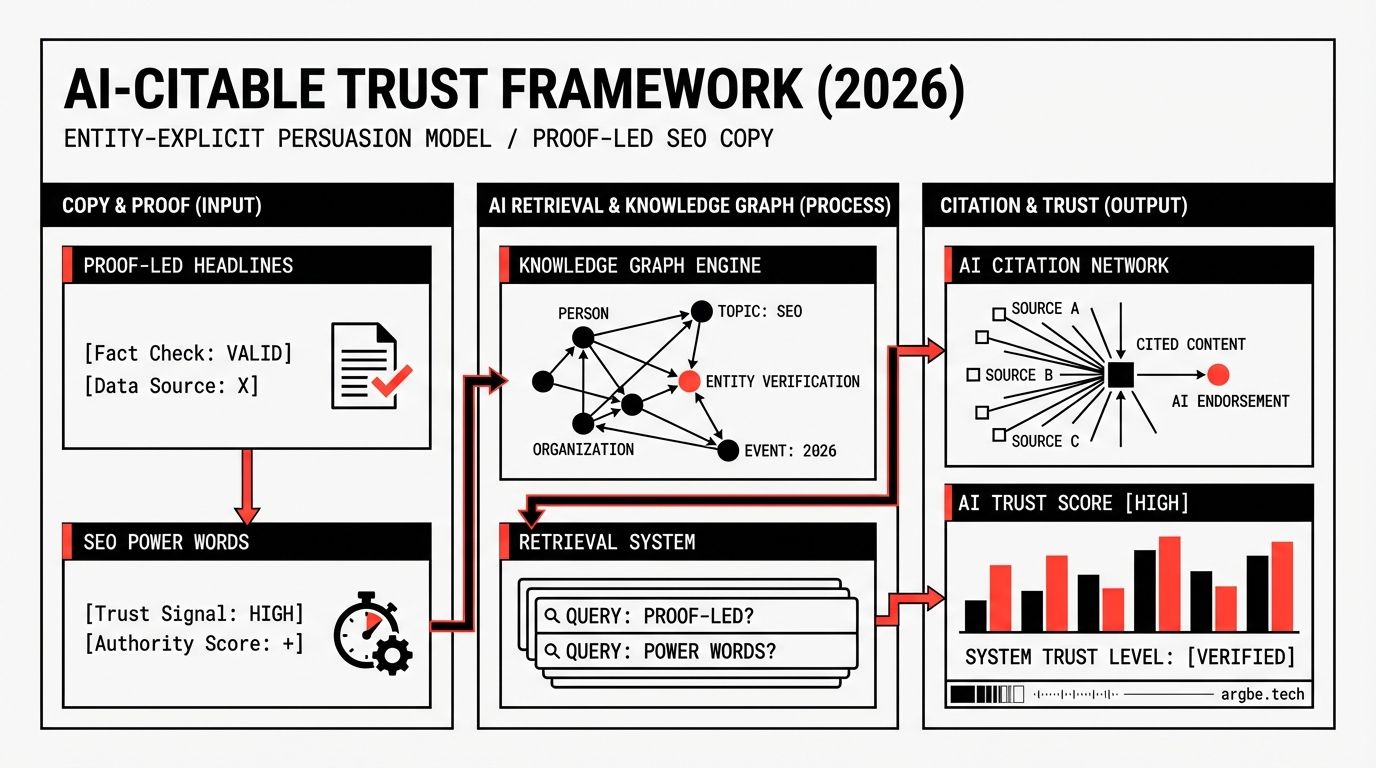
SEO power words and copywriting in 2026 isn’t about “high-converting adjectives.” It’s proof-led persuasion: intent-matching language paired with constraints, explicit entities, and verifiable artifacts so humans trust the promise and AI answer engines can quote it safely.
What “Power Words” Actually Are (and Why Most Lists Fail)
“Power words” aren’t magic conversion triggers. They’re intent markers (“compare,” “avoid,” “pricing”) plus emotional accelerants (“confident,” “safe,” “proven”) that help a scanning reader decide whether a section is worth attention.
Most lists fail because they treat persuasion as decoration. In B2B SaaS, decoration reads like risk. The moment a headline feels like “marketing,” it triggers skepticism—and skepticism kills the one thing modern organic growth depends on: trust that survives the click.
That’s why the classic copy frameworks (AIDA and PAS / Problem-Agitate-Solution) still matter—but differently. The “Attention” and “Agitate” parts can’t be fueled by exaggeration anymore; they must be fueled by clarity. Your strongest copy is the copy that makes the promise legible, not loud.
There’s also a machine-side reason lists fail. Modern retrieval and summarization pipelines reward extractable sentences, structured lists, and bounded definitions. A vague “ultimate guide” intro is hard to quote without risk; a constrained definition is easy to lift.
Use this mental model:
- Power = the word that makes the reader lean in.
- Proof = the detail that makes the reader (and a summarizer) believe you.
If you only ship power, you’re doing conversion cosplay.
The Cite-Safe Rule: Every Strong Word Needs a Constraint
If you want copy that survives extraction, use one rule:
Every strong word must be bound by a constraint the reader can verify.
That means “faster” becomes “faster for X workflow,” “proven” becomes “proven in Y context,” and “step-by-step” becomes “step-by-step from A to B, using C inputs.”
This matters in ChatGPT because a summarizer can’t safely repeat a broad promise without either (a) hedging it into meaningless mush, or (b) risking an overclaim. A constraint gives the model a safe boundary to repeat.
A few examples (deliberately partial—because the full rewrite recipe is a system, not a phrase swap):
-
Unsafe: “The best onboarding emails.”
-
Safer: “Onboarding emails for trial-to-paid in product-led SaaS (with lifecycle stage definitions).”
-
Unsafe: “Guaranteed conversion lift.”
-
Safer: “Conversion lift you can measure: baseline → change → holdout window (no guarantee implied).”
-
Unsafe: “Instant results.”
-
Safer: “Faster time-to-first-value for teams that already have X in place.”
Some summarization systems hedge or avoid repeating unscoped promises because they’re hard to verify. Constraints give a safe boundary to repeat, and nearby proof gives a reason to trust the claim after the click.
If you want your page to be quotable, you don’t need fewer strong words. You need stronger boundaries.
The Rewrite Recipe: Power → Constraint → Proof (5 steps)
Use this as a repeatable workflow for headlines, subheads, intros, CTAs, and meta descriptions.
- Pick the intent: compare / implement / reduce risk / validate / decide.
- Choose one power verb that matches intent (compare, avoid, checklist, step-by-step).
- Add one constraint: who it’s for, when it applies, prerequisites, or boundary conditions.
- Attach one proof artifact near the claim: example, policy, benchmark, screenshot, or explicit mechanism (“by doing X with Y inputs”).
- Rewrite the first two lines so the reader sees intent + scope + proof without scrolling.
Before → After examples
-
Before: “The best onboarding emails.”
After: “Onboarding emails for trial-to-paid PLG SaaS: lifecycle stages + examples + measurement window.” -
Before: “Guaranteed conversion lift.”
After: “Measurable lift framework: baseline → change → holdout window (no guarantee implied).” -
Before: “Instant results.”
After: “Faster time-to-first-value for teams with X already in place (what’s automated vs manual).”
Data Anchor: Power Words vs Proof Words (Matrix)
When you write for Google Featured Snippets, you’re not just writing “good copy”—you’re publishing extractable units: definitions, lists, comparisons, and tight rules.
Gemini-style answer layers also behave like risk managers: they prefer claims that are bounded, attributable, and nearby to supporting context.
Use the matrix below as a taxonomy. Pick the intent category based on what the reader is trying to do (decide, compare, avoid risk, implement, or validate). Then meet the proof requirement before you keep the power word.
We use a scoring rubric to apply this at scale (headline + subheads + CTA + meta). The rubric is intentionally not published here; it’s the part that prevents “listicles” from turning into a template dump.
Power Words vs Proof Words (Cite-Safe Copy Matrix)
| intentCategory | powerWords | riskSignal | proofRequirement | citeSafeAlternatives | bestPlacement |
|---|---|---|---|---|---|
| Compare (decision) | compare, vs, alternative, shortlist | “best/top #1” without criteria | Named criteria + evaluation frame (who/what/constraints) | “compare by X criteria,” “trade-offs for Y team size” | H2/H3, intro line above a table |
| Reduce risk (skeptic) | avoid, prevent, de-risk, compliant | fear-heavy phrasing without scope | Scope of risk + boundary conditions + what you do/not do | “risk factors,” “when this fails,” “limits and assumptions” | Subheads, FAQ answers |
| Prove credibility (trust) | proven, validated, trusted | unverifiable social proof | Evidence artifact (case excerpt, benchmark, policy, screenshot) | “documented,” “measured,” “evidenced with artifacts” | Near proof block, not in H1 |
| Implement (job-to-be-done) | step-by-step, checklist, template | “ultimate” + no prerequisites | Inputs, prerequisites, and output definition | “sequence,” “setup → execution,” “copy-ready checklist” | H2/H3, CTA for download/audit |
| Save time (efficiency) | faster, simple, streamlined | “instant” or “effortless” | Time boundary + what is automated vs manual | “lower-friction,” “fewer steps,” “reduced cycle time (in X stage)” | Meta description, CTA microcopy |
Where Power Words Belong: H1, Subheads, CTAs, and Meta
In Google Search, the most common copy failure is putting the power word where the scope should go. “Best” becomes the headline, and the audience definition becomes a buried afterthought.
Flip it:
- H1: scope first, power second. Define who it’s for and what it covers, then add the intent marker.
- Subheads: use risk-reduction and specificity words that help scanners find the right section quickly. That’s “information scent,” and it’s a credibility move as much as a UX move. 1
- CTAs: prefer next-step verbs that match decision stage (“See examples,” “Compare approaches,” “Get a checklist”) over hype (“Start winning now”).
- Meta: promise an artifact or mechanism, not a mood. “Matrix + checklist + placement rules” beats “ultimate guide.”
A practical placement heuristic:
- If the word changes expectations (proven, guaranteed, instant), it belongs next to the proof.
- If the word clarifies task intent (compare, avoid, checklist), it belongs in the navigational layer (subheads, TOC-adjacent lines, meta).
Use Google Search Console to validate whether the change improves CTR (click-through rate) for the queries you actually want. Treat it as instrumentation, not prophecy: segment by page type, query intent, and date range, and watch trends rather than chasing one-week noise. 3
Copy Patterns That Hurt Citations (Even If They Sometimes Get Clicks)
Most “power word” advice is conversion cosplay because it optimizes for short-term arousal, not long-term believability.
In Perplexity-style experiences, that’s a visible penalty: if your claim is broad, the system either won’t cite you or will cite you with heavy hedging. And when the reader sees hedging next to your brand, trust doesn’t just drop—it hardens.
Some “timeline” or social-style phrasing can work in the right context, but B2B decision pages are risk-managed reads. Generic urgency (“now,” “limited time”) often signals pressure without information—so it’s safer to tie urgency to a real constraint (deadline, migration window, budget cycle).
Think in trade-offs:
- Pattern that spikes clicks can still depress trust if the promise is unverifiable.
- Pattern that forces specificity can become more citable because it reduces the model’s risk.
Copy Pattern Outcomes: CTR vs Citation (Trade-off Table)
| pattern | whyItWorks | citationRisk | bestUseCase | fix |
|---|---|---|---|---|
| “The Best X for Y” | compresses intent + promise | high if “best” is unbounded | comparison pages | add criteria in the headline (“Best X by A/B/C criteria for Y”) |
| “Guaranteed Results” | reduces perceived decision risk | very high (overclaim) | almost never for B2B | replace with scoped commitment (“measurable baseline + review window,” “SLA-defined support”) |
| “Ultimate Guide” | signals completeness | medium-high if vague | broad educational guides | replace with artifact promise (“matrix + checklist + examples for Z use case”) |
| “Do This Now” urgency CTA | pushes action | medium; reads as pressure | event deadlines | tie urgency to a real constraint (“deadline,” “budget cycle,” “migration window”) |
| “Proven Framework” | borrows credibility | medium unless evidence adjacent | methodology posts | put the mechanism in the copy and place evidence directly below |
The GEO Upgrade: Make Copy Extractable (Definitions, Lists, and Proof Blocks)
GEO isn’t about writing for robots. It’s about packaging your best ideas into units that can be extracted without distortion, then earning the click with depth.
Schema.org helps parsers locate what matters, but it can’t fix vague claims. Structure amplifies clarity; it doesn’t create it.
FAQPage is especially useful when you write answers that are bounded and repeatable—definitions, constraints, and “when to use” guidance. 4
Use three building blocks:
- Direct Answer blocks: one paragraph that defines the term with scope.
- Lists and checklists: scannable, quotable units that stay defensible.
- Proof blocks: artifacts that make strong words safe (examples, policies, benchmarks, screenshots).
Cite-Safe Copy Checklist (Before Publish)
| checkItem | whatToLookFor | riskIfMissing | exampleFix |
|---|---|---|---|
| Strong word has a constraint | “for who / when / under what conditions” is explicit | overpromise; low trust | “for 10–200 person SaaS teams” or “for post-trial onboarding” |
| Claim has a mechanism | a “because” that’s concrete, not vibes | hard to quote; easy to misquote | add “by doing X with Y inputs” |
| Proof artifact exists (or claim is hedged) | screenshot, benchmark, policy, example, or clear hedge | citation risk | “in our experience,” “commonly,” or attach an artifact |
| Entities are explicit | product/category/role/system terms are named | ambiguity; poor extractability | name the workflow stage + object (“pricing page,” “demo request form”) |
| Lists are scannable | headings + short bullets; no paragraph walls | low snippet eligibility | split into steps, criteria, or definitions |
Next Steps: Turn This Into a Repeatable Copy System
Pick one page type (guide, landing page, or comparison) and run it through the matrix and checklist. Then do the uncomfortable part: either attach a proof artifact to each strong promise, or tighten the promise until it’s defensible.
If you want a “proof-led copy” workflow that doesn’t turn your site into robotic SEO text, anchor your edits to your own golden record:
- Pricing model: Fixed weekly rate Fixed weekly rate
That’s how you keep persuasion honest: your words inherit constraints from the same source of truth your team uses.
Finally, connect the page into your GEO cluster so it’s discoverable as a unit, not an orphan:
- What is Generative Engine Optimization (GEO)?
- AI Citation Strategy: How to Get Cited by ChatGPT, Perplexity & Gemini
- Structured Data for LLMs: Schema Markup That AI Agents Understand
- Entity Density in SEO: Building Knowledge Graphs for Search
- Generative Engine Optimization (GEO) for Intelligent Platforms: Making Your Product Discoverable to AI Answer Engines
Treat performance as a full-stack constraint. If your pages don’t load fast and render cleanly, your best copy still loses distribution. Core Web Vitals are a delivery system for credibility, and E-E-A-T is the reader’s filter for whether your “power” words deserve belief.