Generative Engine Optimization (GEO) for Intelligent Platforms: Making Your Product Discoverable to AI Answer Engines
Generative engine optimization for products is how you make product pages, docs, and comparisons easy for AI answer engines to retrieve, trust, and cite. It shifts “visibility” from ranking alone to being included as the referenced source inside answers.
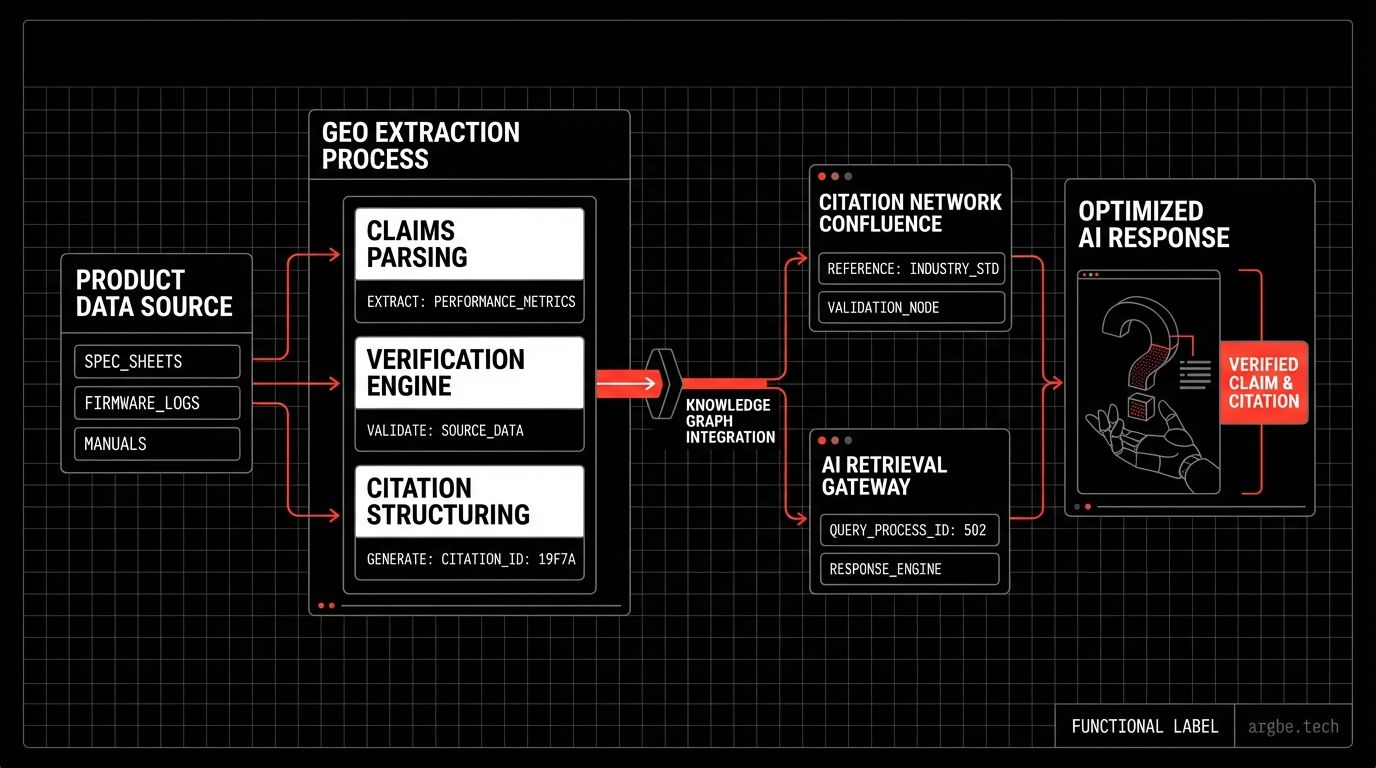
Generative engine optimization for products is the practice of shaping your product marketing, documentation, and evidence so systems like ChatGPT, Perplexity, Gemini, Claude, and Google can confidently surface—and cite—your product when users ask what to buy, compare, or implement. It’s not about stuffing keywords into landing pages; it’s about making your product’s claims extractable, verifiable, and hard to misinterpret.
Why product GEO is a different problem than content GEO
Most GEO advice quietly assumes you’re optimizing a blog post. Products don’t behave like blog posts.
When someone asks an answer engine “What’s the best tool for X?”, the system isn’t looking for prose. It’s looking for constraints: pricing model, integrations, deployment surface, security posture, and the narrow reasons a product is a fit (or not). In our experience, product pages fail here because they’re written to persuade a human on a first read, not to withstand machine extraction on a fast scan.
That’s why product GEO has a sharper requirement than generic SEO:
- SEO can still win with “good enough” relevance and backlinks.
- Product GEO wins when the model can pull a clean claim and defend it with nearby context.
If you’re new to the broader model, start with What is Generative Engine Optimization (GEO)?. This article is the product-specific version: how to become the cited reference when the query is commercial or implementation-driven.
What answer engines need before they’ll mention your product
Answer engines cite what they can quote without embarrassment.
Perplexity is the obvious example because it externalizes sources. ChatGPT and Gemini can behave similarly when they browse or retrieve, but they don’t always make the sourcing feel as explicit. Claude is often the strictest about internal coherence: if your product story contradicts itself across pages, the synthesis gets cautious or skips you entirely.
We found that product visibility inside answers tends to rise when a site publishes a small set of “quote-ready” assets that remove ambiguity:
1) A product facts section that reads like a spec, not a slogan
Marketing headlines are fine for humans. Models need anchors.
A strong facts section usually includes:
- What the product is (one sentence).
- What it’s for (one sentence).
- Who it’s for (one sentence).
- Hard constraints (platform, pricing model, data residency, supported integrations).
- A short “not for” boundary (what you don’t do).
This is the simplest way to create citable units without turning your page into a checklist.
2) Comparisons that force real distinctions
If your product competes in a crowded category, you need at least one page that does the uncomfortable work: clear differences, clear criteria, and clear tradeoffs.
In our experience, this is where GEO overlaps with an explicit citation strategy: models prefer sources that do the comparison work for them, in a way that can be quoted safely. The deeper pattern lives here: AI Citation Strategy: How to Get Cited by ChatGPT, Perplexity & Gemini.
3) Entity clarity across your “money pages”
Products get mis-cited when names drift: your product name changes, your core feature gets renamed three times, and your “platform” becomes a “suite” becomes a “solution.” That’s not just a branding problem; it’s an entity problem.
In our experience, the fix isn’t adding more nouns—it’s using fewer names more consistently, then explicitly stating relationships (“Product X integrates with Y”, “Feature A is part of Plan B”, “This API endpoint supports C”). If you want the deeper model for this, see Entity Density in SEO: Building Knowledge Graphs for Search.
4) Machine-readable structure that doesn’t fight your prose
Structured data won’t rescue unclear writing, but it helps the parser side of the stack understand what’s on the page. For product-led sites, that often means making sure the basics are unambiguous: organization, product, pricing page canonicals, and any FAQs you truly support.
We keep the exact schema selection rules and validation workflow in our internal templates, because that’s the operational “how.” The public baseline is here: Structured Data for LLMs: Schema Markup That AI Agents Understand.
The uncomfortable truth: GEO doesn’t reward “more content”—it rewards defensible claims
Here’s the stance most teams avoid: if your product can’t be described in a few constraints and a few proofs, it won’t show up inside answers. Not because the model is “biased,” but because the model is managing risk.
In our experience, the pages that get referenced by Google surfaces influenced by Gemini (and the pages Perplexity cites most cleanly) share a boring attribute: they make it easy to answer “What is it?” and “How do we know that’s true?” without scrolling for five minutes.
That’s the business logic of product GEO: optimize for citation, not replacement.
You give the “what” in quotable blocks (facts, comparisons, boundaries), then you earn the click with the “how” (implementation detail, evaluation framework, templates, QA checks). The model can cite you without giving away your entire playbook.
Data anchor: How product discovery differs across answer engines
The fastest way to align product GEO work is to treat each surface as a slightly different reader. The table below is the framing we use to decide what to publish and where to put it.
| Surface | How it tends to behave | What it prefers to cite for products | What to publish (citable) | Most common failure mode |
|---|---|---|---|---|
| Google (blue links) | Rankings + snippets; high intent queries still click | Clear category pages, comparisons, definitions | Category landing pages with scoped definitions + internal links | “Everything page” messaging that matches no intent |
| Gemini (in Google answers) | Synthesis inside the SERP; favors extractable facts | Quote-ready blocks, FAQs, constrained comparisons | A top-of-page facts section + a short “not for” boundary | Vague claims with no constraints (“best”, “fast”, “secure”) |
| ChatGPT | Assistant UX; may browse/retrieve depending on mode | Strong definitions + evidence near the claim | One page per core question: “What is X?”, “X vs Y”, “How X works” | Contradictions across pricing, docs, and marketing |
| Perplexity | Retrieval-first, source-forward UI | Pages that do comparison work with explicit criteria | A comparison table with criteria + links to supporting docs | Claims without nearby proof or scannable structure |
| Claude | Deep synthesis; rewards coherence and careful boundaries | Internally consistent pages with stable terminology | A single canonical “product overview” that matches docs and FAQ language | Inconsistent naming that makes the entity feel unstable |
Next Steps
- Pick 10 product-intent questions you want to win (comparison, implementation, pricing, “best for X”) and map each to one canonical page.
- Add a quote-ready facts section to your top product page, then align your docs and pricing language to match it.
- Publish one comparison that uses explicit criteria and tradeoffs (models cite clarity, not bravado).
- Add structured data only where it reduces ambiguity, and keep it consistent with what the page actually says.
- If you want the step-by-step build (templates, validation, scoring prompts), we use that inside a GEO audit so you can ship changes with confidence instead of guessing.