Building with Svelte in January 2026: The Signals That Change Delivery Defaults
January 2026 isn’t about Svelte “hype.” It’s about delivery defaults: how Svelte 5 and SvelteKit shape fast SSR apps you can actually operate—and where Svelte fits beside Astro 5 and Next.js in real pipelines.
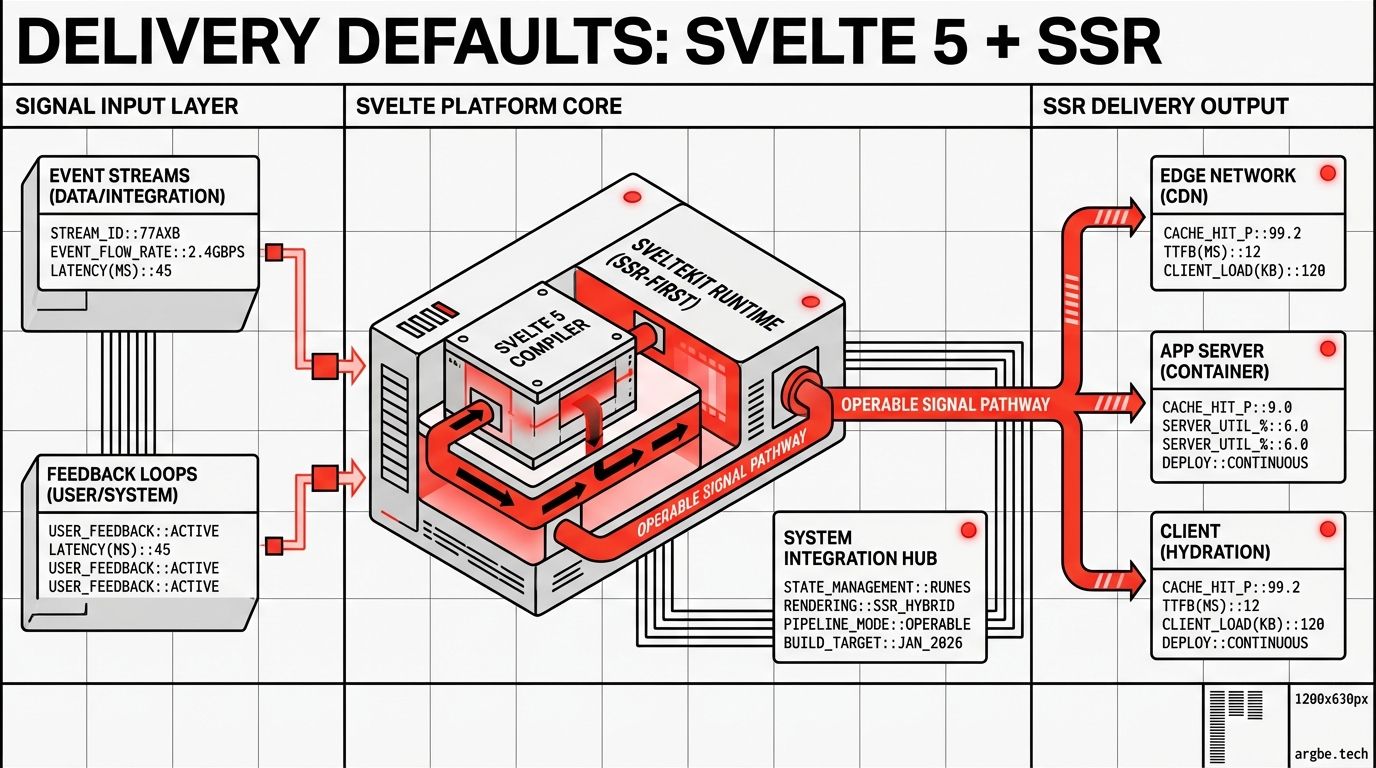
Svelte in January 2026 is less “news” and more signals: what defaults are becoming the path of least resistance for shipping fast, observable SSR—and what those defaults imply for caching, failure modes, and iteration speed.
This matters because framework decisions rarely fail on features. They fail on defaults that quietly shape:
- runtime costs
- page speed
- how safely you can change behavior in production
What Svelte Teams Should Pay Attention to This Month
When people say “news,” they often mean announcements. The updates that move revenue are usually more boring: they change what becomes normal for real teams.
Here are the January 2026 signals worth acting on:
- Svelte 5 shifts the cost curve of complexity. More explicit state/reactivity makes large apps easier to reason about and easier to keep fast.
- SvelteKit keeps pulling teams toward SSR-first discipline. SSR isn’t a checkbox—it forces clarity around data boundaries, caching, and reliability.
- “Framework choice” is becoming “delivery choice.” The useful question is no longer “SvelteKit vs Next.js.” It’s: which default makes our product faster to ship and safer to operate?
If you’re new to this lens, start with: What Are Intelligent Platforms? The Future of Web Apps.
The Core Idea: Svelte 5 Changes the Shape of Operable UI
An intelligent platform is not “AI in the UI.” It’s a system that senses what’s happening, makes a decision, and acts safely—without turning releases into gambles.
Svelte matters here because UI behavior is part of your operating model.
1) Reactivity you can reason about becomes an operations feature
Many “random performance regressions” aren’t random. They’re mismatches between:
- what the UI appears to depend on
- what it actually depends on
- what the runtime must recompute on interaction and navigation
When state and dependencies are explicit, you pay less “why did this rerender?” tax later—especially when the app becomes large.
This is where React comparisons are useful:
- React (and the ecosystem around it) offers immense flexibility—and many ways to accidentally ship extra client weight.
- Next.js can make the trade feel worth it because it provides strong full-stack conventions.
- SvelteKit usually asks for fewer moving parts, which is a real advantage when your goal is predictable behavior under load, not maximum flexibility.
For the broader tradeoffs between Astro and Next.js, see: Astro vs Next.js: Choosing the Right Framework in 2026.
2) SSR defaults force caching and failure modes to be explicit
SvelteKit’s SSR posture is a feature and a constraint:
- Feature: fast first render, crawlable pages, reliable previews.
- Constraint: the server boundary is real, so you can’t hand-wave:
- caching strategy (what, where, TTL, invalidation)
- dependency behavior (what happens when an API is slow or down)
- observability (what you measure, log, and alert on)
Teams that get the most out of SvelteKit treat it as the start of an operations story, not the end of a “frontend story.”
If you want the architecture view—events, orchestration, human-in-the-loop controls—read:
The Intelligent Platform Stack (2026): Event-Driven Data, Agent Orchestration, and Human-in-the-Loop Operations.
3) Svelte 5 inside Astro 5 is a pattern—not a compromise
Astro and SvelteKit solve different problems by default:
- Astro optimizes for shipping less JavaScript and adding interactivity only where it earns its keep.
- SvelteKit optimizes for app-style routing + SSR ergonomics, where interactivity is assumed.
In practice, teams succeed with Svelte 5 in both models:
- Content-heavy sites (docs, marketing, editorial) with interactive pockets → Astro + Svelte islands
- App-first products (auth flows, dashboards, workflows) → SvelteKit
The key insight: “Svelte” is not synonymous with “SvelteKit.” Svelte can be your component layer inside a broader delivery strategy.
4) Styling systems are part of “UI velocity”
Svelte can help you ship fast pages, but that doesn’t automatically mean you ship fast changes.
UI velocity often dies in CSS drift, inconsistent components, and slow experiment loops. A standardized styling system (often Tailwind v4 today) matters because it reduces negotiation overhead and makes UI change cost predictable.
If your takeaway feels too framework-centric, this is the corrective:
An intelligent platform is a system. Your component + styling system is part of its operating model.
5) Stack choice is a control decision
If you’re building an intelligent platform, your framework choice is really a choice about control:
- control over what ships to the browser
- control over how data is fetched and cached
- control over how safely you can change behavior based on signals
That’s why this belongs in the same cluster as agentic systems. You can connect agents to tools and workflows—but if the platform underneath is slow, opaque, or fragile, “autonomy” becomes risk.
If you want the agents layer:
Agentic Intelligent Platforms: How AI Agents Turn Web Apps Into Self-Optimizing Systems (2026 Architecture Guide).
Data Anchor: Svelte-Oriented Framework Comparison (January 2026)
Choose based on delivery constraints—not preferences.
| Option | Default delivery model | Where Svelte 5 fits | What teams like about it | What teams underestimate | Best fit |
|---|---|---|---|---|---|
| SvelteKit | SSR-first app framework with routing/adapters | Native component model; fastest path to “Svelte everywhere” | Tight mental model; strong SSR ergonomics | Cache discipline + failure modes; conventions vary without team standards | Product apps where the UI is the product (auth flows, dashboards, workflows) |
| SvelteKit + TanStack Query | SSR-first app + explicit server-state caching | Svelte 5 UI + TanStack Query for async/server state; SSR prefetch + hydrated cache TanStack | Predictable data fetching; fewer “refetch storms”; clearer loading/error states | Cache invalidation strategy still needs ownership; hydration boundaries and request scoping | SvelteKit apps that hit real APIs (dashboards, marketplaces, B2B portals) and need reliable SSR data |
| Astro 5 + Svelte 5 islands | SSR/SSG with islands by default | Svelte 5 powers interactive pockets without paying a JS tax site-wide | Lean critical path; content + interactivity balance | Too many islands fragment state/data flow; shared state needs intentional boundaries | Content-heavy platforms with interactive tools (calculators, onboarding, pricing) |
| Next.js (React) | SSR with strong conventions + ecosystem gravity | Typically not part of the stack; React is center | Hiring pool; ecosystem breadth; full-stack patterns | Client weight creep; cross-team consistency takes work | App-heavy products prioritizing React alignment and ecosystem breadth |
| TanStack Start (React) | Full-stack React framework with full-document SSR + streaming | Svelte 5 is not used; alternative “control-first” full-stack React surface TanStack | Type-safe Router foundation; SSR/streaming + server functions in a tight model TanStack | Newer conventions require discipline; teams must define caching/ops standards explicitly | React teams who want more explicit routing/control than Next.js and are OK owning more architecture |
| Vite + React (SPA) | Client-first with simple deployment surface | No Svelte; React baseline | Simple hosting; fast local iteration | SEO + first render require extra work; runtime errors can be more user-visible | Internal tools and highly interactive apps where SEO is secondary |
| Astro 5 + React islands | SSR/SSG with React islands | No Svelte; React islands are the interactivity layer | Astro performance defaults + reuse React components | Island boundaries can hide duplicated logic; easy to over-ship JS by habit | Sites with existing React investment that want lean delivery defaults |
Operational Checklist: “Defaults We Can Operate”
Use this when you prototype:
If you choose SvelteKit
- Define caching strategy early (where caches live, TTL, invalidation triggers).
- Instrument server timing on your hardest route (cold start, steady state, peak).
- Decide conventions for data loading + error handling (so teams don’t diverge).
- Add observable guardrails: structured logs, tracing context, error budgets.
If you choose Astro + Svelte islands
- Set a strict client-JS budget per page (and measure it).
- Treat each island boundary as a contract (props/state boundaries).
- Avoid “island sprawl”: consolidate interactivity where shared state matters.
- Ensure analytics/experiments don’t reintroduce JS tax across the site.
Regardless of framework
- Make UI velocity measurable: component patterns, tokens, style rules, review conventions.
- Treat “delivery defaults” as architecture, not aesthetics.
Next Steps
- Pick the decision you’re actually making: “delivery defaults we can operate” is concrete; “framework preference” isn’t.
- Prototype the hardest route and measure runtime behavior—not build speed.
- Choose the stack that makes your failure modes and caching strategy explicit by default.
- If you’re building an intelligent platform, prioritize foundations that support safe iteration.