What Are Intelligent Platforms? The Future of Web Apps
Intelligent platforms combine a modern web stack with measurable feedback loops so the product can adapt based on real usage, not guesses. They treat performance, observability, and AI-assisted operations as first-class features.
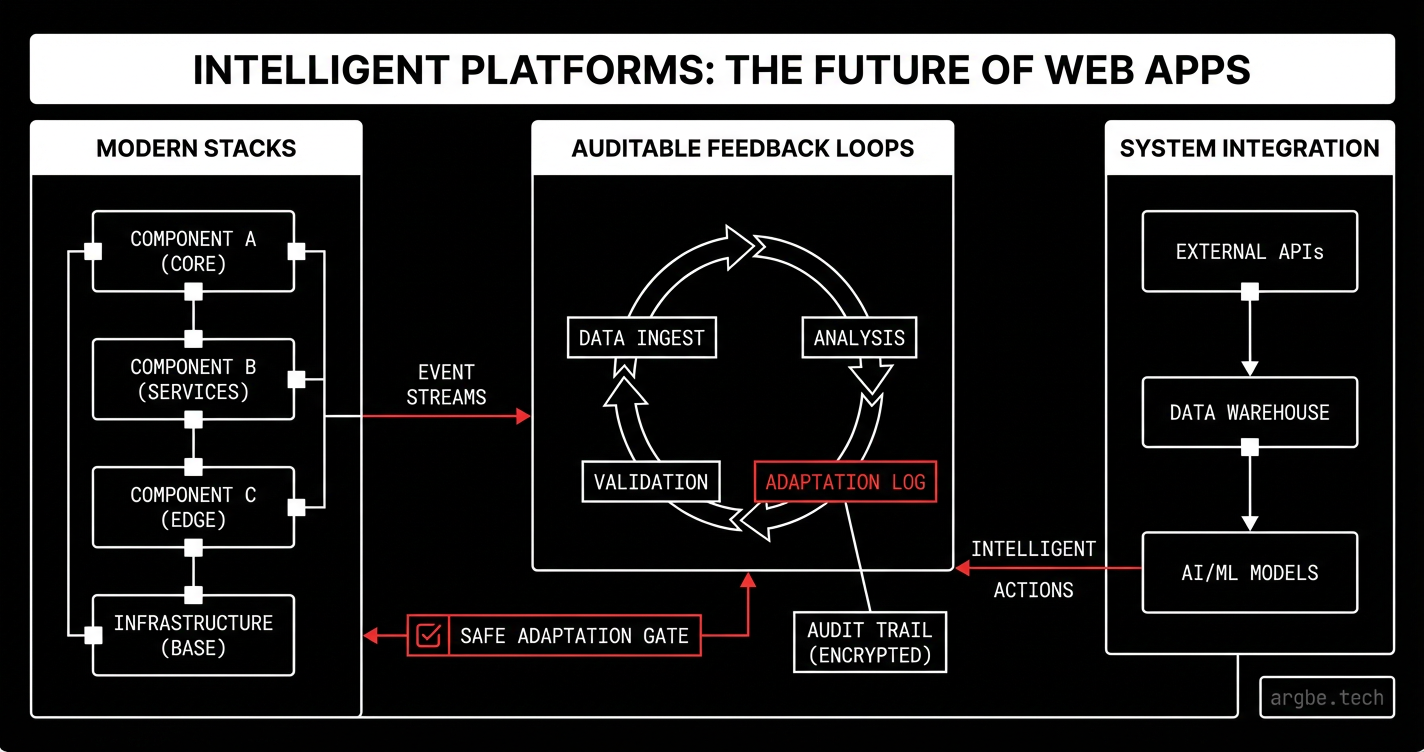
An intelligent platform is a web application foundation that continuously learns from real behavior (performance, conversions, support signals, and operations) and then changes how it runs—what it renders, what it caches, and what it prioritizes—so the product improves without constant rebuilds. It exists to reduce waste: fewer “big rewrites,” fewer blind launches, and fewer slow pages that quietly tax revenue.
What Makes a Platform “Intelligent” (Beyond Marketing)
Most platforms claim intelligence because they added a chatbot or sprinkled in “AI features.” We don’t buy that definition. In our experience, intelligence shows up when the platform can sense what’s happening, decide what matters, and act safely—while leaving a trail you can audit.
That requires three things working together:
- A high-performance delivery model that’s friendly to humans and crawlers.
- A feedback loop that turns production signals into decisions.
- A controlled execution layer where changes are gated, observable, and reversible.
This is why stack choices matter. Astro 5, Next.js, SvelteKit, React 19, and Svelte 5 each push you toward different defaults for routing, rendering, and composition. Tailwind CSS v4 affects how quickly teams can ship consistent UI changes (and how safely they can refactor) when the platform starts iterating more often.
If you want the longer framework decision story, we laid out tradeoffs in Astro vs Next.js: Choosing the Right Framework in 2026.
The Nuance: “Intelligent” Is a System, Not a Feature
An intelligent platform isn’t “AI in the UI.” It’s a set of operational guarantees that make smart behavior possible in the first place.
1) Sensing: Instrumentation You Can Trust
You can’t optimize what you can’t measure, and you can’t measure what you don’t name. We found the most common failure mode is collecting plenty of telemetry but none of it maps cleanly to business outcomes.
What “sensing” looks like in practice:
- Performance signals: Core Web Vitals, server timing, cache hit ratio, and image payloads.
- Product signals: funnel drop-off, feature adoption, search queries, and “no-result” events.
- Support signals: repeated tickets, time-to-resolution, and common user confusion.
- Ops signals: error budgets, saturation, cold starts, and third-party timeouts.
Astro 5 tends to make “sense first” easier for content-heavy sites because you can ship less JavaScript by default and still integrate islands where they earn their keep. Next.js is strong when the app itself is the product, and you want a single mental model for server and client. SvelteKit sits in a sweet spot for teams that want SSR as a default and a smaller surface area than some React-heavy setups.
2) Deciding: Turning Signals Into Policies
Once the platform can observe reality, it needs a policy layer. Policies are where intelligence becomes boring—in the best way.
Examples of policies we use (and insist on):
- If a route is slow, degrade gracefully (ship less client JS, reduce above-the-fold complexity, or change streaming strategy).
- If a dependency flaps, fail soft (serve cached content, queue background work, and keep the UI responsive).
- If a section is frequently abandoned, test a smaller first screen and push details behind interaction.
This is also where AI agents become useful: not as a replacement for product thinking, but as a tireless analyst and operator. We build agents using Claude and Gemini, then connect them to internal tools via MCP so they can read dashboards, open issues, and propose changes with clear constraints.
3) Acting: Shipping Change Without Fragility
The “act” part is what separates a dashboard from an intelligent platform. Acting means the platform can change behavior safely:
- At runtime via caching strategy, edge routing, feature flags, or personalization rules.
- At deploy time via automated checks, gated experiments, and progressive rollouts.
This is where frameworks and architecture choices show up as business outcomes. A platform built as a single, highly coupled SPA can be fast, but it tends to make partial rollouts and fine-grained rendering decisions harder. A platform designed around SSR and islands can make it easier to constrain where JavaScript runs and to keep the critical path lean.
If you want a concrete example of “acting” through agents and guardrails, see Agentic Intelligent Platforms: How AI Agents Turn Web Apps Into Self-Optimizing Systems (2026 Architecture Guide).
Where Intelligent Platforms Go Wrong
We see the same traps repeat across teams—especially teams that ship quickly and then try to bolt on intelligence later.
Mistake 1: Treating AI as the product
If the app is slow, unstable, or unobservable, adding AI features mostly adds cost and unpredictability. Intelligence requires a clean baseline: predictable rendering, predictable data access, predictable failure modes.
Mistake 2: Building a data lake instead of a feedback loop
Big piles of events don’t create intelligence. A feedback loop requires:
- Clear event naming
- A short path from signal → decision → change
- Ownership (someone is accountable for outcomes)
Mistake 3: Ignoring UI velocity and consistency
This is where Tailwind CSS v4 earns its keep. When teams can change UI without hunting across bespoke CSS rules, they can iterate faster and with fewer regressions. In our experience, UI consistency becomes a compounding advantage once you introduce experiments and segmented experiences.
Mistake 4: Choosing a framework for vibes
Frameworks are not religions. They’re operational constraints.
- Astro 5 shines when you want content + interactivity without paying a JavaScript tax everywhere.
- Next.js is a strong fit when the app is the interface to a complex backend, and you want deep React ecosystem alignment (including React 19’s direction).
- SvelteKit pairs well with teams that want SSR-by-default ergonomics and a tight integration story with Svelte 5.
For a current snapshot of what’s changing in the Svelte world, we track it in Building with Svelte News January 2026.
Data Anchor: Feature Comparison for Intelligent Platform Foundations
The table below is the quickest way to pick an “intelligent platform” foundation based on what you’re actually building.
| Option | Default rendering posture | Strengths for intelligent platforms | Common risks | Best fit |
|---|---|---|---|---|
| Astro 5 | SSR/SSG with islands | Keeps the critical path lean; makes “interactive only where needed” the default; great for content + product hybrids | Teams can over-fragment islands; data patterns can sprawl without conventions | Marketing + docs + app surfaces that still need real interactivity |
| Next.js | SSR with server components and routing conventions | Strong full-stack story; broad ecosystem; good for complex app workflows; pairs naturally with React 19 | Easy to accumulate client-side weight; routing/data patterns can get complex across large teams | SaaS apps and authenticated dashboards where the app is the product |
| SvelteKit | SSR-first with flexible adapters | Small mental model; fast iteration; good SSR ergonomics; integrates cleanly with Svelte 5 | Smaller hiring pool in some markets; patterns can vary by team without discipline | Teams prioritizing speed-to-change with a smaller framework surface area |
| React 19 (SPA) | Client-first | Simple deployment surface; plenty of libraries; straightforward local state for rich UI | SEO and first-load performance require extra work; runtime failures can be more user-visible | Highly interactive tools where SEO matters less and network conditions are controlled |
| Any stack + Tailwind CSS v4 | Styling system (not rendering) | Increases UI change speed; reduces CSS drift; supports consistent design tokens across experiments | Can become inconsistent without shared components and tokens | Any team running frequent UI tests and iterative product work |
Next Steps
- Decide what “intelligence” means for your product: one measurable outcome (speed, conversion, retention, support load) beats ten vague goals.
- Pick a foundation that matches your delivery reality: content-heavy sites and app-heavy products have different optimal defaults.
- Build the loop before the agent: instrumentation and policies first, automation second.
- If you want our step-by-step implementation approach (the parts we keep proprietary because they’re expensive to learn the hard way), ask us to review your current stack and we’ll map a pragmatic path to an intelligent platform.