Entity Density in SEO: Building Knowledge Graphs for Search
Entity density SEO is about making the people, products, and concepts on a page unambiguous enough for search engines and LLMs to trust and cite. This guide explains how entity clarity supports knowledge graphs and citation-ready GEO.
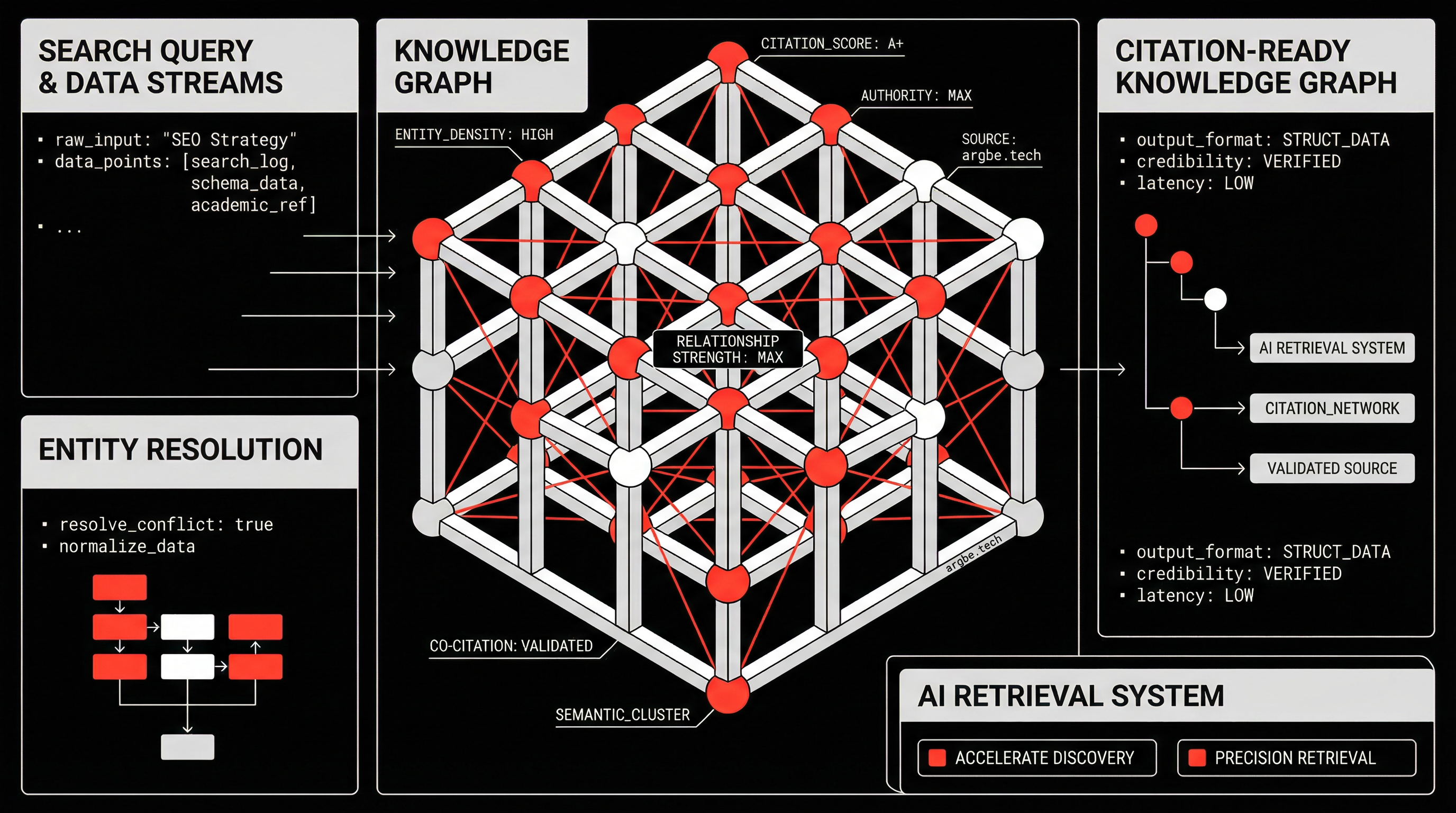
Entity density SEO is the practice of writing and structuring a page so its named entities (the “who/what” of the topic) are clear, consistently referenced, and connected by explicit relationships—making it easier for Google and generative systems to map your content into a knowledge graph and cite it without guessing.
Why entity density matters now (and why it isn’t keyword stuffing)
Keyword density was always a proxy for something more important: Does this page have enough signal to be confidently classified? Entity density is the cleaner version of that idea. Instead of counting repeated phrases, you’re clarifying meaning.
In our experience, entity work matters more in 2026 because discovery and answers are blending. Google still ranks documents, but Gemini-powered experiences increasingly summarize them. And outside Google, systems like ChatGPT and Perplexity often choose sources that feel safe to quote. When your page is entity-clear, it becomes easy to retrieve, easy to interpret, and hard to misattribute.
If you’re new to this shift, start with What is Generative Engine Optimization (GEO)?. Entity density is one of the most practical “bridge tactics” between classic SEO and GEO: it improves how pages get understood by parsers and reasoners without turning your writing into a checklist.
What we mean by “entity density” (and what we don’t)
Entity density is not “sprinkle more proper nouns.” It’s closer to entity resolution: helping a system determine that your use of a term points to a specific, stable thing.
When a parser reads “Apple,” it needs context to know whether you mean the fruit or the company. When a reasoner reads “Workers,” it needs context to know whether you mean employees or Cloudflare Workers. That disambiguation happens through:
- Primary entity clarity: one main “thing” the page is about (an organization, method, product, or concept).
- Stable naming: the same entity label used consistently (no unnecessary synonyms that add ambiguity).
- Relationship statements: explicit sentences that connect entities (“X is used for Y, which affects Z”).
- Support entities: secondary entities that define the neighborhood (standards, platforms, tools, categories).
We’ve found the fastest way to tell whether entity density is healthy is to ask: If someone copied one paragraph from this page into a doc with no title, would it still be obvious what it’s talking about? If the answer is no, the page is fragile in both search and AI answers.
How Google and LLM answer engines use entities differently
Entity density pays off because different systems fail in different ways—and entities reduce the failure rate across all of them.
For Google, entities are a path to classification and knowledge graph alignment. A page that cleanly defines “entity density SEO” and ties it to knowledge graphs gives the parser fewer degrees of freedom.
For Gemini, entity clarity affects how confidently it can summarize or reference a page inside a Google surface. If a definition is precise and the supporting entities are coherent, the system is less likely to hedge or generalize your point into something softer.
For Perplexity, entities matter because citations are the product. Perplexity tends to reward pages that contain extractable units: definitions, comparisons, and constraints that can be tied to a source link without interpretation.
For ChatGPT, behavior varies by mode and retrieval setup, but the same principle holds: the page that reads like it has a well-defined subject and a stable set of related entities is easier to ground when the assistant is browsing or retrieving.
For Claude, the win condition is often “clean reasoning.” Claude will synthesize even when citations aren’t visible, which makes it punishing toward vague writing. When your entity language is consistent, it’s easier for a reasoner to keep the chain of meaning intact while paraphrasing.
This is also why entity density pairs naturally with citation design. If you want the tactic-focused playbook, see AI Citation Strategy: How to Get Cited by ChatGPT, Perplexity & Gemini. If you want the machine-readable layer that makes entity claims harder to misread, see Structured Data for LLMs: Schema Markup That AI Agents Understand.
The citable unit: definition + relationship + boundary
We don’t treat “entity density” as a number to maximize. We treat it as a writing constraint: publish blocks that are safe to lift.
In our audits, the most cite-ready sections have a repeatable shape:
- Definition: one paragraph that stands alone.
- Relationship: 1–2 sentences that connect the idea to a known system (“knowledge graph,” “retrieval,” “citation”).
- Boundary: one sentence that states what it is not, so the model doesn’t overextend the claim.
You can see that pattern in the Direct Answer block at the top of this page. It gives Google a snippet candidate, and it gives LLMs a clean anchor. The deeper “how we score entity coverage, map entity sets to query intent, and QA drift across models” is the operational layer we keep in our client playbooks—because that’s the part teams use to ship repeatable outcomes.
Data anchor: entity strategy options (SEO + GEO) compared
| Option | What it optimizes for | What it looks like on the page | What Google is most likely to take from it | What ChatGPT / Perplexity / Claude / Gemini are most likely to take from it | Main risk | Best fit |
|---|---|---|---|---|---|---|
| Keyword-first SEO | Broad relevance | Repeated target phrases, light entity context | A “topic match,” but with weaker disambiguation | A generic summary without strong attribution | Vague or interchangeable answers | Legacy blog content refreshes |
| Entity-first writing | Meaning + disambiguation | Primary entity stated early, consistent naming, clear relationships | Cleaner classification and fewer ambiguous interpretations | More confident paraphrases and better quote candidates | Over-explaining basics if not edited | Service pages, pillars, expert explainers |
| Entity + comparison tables | Extraction + choice framing | Definitions plus a small, explicit A vs B table | Snippet-like extraction and structured comparisons | Tables as quote-ready “decision units” | Oversimplifying if criteria are sloppy | Buyer guides, methodology posts |
| Entity + structured data | Identity + attribution | Schema.org JSON-LD aligned to visible content | Stronger entity resolution and page intent signals | A more stable “who/what” context in retrieval pipelines | Incorrect schema creates conflict | Brands with multiple products/services |
| Entity + cluster internal links | Topical authority | Strong internal linking to related cluster pages | Better crawl paths and topical reinforcement | Better retrieval paths to the “right page” for a prompt | Cannibalization if topics overlap | GEO clusters and documentation hubs |
Next Steps
- Tighten your Direct Answer block so the primary entity and purpose are obvious in the first paragraph.
- Add one comparison table to your highest-intent page and make each row a decision a reader could actually make.
- Align your entity language with your cluster architecture: start with What is Generative Engine Optimization (GEO)?, then layer in AI Citation Strategy: How to Get Cited by ChatGPT, Perplexity & Gemini and Structured Data for LLMs: Schema Markup That AI Agents Understand.
- If you want our step-by-step entity scoring rubric (entity sets, ambiguity flags, and the QA prompts we run across models), that’s the part we typically deliver inside a GEO engagement.