Generative Engine Optimization (GEO) for AI Agents: Making Your Product and Docs Retrievable, Citable, and Actionable
GEO for AI agents is the practice of structuring product pages and documentation so assistants can retrieve specific facts, cite your URL, and take correct actions without guessing.
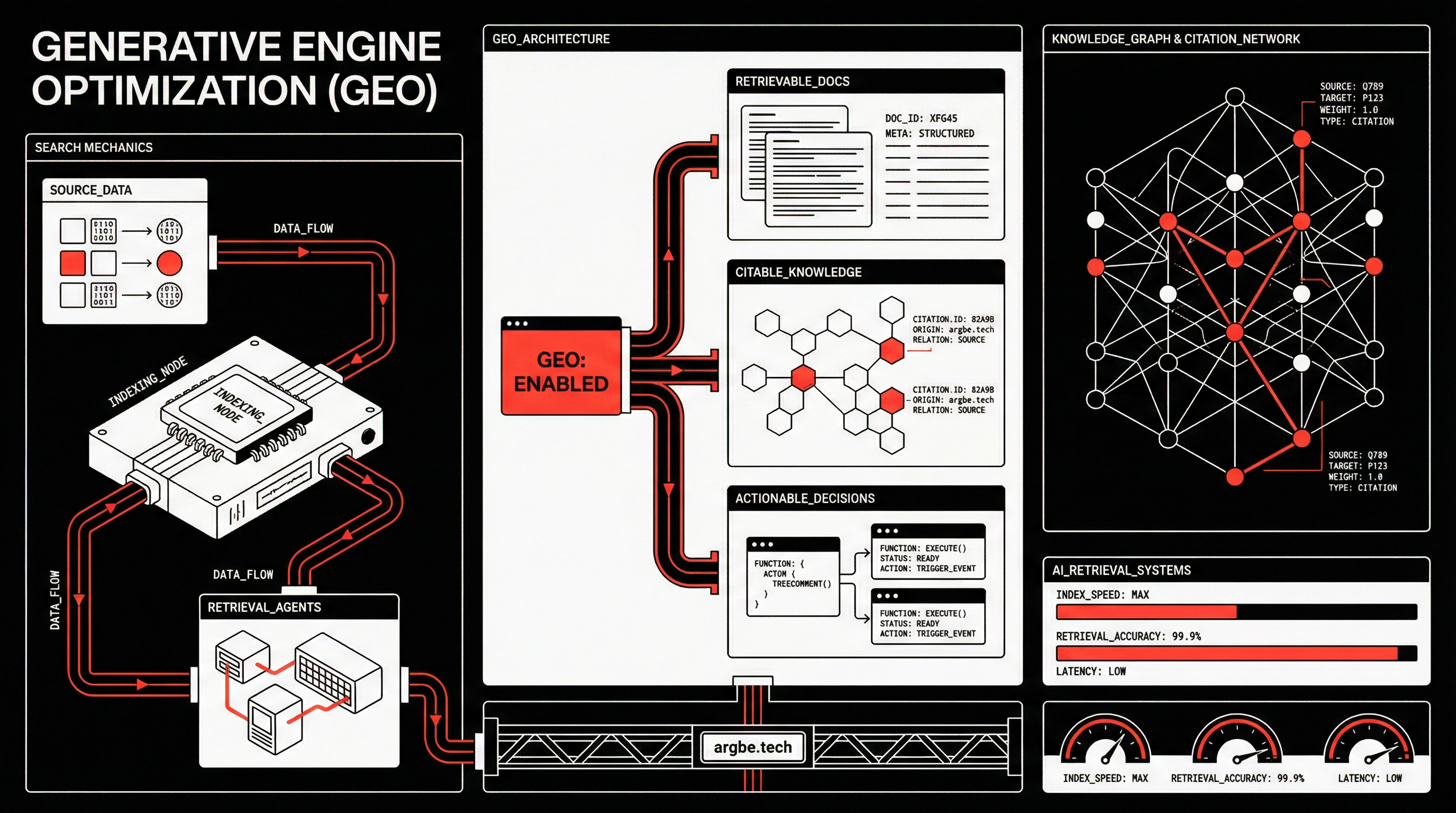
GEO for AI agents is the practice of structuring your product pages and documentation so systems like ChatGPT, Perplexity, Claude, Gemini, and Google can retrieve the right facts, cite your URL, and execute the next step without inventing missing context.
Why AI Agents Change What “Search” Means
Classic SEO is optimized for a click. AI-agent retrieval is optimized for a decision.
When a human uses Google, they tolerate ambiguity because they can open five tabs, compare, and infer the answer. When an agent uses ChatGPT, Perplexity, Gemini, or Claude to complete a workflow, ambiguity turns into failure: the agent either refuses (“I can’t find that”), guesses (“it seems like…”), or completes the task incorrectly.
In our experience, this is the biggest misconception teams bring into Generative Engine Optimization: they assume “ranking” automatically translates into “being used.” It doesn’t. Agents don’t just want relevance; they want extractability (can I pull a precise claim?), attribution (can I cite a stable source?), and actionability (can I apply it without extra back-and-forth?).
If you’re still getting oriented, start with What is Generative Engine Optimization (GEO)?. If you care specifically about citations (not just mentions), read AI Citation Strategy: How to Get Cited by ChatGPT, Perplexity & Gemini.
The Retrieval Stack: Parser, Reasoner, and UI Reality
It helps to think in layers, because each system “rewards” different kinds of clarity:
- Parser-first behaviors show up most clearly in Google surfaces and in Gemini’s ecosystem: structure, entities, and explicit relationships reduce misreads. This is where schema and consistent naming pay off. See Structured Data for LLMs: Schema Markup That AI Agents Understand.
- Reasoner-first behaviors show up in Claude: it’s strong at synthesis, but it punishes vague definitions and inconsistent terms because the text can’t support a coherent chain of thought.
- Citation-forward behaviors show up in Perplexity: it externalizes the retrieval step, so weak sourcing becomes visible. ChatGPT can behave similarly when it browses or retrieves, even if the interface doesn’t always show citations as aggressively.
We build agents in environments like Claude and Gemini, then connect them to tools via Model Context Protocol (MCP). The same discipline that makes an agent reliable (stable inputs, unambiguous entities, auditable outputs) also makes your content more retrievable and cite-worthy.
What “Agent-Ready” Content Looks Like (And What It Is Not)
Agent-ready content is not “long-form thought leadership with a few keywords.” It’s content designed to be quoted correctly.
We found the highest-yield pages share a few properties:
- A top-loaded definition that removes interpretation. (You’re reading it right now.)
- Named entities that disambiguate the thing being discussed: product names, versions, standards, regions, pricing units, constraints. This is the knowledge-graph side of GEO. See Entity Density in SEO: Building Knowledge Graphs for Search.
- One canonical place per claim (stable URL, consistent headings). If an agent sees three conflicting “sources” on your site, it will hedge or skip you.
- Proof adjacent to claims: docs, policies, changelogs, or structured references that lower risk for the model.
Here’s the part that drives revenue: we optimize for citation, not replacement. We make the “what” easy to quote (definition blocks, constraints, comparisons), then keep the “how” behind the click (exact implementation steps, templates, audits, and QA prompts). That’s not withholding; it’s how you prevent your process from being flattened into a generic answer.
If your business is product-led, the bridge from GEO to conversion is even more direct. See Generative Engine Optimization (GEO) for Intelligent Platforms: Making Your Product Discoverable to AI Answer Engines.
GEO Approaches Compared (What AI Agents Can Actually Use)
| Approach (3–5 options) | What it optimizes for | What an agent can reliably extract | Citation likelihood | Common failure mode | Implementation lift |
|---|---|---|---|---|---|
| Traditional SEO page (keyword + narrative) | Click-through from Google | General positioning and benefits | Low–Medium | Claims are present but not quote-ready; terms drift across sections | Low |
| “LLM-friendly” prose (clean writing, few artifacts) | Readability for humans/models | Definitions and high-level guidance | Medium | Sounds correct but lacks proof, constraints, or stable entities | Low–Medium |
| Schema + entity graph (structured data + consistent entities) | Parser accuracy and disambiguation | Named facts, relationships, and scope boundaries | Medium–High | Schema exists but the page copy still hides the answer | Medium |
| Agent-ready docs (definitions + constraints + comparisons + proof) | Retrieval, citation, and action | Quote-ready units and actionable constraints | High | Teams publish the “what” but never maintain it, so it goes stale | Medium–High |
| Tool-connected surfaces (docs + API specs + agent interfaces) | Execution inside workflows | Parameter-level details that can drive actions | High (when accessible) | Access barriers (auth, rate limits) or missing error semantics | High |
In our experience, most teams stop at “LLM-friendly prose” and wonder why they get mentioned but not cited. The move that changes outcomes is turning your most important pages into quote-ready units that reduce model risk. That’s what makes an agent comfortable attaching your URL as the source.
Next Steps
- Rewrite the top of 3–5 money pages into a definition block plus one small comparison table that forces clear distinctions.
- Pick your must-not-drift facts (pricing units, supported regions, compliance scope, versioned features) and put them in one canonical place with proof nearby.
- Run the same question through Perplexity, ChatGPT, Gemini, Claude, and Google, then note what each system quotes, what it ignores, and where it hedges.
- If you want our exact agent-evaluation prompts and content QA workflow for GEO, we can share it as part of an engagement.