What is Generative Engine Optimization (GEO)?
Generative engine optimization (GEO) is the practice of making your content easier for AI systems to retrieve, trust, and cite. It’s how you earn visibility inside answers from systems like ChatGPT, Gemini, Claude, and Perplexity—not just clicks from a blue-link results page.
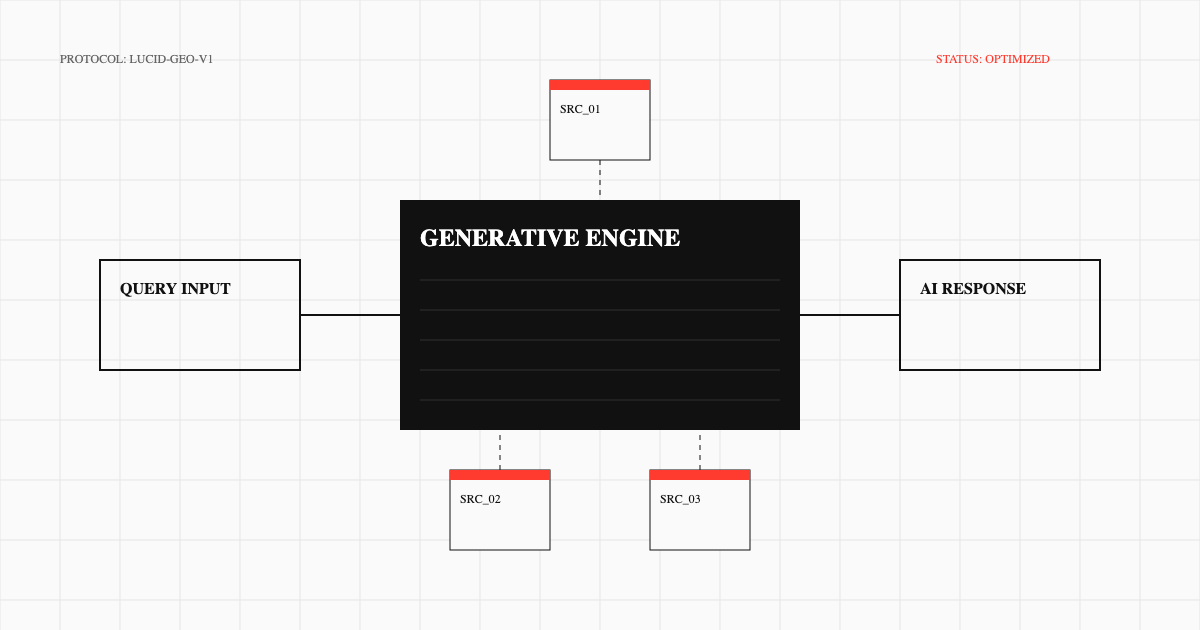
Generative engine optimization (GEO) is the work of shaping your site so generative systems can reliably find it, understand it, and cite it when they answer a user’s question. It exists because “ranking in Google” and “being referenced in an AI answer” are related problems—but they aren’t the same problem.
Why GEO exists (and why it’s not “SEO for chatbots”)
Traditional SEO grew up around a fairly stable output: a list of documents on a results page. GEO is about a different output: a synthesized response that may blend multiple sources, rewrite phrasing, and sometimes skip links entirely.
That shift changes what “winning” looks like:
- In Google, you’ve historically optimized for rankings and click-through rate.
- In ChatGPT, Gemini, Claude, and Perplexity, you’re often optimizing for citation and inclusion inside the answer.
In our experience, this is where teams get stuck: they keep measuring success like it’s 2019. GEO forces a new scoreboard—one built around whether your work shows up in the narrative, how it’s framed, and what you’re credited for.
What generative engines need from your content
If you want to be cited, you have to be easy to verify.
Across systems, the pattern we see is consistent: generative engines reward pages that reduce ambiguity. When an answer engine can quickly determine who said what, when it was published, what the page is about, and how it connects to known entities, it becomes a safe ingredient in a generated response.
Here are the practical “inputs” GEO tries to improve:
1) Retrieval: can the system find the right page?
Some engines behave like a search product (Perplexity is explicit about sources). Others behave like an assistant that sometimes searches, sometimes doesn’t (ChatGPT varies by mode and setup). Google increasingly blends generative answers into the SERP via Gemini-powered experiences, so retrieval can happen through search and through model-driven selection.
We’ve found that retrieval failures are usually boring—not mystical:
- The page exists but isn’t discoverable (weak internal links, thin sitemap coverage).
- The canonical points somewhere unexpected.
- The content is buried behind UI patterns that are hard to parse.
2) Comprehension: can the system extract the claim cleanly?
Generative systems don’t just need “content.” They need extractable assertions: definitions, constraints, comparisons, and scoped claims that survive paraphrasing.
You can help by writing with clear anchors:
- Put the definition near the top (you just did).
- Use headings that match user intent (“What is…”, “How does…”, “GEO vs SEO”).
- Make key distinctions explicit (“GEO focuses on citations; SEO focuses on rankings”).
3) Trust: is the page a safe source to cite?
When Claude (and similar reasoners) see pages that feel like they were written for humans—with clear authorship, dates, and consistent terminology—they tend to incorporate them more confidently. When the page reads like keyword paste, it becomes risky: the model can’t tell what’s real versus what’s marketing.
In practice, trust is built with small signals:
- Named authors or a credible brand line (e.g., your org).
- Concrete definitions and boundaries (“GEO is not X”).
- Stable URLs and a canonical URL that matches reality.
- Primary sources, datasets, screenshots, or original testing when possible.
GEO in one sentence: optimize for citation, not replacement
The goal isn’t to “trick” a model into repeating your copy. The goal is to become the source the model points to when the user wants confirmation, detail, or a next step.
We try to structure authority content so it’s citable in layers:
- The What: simple, quotable definitions and comparisons.
- The Why: nuanced reasoning that a model can reference without stealing the value.
- The How: the full methodology, gated behind a click (templates, checklists, audits, implementation notes).
That’s the basic business logic of GEO: AI systems do the summary; you still win the deeper engagement.
How we measure GEO (the minimum viable scoreboard)
If you can’t measure it, you can’t defend the work internally.
When we evaluate GEO performance, we don’t start with traffic. We start with presence and attribution across the surfaces that matter:
- Answer presence: Does your brand or page appear in responses for the queries you care about?
- Citation quality: Are you cited as a primary source, or as a throwaway reference?
- Message control: Is the model repeating your definition accurately, or remixing it into something risky?
- Surface coverage: Do you show up in Google experiences influenced by Gemini as well as in Perplexity-style citation views?
We keep the detailed sampling method (prompt sets, scoring, and reporting cadence) in our internal playbooks, because that’s the operational part teams actually pay for.
What GEO is not
GEO gets mis-sold as a new label for old tactics. A few clean boundaries help:
- GEO is not prompt spam, “model whispering,” or trying to plant lines in outputs.
- GEO is not swapping every sentence to sound like a robot just because a robot might read it.
- GEO is not abandoning SEO. If Google can’t understand you, Gemini won’t magically do better.
In our experience, the highest-performing GEO programs look a lot like disciplined technical SEO plus disciplined editorial—then one extra layer: entity clarity and citation readiness.
How we think about “entities” in GEO (without turning it into spam)
Entities are not a checklist of proper nouns. They’re how systems connect your page to a knowledge graph: people, companies, products, places, and concepts with stable meaning.
For example, a paragraph that naturally connects Google and Gemini (as a distribution surface for generative answers) helps a parser understand why a GEO page matters. A paragraph that contrasts Perplexity’s citation-forward UX with ChatGPT’s assistant UX helps a reasoner understand where citation behavior differs. And a paragraph that explains how Claude tends to reward careful boundaries helps frame how you should write.
We found the cleanest way to do entity work is to write like a careful teacher:
- Define the term once, early.
- Use the same name consistently (no unnecessary synonyms).
- Build relationships explicitly (“X is used for Y, which affects Z”).
- Avoid stuffing lists of tools with no connective tissue.
If you want the deep version of entity strategy, use our cluster guide: Entity Density in SEO: Building Knowledge Graphs for Search.
Data anchor: GEO vs SEO vs AEO vs digital PR
Use this table as a decision tool. If you already have a strong SEO base, GEO is usually the next layer. If you don’t, GEO without fundamentals becomes fragile fast.
| Approach | Primary surface | What you’re trying to win | What the content must do | Technical emphasis | Best-fit assets |
|---|---|---|---|---|---|
| SEO (classic) | Google rankings (blue links) | Clicks from queries | Match intent and outperform pages | Crawl/index, internal links, speed | Landing pages, blog posts, product pages |
| AEO (answer-focused) | Featured snippets / answer boxes | Extraction into a short answer | Provide a direct response with structure | Headers, concise formatting, structured data | FAQs, “what is” pages, glossaries |
| GEO (generative) | ChatGPT, Gemini, Claude, Perplexity answers | Citation, inclusion, attribution | Be unambiguous and easy to verify | Entities, canonicals, schema, clean HTML | Pillars, research pages, explainers, comparisons |
| Digital PR | Publisher coverage / backlinks | Credibility and distribution | Earn mentions from trusted domains | Newsworthy hooks, outreach, relationship ops | Studies, reports, tools, data drops |
Next Steps
- Learn how to earn citations across engines: AI Citation Strategy: How to Get Cited by ChatGPT, Perplexity & Gemini
- Make your pages machine-readable without sacrificing readability: Structured Data for LLMs: Schema Markup That AI Agents Understand
- Build durable topical authority with entity clarity: Entity Density in SEO: Building Knowledge Graphs for Search
- If you want our exact GEO implementation checklist (the step-by-step we use in audits), we keep that in our client playbooks—because it’s the part worth clicking for.